Monday, March 28, 2022

Spring migrants at RSPB Lakenheath

1. Where to go? It's an odd spring, lots of some migrants, but very few of some others. Garganey are here in numbers particularly at the traditional site of RSPB Lakenheath and its Washlands, so that seemed like a good place to go.

I still remember my first Garganey at Fairburn Ings in May 1977. There is something wonderfully uplifting about the arrival of this fabulously patterned bird. No spring is complete without a decent sighting of this exotic fowl. How different to the autumn when the detection of the dull brown duck amongst so many other dull brown ducks is one for the enthusiast. 

2. The Washlands. Once the mist had lifted and the sun beat down out of a clear blue sky the splendour of this large pool was revealed. Birds everywhere. Still plenty of Wigeon, Teal, Shoveler, Gadwall, with a smattering of Shelducks all resplendent, Black-Tailed Godwits everywhere (78 in total) with some in emerging brick red, and 53 Avocets. Small parties of Snipe and Redshank added to the mayhem. Careful scanning with the scope (and some helpful guidance from a regular here) added the hoped for Garganey; 4 males and at least 3 females, and finally a Little Ringed Plover, a Dunlin, and 5 Ruff

3. The walk to Joist Fen along the river was excellent. Highlight was a Water Pipit which kindly flew in. Now in fantastical summer plumage, all peach and slate with a bright yellow leg ring on the left leg. 20 Redwings and 13 Fieldfares moved through, a sky dancing Marsh Harrier, constant Stonechats (I think about 3 pairs along this stretch)  and then a flock of 100 Golden Plover high over the Norfolk side of the river.

4. Joist Fen. Over the years I must have spent many hours here gazing out over a vast red bed hoping for a glimpse of the breeding Cranes without any success at all. But today the two resident pairs put on a decent, if distant show, flying around at frequent intervals. Circling up like some lumbering cargo plane slowly gaining hight, then gliding down to some favoured spot to presumably feed. 

When the Cranes weren't in sight we had 9 more Marsh Harriers, an obliging Water Rail, a Bearded Tit, and lots of resplendent Reed Buntings

5. Great to have the full trio back with Mike and David. Always a top day out when we get together. An excellent start to spring.

Saturday, February 26, 2022

late winter at Minsmere

It's that time of the year when the winter specialities are departing and nothing new has come in, so it gets a bit desperate. A couple of year ticks and more were up in Suffolk, so Friday saw me and David at Minsmere, Mike being unavailable.

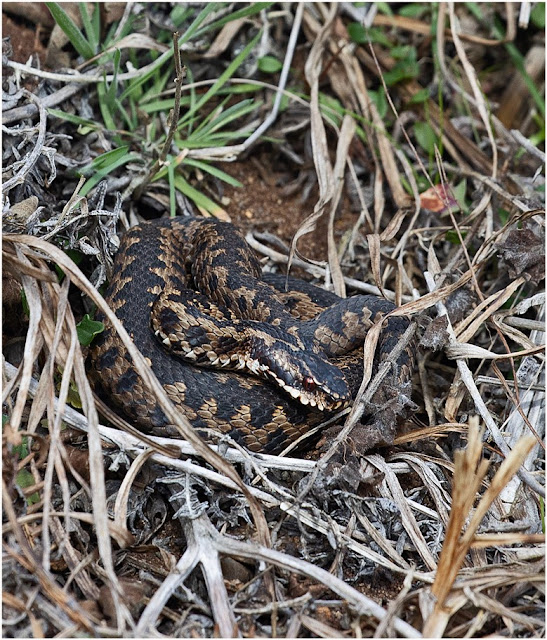
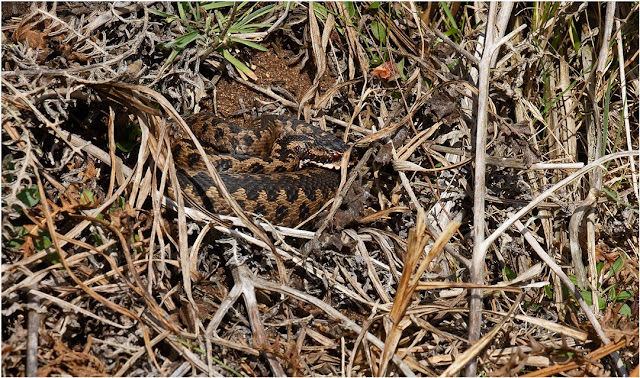
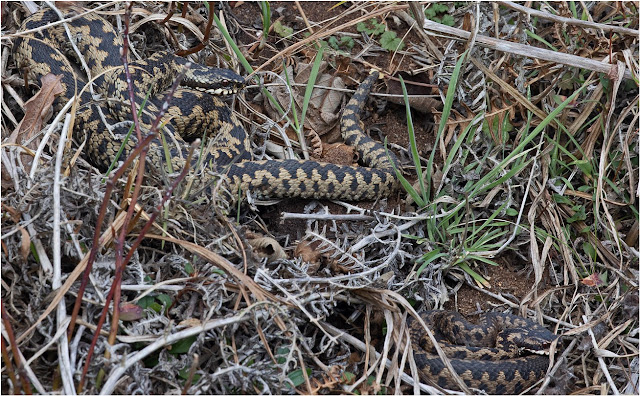
David's foot injury has been taking a time to heal, so I promised I wouldn't thrash round the reserve, but ... we did the adder spot on the sand martin bank. Nothing. North Hide. Nothing. Adders again. Nothing. Island Mere. Nothing. Obviously there wasn't literally nothing, there was a year tick in the form of a Coal Tit, I missed a Bittern at Island Mere, and there were a lot of Marsh Harriers. We finally got the Adders around mid-day on the Sand Martin bank, two males slowly waking up before they slithered off.

If you go, walk round the north side of the dragonfly pool, and in the middle of the bank right by you is a grey pipe. They were about a metre above that, slightly right. Fantastic.

Then down the marsh side of the scrapes. It was nice in the sunshine, with plenty of Wigeon, Shoveler, Avocets, and handfuls of Black-Tailed Godwit, Dunlin, Curlew, Ringed Plover, Turnstone, and Pintail. So very nice. But no Smew which was our target. I popped down to the Sluice to see if the Lesser Yellowlegs was around, and it was! Fantastic views, a grey washed out Wood Sandpiper-type bird. And those legs, so bright yellow. I went back to collect David who was resting his injured foot in a hide, and dragged him round just in time to see it flying off. Sorry David.

From there it was back along the seaward side. Stonechat flycatching in the sunshine, two female Common Scoter on the sea. And a long sit on the bench to enjoy the afternoon sunshine. And that was it.

Except not quite. As we were leaving we mentioned to the staff we hadn't seen the Smew, and they pointed us towards the pool by the viewpoint, about as close to the centre as you could get, and there was the pair. a male is a tricky bird these days, and this one was fantastic. Thanks you RSPB staff.

Then as we were leaving, a herd of Red Deer on the Heath. 32, all hinds from what I could see. Just huge beasts. Scope filling views. Fantastic. 

So in the end, a very decent list. And David got his adder photos. Fantastic they are too They are on his blog, and a bonus three from David below.


Sunday, February 13, 2022

Ridiculous Abberton. Again.

Red Necked Grebe can be a difficult bird to get on the year list, but over the last couple of years Abberton has delivered. I saw one towards the end of last year but this year so far the resident bird has been a bit elusive, with just the occasional record from Abberton church. So this Saturday morning I dropped Mrs D off at her usual morning session at the library and went straight there. 

I thought it was going to be hard particularly when I saw the wind roughing up the surface, but I scanned across and there it was, nonchalantly bobbing around like butter wouldn't melt in its beak. Difficult? Moi? It was mid-distance, but in the scope clear enough for me to think the vertical stripe on the face near the ears made it a bird hatched last year. Fantastic. Hadn't expected it to be that straightforward or such decent views.

And with that I did a quick couple of stops at the causeways before heading back. I saw Long-Tailed Duck, Scaup, Goosander, Smew, White Fronted Goose (now down to 16) Pink Footed Goose, Black Tailed Godwit, Ruff, Golden Plover. And I wasn't even trying. Most of these birds were ridiculously close.

I was asked, when chatting with a fellow birder in Kent on Monday (Excellent. Couldn't miss, again. Shorelark, Hen Harrier, Merlin, Glossy Ibis, Black Throated Diver, Greenshank) whether I went much to Amwell given it is in my area, and the answer is no. Its hard to explain but I think if I'm going to get in my car and go out of my immediate area, it is hard to resist the pull of Abberton. It's like having a three-star Michelin restaurant in the neighbouring town. Why would you go anywhere else?

Friday, February 04, 2022

Year listing update

Lack of posts does not mean lack of birding. I've been reasonably busy year-listing.

I'm not a great one for listing for the sake of it, But for me it gives me a target, a place to go, a plan for the day, and as a well known non-birder might have said, good birding is what happens whilst you were busy making other birding plans.

Mike and I had an owl day. Long-Eared, Little, at you-know where, and then Short-Eared Owl at Eldernell with a couple of distant Cranes. We were drawing a blank with the Shorties until a local birder pointed us to the relevant field, and in particular a small bush in the middle with a distinctive set of logs and branches and a very distinctive roosting owl. Of course, of course, how could we not have noticed the giveaway trampled grass round the edge of the field. Doh. And if I had a pound for every photo of that stump and that owl that has been in my twitter feed, I could afford my next fuel bill.

Then Old Hall Marshes. The full version. Blimey that's a long way. I had a 'doesn't seem that far' moment, and then realised the bend was not the start of the way back, but half way along the way out. Anyway, we had a couple of Merlins perched up, the second looking quite small with, on full zoom, light feather edgings on all its back feathers, so an imm male for me. 

A young (in comparison) couple, looking like they had just stepped out of an outdoors clothing catalogue, came the other day, he with rubbish binoculars. We said hello and offered them a view of the Merlin down the scope. They were thrilled, in awe of this tiny falcon, and then excitedly telling us of the Bearded Tit they had seen. It is easy to get cynical about the quality of the birds we see on our trips, dryly exchanging lists of scarce birds with other equally laconic and weary old birders, but there, in that reaction, of those two young folk probably on one of their first wildlife expeditions, is the emotional truth of our pastime. The thrill and excitement of seeing a hoped-for bird doesn't diminish over the years, even if our reactions may. We added Ruff, then Great Northern Diver off the end, but the recently reported White Fronted Geese had given us the slip.

Then the annual visit, that 'will it be worth it?' trip to WWT Welney. We paid up, paused at the cafe view over Lady Fen where a lone lady asked if we were experts? Well, modesty forbids! But I'll have a go. That pipit over there? Scope up and yes, madam, you were right to point that one out, and thank you for adding Water Pipit to the year list.

Onwards to the Main Observatory and the day's target couldn't have been easier. Nine Tundra Bean Geese, asleep right in front. The darkish heads and give-away broad white edges to the flight feathers marked them out, and soon enough they got up and wandered round. Surely the best ever view of wild geese.

At the next hide a flock of distant Swans turned out to be Bewick's Swans. I find these hard to see on an annual basis, relying on Abberton bringing in a couple each winter, but this flock was thirty strong, with a couple of juveniles, and made excellent if somewhat distant viewing. I find a view of winter geese and swans isn't really complete unless you hear them call and see them in flight, and a small group obliged by calling loudly and flying off, their slightly faster wing-beats being clear in comparison to a pair of Whoopers passing.

Finally, the key Welney Species, the one all the birders come for. It took a while, but eventually there it was, on the feeders, Tree Sparrow.

Then yesterday a small window of opportunity and it was back to Abberton. firstly Layer-Breton causeway, and a ridiculously close flock of wildfowl-collection tame White Fronted Geese. 31, plus a Pink-footed Goose. They flapped a bit showing off their barred bellies - they seemed to be mainly adults - then obliged by flying off to feed on a field, and then flew back, calling, flying around. Surely the best ever view of wild geese. 

I got Smew here too. A redhead, sitting comfortably at close range in front of its usual reed bed. I watched the geese for a while, then mentioned to a couple of birders the really easy Smew on the other side of the road, we crossed back over, and of the Smew there was absolutely no sign.

Finally, Lodge Lane on the eastern side. This is a difficult access point due to lack of parking, but top Essex Birder Darryl had recently posted a request to park in Peldon Community Centre car park and walk up, so I did. It's a non-trivial walk, but easily doable, and the views were excellent. Lots of Wigeon, a few Goosander, about 30 Dunlin, nice views of a male Marsh Harrier, and then in the distance amongst the many Great Crested Grebe, something smaller. Clearly a Grebe, more black and white and without the distinctive silhouette of Red-Necked, probably one the Slavonian that has been seen on and off over the winter. The silhouette lacked the peaked-forehead of Black-Necked but could I be sure, at this range? It was one of those moments where I have to ask what kind of birder am I? Am I  birder of integrity, who's list only contains cast iron certainties? Or am I the kind of birder who will bump up their list on the flimsiest of view? Well, there's only one answer to that. 131. Slavonian Grebe.

Friday, January 07, 2022

Shifting baselines

B&B in the Cotswolds for a very pleasant stay over the New Year (2 Brambling in the garden and pair of Raven over, as you ask. And a Red-Legged Partridge getting on to my 'birds that have hit me in the dark' list, but that is a story for another time). Chatting to the owner/farmer he was lamenting the loss of songbirds over the decades.

It got me thinking. Obviously we all agree, but is it a straightforward loss? Is there more to it?

Perhaps the biggest change is flocking; we now have a situation that is normal for North America and rainforests, which is they are largely birdless apart from 'the flock' which contains everything. I saw a comment ages ago that the return of the Sparrowhawk meant birds behaved differently, as they flock to avoid predators. It stuck in my mind. Just now the excellent Steve Gale at North Downs and Beyond tweeted 'a spectacular gathering of finches - 550 Brambling, 450 Chaffinch, 125 Linnet.' That's a lot of finches. And that's a lot of finches in one place and not somewhere else.

Why do birds flock? I guess because it helps them find food, and helps when predators are around. If there were no predators, would birds flock less if when they find food they can have it all? Would there be 55 flocks of 10 Brambling scattered round Surrey rather than one of 550?

And the second point is that baseline we hear about, the records from the 19th century of masses of birds, right through to the 1970s and 1980s; those were years of busy keepering, of crows and hawks being shot on sight. So the 'natural' baseline is in fact an unnatural baseline; it was the numbers of songbirds you get when you take predators out. 

So there we have it; a couple of random ideas. With no data to support. And a happy new year to you both all.

Saturday, December 04, 2021

Surely Abberton with these Grebes you are really spoiling us.

A Saturday morning window of opportunity, so pop down to the local park to look at the ducks. I mean drive to Abberton to see what is around. 

Quick stop at Layer De La Haye Causeway. Three Scaup females asleep in  with the Tufties and Pochard, a couple of Goosander at the over flow, and on the other side a Red-Necked Grebe happily swimming around amongst the thousands of Tufted Ducks. Then round to Hide Bay to get 3 Bewick's Swans. Nice views too as they paddled away stirring up the base of the bay before sticking their heads in to feed. A couple of Slavonian Grebes distantly from Island Hide and that was my lot. The support cast of Pintail, Black Tailed Godwit was pretty decent, and a small flock of Fieldfare was just about my first of the winter. There was a Long-Tailed Duck out there somewhere, but I've seen it already this winter and time was pressing, and I drove past the Cattle Egrets and could not be bothered to stop. 

Way back in the last century it wasn't like this. Abberton was smaller, and full access was for the select few. But then the expansion happened, and the whole reservoir was opened up, and now there's all this stuff available pretty much all winter. 

So it's clearly a big improvement, but ... part of me says birding isn't meant to be like this. You should have to work for birds like Red-Necked and Slavonian Grebe. If you went to Minsmere and saw this you'd think it a red-letter day, but its just every day at Abberton. Hanningfield is quite a decent reservoir and a bit nearer, but what's the point? 

Perhaps I grumble too much. Enjoy them whilst they are there. 

Tuesday, November 23, 2021

To do list

I stopped working and started birding intensively in 2015. Since then I've seen quite a few new birds, and caught up with quite a few birds that were poorly seen or only seen once birds. 

But there's a few that I haven't seen or haven't seen well since 2015, and really could and should see again. Here's the list with annotations (note doesn't include my two glaring life misses Storm Petrel and Quail, or either of the Hippos warblers, or birds that are no longer breeders eg Montagu's Harrier, Golden Oriole, or birds such as Chough which are in a specific location).

Leach's Petrel. Seen a couple at Canvey. Would like to see some more.

Honey Buzzard. - Clumber Park and one off Bempton back in the 80's. Nothing since

White-Tailed Eagle - Kent 1990's

Grey Phalarope - once in Keyhaven, 90's

Black Grouse. Once in the late 80's, again last year, but I'd like a decent view of both sexes.

Glaucous Gull - used to be regular in Yorkshire in the 80's, a couple down south, but not for a while

Puffin - regular at Bempton, occasional at Portland

Wryneck - Spurn, Portland at various times

Richard's Pipit - Wraysbury, late 80's early 90's.

Mealy Redpoll - various times in the 90's. Saw an Arctic at Aldborough a few years ago but the flock cleared off before I could pick out the Mealy's.

The list isn't as long as I thought it might be. But enough to be worth chasing.

Monday, November 22, 2021

Bet on the Bittern


To the Lea Valley with David for some photography. Firstly the Wildlife Discovery Centre, to look for Bitterns. It has lots going for it; nice clear windows, helpful staff, and a reed bed with two cuts in it that allow you to see birds walking across or going down, and best of all it actually has a Bittern. There is just one problem, which is at this time of year you are looking straight at the sun.

We do quite well, Bittern, take some photos (see above) then Water Rail, then on advice we walk up to and beyond Holyfield Farm to a flock of passerines and get 5+ Brambling, and a Cattle Egret along the way, then back to see a Kingfisher. So an excellent morning.

It struck me as we were watching the Bittern and a conversation was struck up about whether it has a preferred circuit and how often it crosses the tracks that it would be an excellent way to raise money to have a session of Bet on The Bittern. One could divide the session into 20 minute intervals, and people could place bets on whether in that time slot the Bittern was going to exit left, exit right, or stay put. I think Sky could take this up. It's a guaranteed winner.

Finally the photo. Excellent isn't it. You're going Wow DD! We knew you were going to put more effort into photos but that's a really good one particularly for someone with your photographic skills, and I'm going yes yes thanks very much all compliments on my skills much appreciated. And then you're going hang on, that's not you is it? You've nicked one of David's and claimed it as your own haven't you? And yes that is exactly what I've done. It's one of David's. You can, as always, find more of David's excellent photos here.

Saturday, November 20, 2021

They're back


I know I promised an end to rubbish photos, but .... look closely and you can see two Hawfinches.

Hatfield Forest is a traditional Hawfinch site, particularly round the Hornbeams near Bush End car park. But the early years of this century had only a few records and it wasn't until the great eruption a couple of years ago we had decent numbers. Last year there were a few in mid winter, so with numbers having been seen flying over local areas this autumn, it was time to go looking.

I'd had very little apart from 40 Siskins by the lake and 60 Redwings flying round when I saw a larger passerine slipping away over trees, and just glimpsed a long white wing bar. Not enough to tick, damn! I gave it a bit longer, and picked up one, then three flying into the tops of trees.

We know how this goes, having seen enough a couple of winters ago. They go into the tree tops then drop down slowly to the floor below, as presumably these did. I didn't go in to avoid any disturbance, and had no further views.

I've no idea how many there are. I could have seen them all in this viewing, there could be lots more scattered round. No matter, its great to have them back.

Wednesday, November 10, 2021

Going Nutcrackers.

A Nutcracker has been seen in Scotland. Exciting for the finder, congratulations, and good luck to those who go for it.

I was fortunate enough to see the Westleton one in 1853 or whenever it was.

My preferred order of seeing Nutcracker (or pretty much any other bird, come to that) is:

1. Find one.

2. See a few in their natural habitat.

3. Travel to see one. If its not too far and there is other stuff there.


Saturday, October 23, 2021

The Patch in focus

I guess most patches get a bit samey. The first year is full of 'wow - Yellowhammers!', the next year is 'good to see the Yellowhammers still here', and short after that its 'rubbish - just Yellowhammers'. 

So as I'm on year seven, I feel in need of a bit of a change of angle. And I thought photography might be it. One reason is that I noticed on the small fields and copses of my patch I tend to get closer to birds, and will spend longer on, say, a Treecreeper than I would elsewhere.

My history of bird photography in the modern era goes something like this. Bought a Canon EOS30D and 100-400 ultrasonic zoom lens back in the early 0's. Was a bit rubbish, then was very rubbish. The autofocus packed up so I was reduced to focussing manually with predictable results.

Last year I got the camera checked out, and the auto-focus has gone, and the 30D isn't really supported anymore. So a week ago I bought a used 650D from Wex Photographic.

The patch visit was okay. Raven over, a couple of Siskins over at the same time, good numbers of Yellowhammers, Reed Buntings, Chaffinches, 4 Mistle Thrushes! And a Fallow Deer which turned out to be a young buck.

Here's the pick of the photos.


Goodbye ... and Hello

It's been a while. It's tested the patience of the most dedicated reader. As he told me on a number of occasions. So I've decide...