Showing posts with label Minsmere. Show all posts

Thursday, September 07, 2023

Minsmere - When Birding Dreams Come True.

To be a birder is to be a perpetual optimist. Today is going to be the day. The day when rarities just pop up on front of you, when bushes drip birds, when your wildlife dreams are realised.

Mike, Dave and I did our usual speculation of what we might see as we sped crawled towards Westleton Heath hoping a SE breeze would deposit rarities. Top of my list was Honey Buzzard; a bird blown over from the continent, or perhaps, if rumours and occasional sightings were true, a local bird. But maybe some passerine migrants, or some decent waders. Mike wanted some year ticks he'd missed out on so far - Dartford Warbler, Grayling Butterfly, Common Emerald. Dave, after extended health-related lay-offs, wanted to just get out with his camera and photograph some wildlife, preferably the massive green Bush Cricket he'd read about at Minsmere.

We started at Westleton Heath, retracing last year's steps to the Deer watchpoint. We got Grayling Butterfly almost immediately performing well on heather, then were immediately into a family party of Stonechats; a harsh churr churr and a Dartford Warbler shot past my head. A family party soon appeared and gave unusually confiding views on an old Gorse bush.

Walking past the quarry a lark dropped into the open area and as I approached to investigate further a small flock lifted with quiet whistles and settled a  few yards further. We spent a good half hour enjoying this feast of Woodlarks, counting at least eight and possibly a few more. Woodlark was a possible bird on the list but we never thought it would be this number and these views.

On to the deer watchpoint and in a repeat of last year we had six Stone Curlews including one out in the open. A splendid list and we could have gone home happy at that point.

Mike and I returned to the car and David hang back to take some photos. When he eventually appeared it was to ask us why we hadn't responded to his calls when what was clearly a juvenile Honey Buzzard had flown over his head. After congratulating David we said not to worry, it was probably still around and we would surely bump into it later. Said with my fingers crossed behind my back.

We pitched up at Minsmere car park and scanned the sky for large raptors duly found one circling; dark brown back, but a white forehead and white underneath - an Osprey, and from the neat solid back probably an adult. We watched this circle for a while, had a Hobby flying underneath it, and as it slid away a gaggle of RSPB staff appeared and got a glimpse of it.

On through the Dragonfly pond - Common Emerald ticked, then onto the shore and East Hide. We had 2 Curlew Sandpipers, and good numbers of other waders. A few duck flew in and we added Wigeon and three Pintail to the list; then on to South Scrape and a Sandwich Tern and a few more waders.

On having South scrape and heading further down the dunes Mike suddenly stopped and pointed to a creature in the grass - unmistakeably a Great Green Bush Cricket ponderously crawling around. A huge insect, just a few on a skewer would make a decent serving. Dave duly clicked away delighted to have got onto one.

Then as we scanned over the reserve a large raptor appeared slowly circling over the Island Mere Reedbed. As soon as we got on it we know what it was, and through the scope it was all there. Large floppy-ended wings held flat, narrow wing base, small greyish protruding head, tail spread again a slight greyish from above. For Dave it was a case of Hello Old Friend; the juvenile Honey Buzzard was back. It was harassed by a Marsh Harrier which was notably smaller, and then as it continued out a Sparrowhawk and Common Buzzard joined in. 

Books go on about telling Common and Honey apart but honestly on a good view its just not an issue. Its blindingly unmistakably obvious. The bird was seen by various groups, and all those ladies with their cameras who tag along with their husbands, the ones who can't tell a Whinchat from a Stonechat and aren't bothered about it, they were all pretty sure they'd seen a Honey Buzzard. 

On to the sluice bushes, and a small party of chats hoping around on the sward; two Whinchats, a Wheatear, and seven Stonechats. We didn't see the Wryneck reported from here, and neither did we meet anyone who'd seen it. 

And that was more or less it. A Kingfisher flew across the path. A Green Sandpiper appeared. But then as the afternoon heat reached a peak we called it a day and headed back.

wow what a list. Woodlark flock, Stone Curlew flock, Honey Buzzard, Osprey, Curlew Sandpiper plus various seasonal goodies. All the main birds self-found and unexpected. It's one thing to go on a twitch for a rare bird and to see it, but to go out with no particular expectations and fill your boots like we did today is the stuff of dreams. The best of birding with, as always, the best of company.

Saturday, February 26, 2022

late winter at Minsmere

It's that time of the year when the winter specialities are departing and nothing new has come in, so it gets a bit desperate. A couple of year ticks and more were up in Suffolk, so Friday saw me and David at Minsmere, Mike being unavailable.

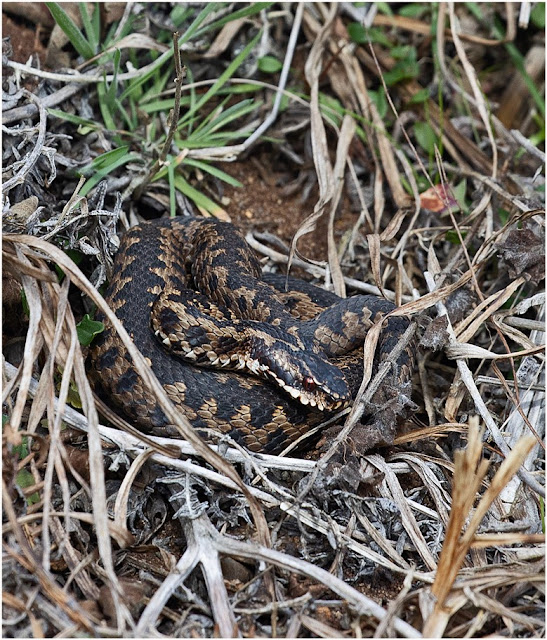
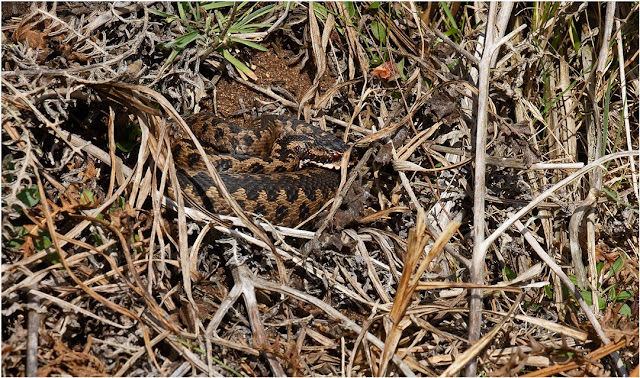
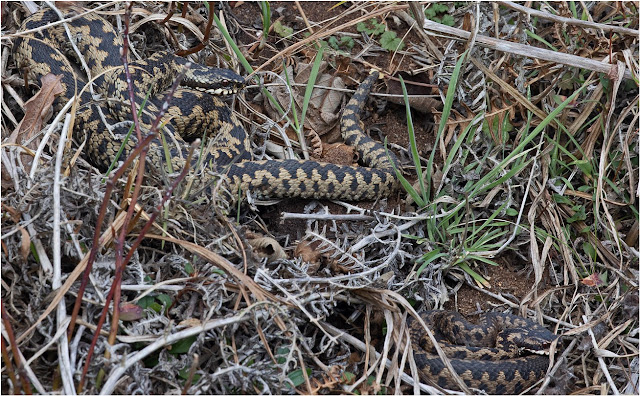
David's foot injury has been taking a time to heal, so I promised I wouldn't thrash round the reserve, but ... we did the adder spot on the sand martin bank. Nothing. North Hide. Nothing. Adders again. Nothing. Island Mere. Nothing. Obviously there wasn't literally nothing, there was a year tick in the form of a Coal Tit, I missed a Bittern at Island Mere, and there were a lot of Marsh Harriers. We finally got the Adders around mid-day on the Sand Martin bank, two males slowly waking up before they slithered off.

If you go, walk round the north side of the dragonfly pool, and in the middle of the bank right by you is a grey pipe. They were about a metre above that, slightly right. Fantastic.

Then down the marsh side of the scrapes. It was nice in the sunshine, with plenty of Wigeon, Shoveler, Avocets, and handfuls of Black-Tailed Godwit, Dunlin, Curlew, Ringed Plover, Turnstone, and Pintail. So very nice. But no Smew which was our target. I popped down to the Sluice to see if the Lesser Yellowlegs was around, and it was! Fantastic views, a grey washed out Wood Sandpiper-type bird. And those legs, so bright yellow. I went back to collect David who was resting his injured foot in a hide, and dragged him round just in time to see it flying off. Sorry David.

From there it was back along the seaward side. Stonechat flycatching in the sunshine, two female Common Scoter on the sea. And a long sit on the bench to enjoy the afternoon sunshine. And that was it.

Except not quite. As we were leaving we mentioned to the staff we hadn't seen the Smew, and they pointed us towards the pool by the viewpoint, about as close to the centre as you could get, and there was the pair. a male is a tricky bird these days, and this one was fantastic. Thanks you RSPB staff.

Then as we were leaving, a herd of Red Deer on the Heath. 32, all hinds from what I could see. Just huge beasts. Scope filling views. Fantastic. 

So in the end, a very decent list. And David got his adder photos. Fantastic they are too They are on his blog, and a bonus three from David below.


Friday, July 16, 2021

Minsmere mid summer

15th July and the first visit this Covid-hit year to Minsmere. Our hopes of sunshine for the insects had disappeared under a forecast of cloud and wind, and we were without Dave due to injury, so feeling a little glum to be without a team member. Still, here Mike and I were at my favourite reserve. 

If, reader,  you are Dave, you didn't miss much mate. It was cloudy and windy, so zero insects, and the birds were nice but just the usual. No point in reading the dull details. Best to stop here and go and get a cup of tea. 

If you are not Dave, Wow! What a day! The fun started on the North Wall when a look up an open ditch revealed a hind Red Deer and a fawn. Here in their natural habitat they grow larger than they do on the hills of Scotland (apparently), and this hind was huge; nevertheless it slipped into the reed bed and disappeared.

Down the beach with Common Terns like a swarm of super-size flies buzzing low over us, then straight dow to the South Scrape public viewing platform to see if the long-staying Roseate Terns were around. They weren't but we had c20 Little Terns, 3 really smart adult/2cy Little Gulls, and a few Sandwich Terns. A fellow birder pointed out 3 Arctic Terns loitering on the mud. I think of these as having grey-breasts and short legs, but in reality that's Common Tern. Arctics have really deep grey breasts and absolutely tiny legs. Also could see the small-dagger shape bill in comparison to Common. Nice - can't rely on seeing these annually in the absence of being able to pop down to a suitable reservoir and string see them in Spring. Also Spotted Redshank, Black-tailed Godwit, Avocet, c20 Dunlin, a Turnstone, and Mike had a brief view of a mini-wader, probably a Little Stint. We searched, but could not relocate. Oh and a few Barnacle Geese too - nice easy year ticks these. Of course they are wild.

Back up to East Hide, and the full glory of the breeding bonanza was in front of us. C200 Avocets including chicks, Common Tern chicks everywhere, some Ruff, more Spotshanks and Blackwits, and tucked in a corners a Green Sandpiper.

Round the remaining hides, back to the car park for lunch, then out to Island Mere. 2 Hobbies gave a hunting display dashing across the mere - surely one of the best wildlife sights available anywhere, a couple of Marsh Harriers, then on leaving a Great White Egret flew past. On to the Bittern Hide, and from our elevated viewpoint an actual flying Bittern and more Marsh Harriers cruising the area.

Just time to return to South Scrape to see if the Roseate Terns had reappeared. Scan their favoured island in the southern corner, and what's this? Two light-pink flushed breasts amongst the mass of Sandwich and Common Terns? pale ivory-grey backs - check; all black bills - check; bright red legs - check; metal leg-ring - check. OH MY GOD Mike! Mike! THEY ARE HERE! We spent a good half hour plus marvelling at these beauties. Slightly bull-headed, a funny trotting walk, and really quite aggressive - one bird chased off the Little Gulls. We put some others onto them (between the Little Gulls and the Arctic Tern, yes that's it, with a Med Gull just behind it). Whilst we were revelling in these birds Mike spotted 2 Spoonbills flying in to join the third one just in front of us (What? How does a Spoonbill slip in near to you unnoticed?). They fed, pecked, argued, generally gave a great display, then flew up to the East Scrape, then West Scrape. 

After an hour or so when we admired a summer-plumaged Sanderling, another Ruff, and the various waders, we realised we couldn't find the Rosy terns any more so we set off back. Just a quick look off the beach at all the terns, a couple of littles in there with their much faster wing beats, then another tern with a faster wingbeat, not a Little Tern, all black head and bill, and smaller and paler than the passing Commons - we'd found another Roseate, presumably one from the scrape.

It's not just the breadth of species, its the scale. Minsmere is full of people just out for the day, or who bird watch occasionally, and why not? An obsession with lists, rarity, and species count can blind one to the spectacle, both visual and aural, of a mass of breeding and post-breeding birds. Being on the platform on the south scrape is like being a kid in a toy shop; fantastic birds wherever you look. Both variety and quantity. Just an unbeatable place when it is on form like this.

Thursday, December 03, 2020

Why I'm in favour of Sizewell C.

Minsmere is just about the best bird reserve in the country. Together with Westleton Heath and Dingle marshes it forms an area of outstanding wildlife. Not just the Bitterns, Marsh Harriers, Savi's Warblers, Dartford Warblers, but also Adders and Red Deer as well as so much else.

There are plans afoot to build a new nuclear power station between the current one at Sizewell B and the reserve. This will clearly impact on the wildlife of this rich and diverse area. Nor surprisingly, this has produced a lot of opposition. But I'm in favour. Here's why.

Firstly, climate change is real. As naturalists, we know this better than anyone. From the Ivy bees and Tree Bumble bees in our gardens to the three species of Egret I saw at Abberton today, our world is full of winged creatures moving north. My research indicated that, in as much as we can tell, this century will see continued warming and gradual change, but there may come a point when that gradual change breaks down and significant change, probably quite bad, occurs. And if the Clathrate Gun goes off, its Good Night Vienna.

As a civilisation we are making progress to slowing and then stopping warming. Globally, there are lots of reasons to be optimistic; As the standard of living goes up across the world, birth rates fall and the population is stabilising. Technology improvements mean significant reductions in CO2 emissions are possible. Every time we slow the increase in CO2 we give ourselves more time to develop better solutions. Climate Armageddon is not inevitable. We can solve this.

In the UK, we need to do our bit, and the most obvious target is electric vehicles. We are going to see a significant push in the next few years (I understand the EU is using 2020 as a baseline, so vehicle manufacturers have been avoiding pushing electric vehicles this year to get a low baseline and will push hard next year). But to make the most of the opportunity to reduce emissions, we need to charge these vehicles on carbon-free electricity, and the best way to do that is overnight. Given we don't have a viable means of storing electricity from variable renewable sources such as wind power or solar, it would seem we need a reliable source of instant overnight power and the best way of doing that currently is from nuclear power stations. 

Sizewell would seem to be a sensible place to build one given there is already one there. It could be the spur to improve the A12, it could help bring jobs and prosperity to the region.

And the wildlife? Well, according to my take on the plans, the plans leave much of the Minsmere/Westleton area intact. The area from the Eels foot at Eastbridge to Sizewell and Leiston may see a lot of activity, but the levels, the reserve, and the heath should be okay.

The RSPB and other are making a lot of noise, but my inner cynic wonders what the real aim is. Might it be to create a sense that wildlife compensation is required, that the 'loss' of the wildlife habitat should be recompensed by the expansion of local or other wildlife areas? Either locally around Walberswick and Westleton, or further afield? 

Reduction in CO2 emissions, cleaner environments, and an increase in wildlife areas in East Anglia? That would be win-win wouldn't it?


Tuesday, July 21, 2020

Minsmere Post Lockdown

A trip to Minsmere to catch up with a friend. The reserve is 'open' but the hides are closed. Most notable however was the lack of the volunteers and other staff who normally guide you directly to the day's star features.

so ... Centre. Tens, possibly a hundred, Peacock butterflies and Red Admirals. Dragon pool - Emperor, Emerald, Common/Ruddy Darters - very common today. Bee Wolves , then Pantaloon Bee on the flowers further on. Wall Butterfly on the shingle, and the first look over the scrape from the East Hide. About 8 Spotted Redshank, similar Ruff, Blackwit, Avocet, a few Dunlin, a very distant Green Sandpiper shimmering in the heat haze. The viewing platform for the South Scrape was open, and we had Turnstone, Common Sandpiper (year tick!), two Little Gulls (adult and 1st winter) and Stonechat. Then round the reserve back for lunch.

Butterfly walk - White Admiral and Silver Washed Fritillary in good numbers down the main butterfly ride, a couple of Norfolk Hawkers, then Whin Hill and back. By that time we were almost done.

But not quite. Still time for a lifer for me. Yes, at the Stone Curlew watch point were two adult Stone Curlews and ... a juvenile! Practically full grown. It sat around looking a bit gormless whilst the parents ran around, no doubt in shock and confusion that they had actually got this far in the child-rearing process. By what mistake in the juvenile rearing process have local foxes managed to miss this one?

So that was it. It's still a good list, but many breeding birds had disappeared so, for example, no Mediterranean Gulls. There is meant to be a juvenile Cuckoo showing well at Whin Hill but with no volunteers around to guide and time pressing there wasn't time to look.

I missed the close-up views of the scrapes. Back at the centre there was a note of Curlew Sandpiper, which could have been anywhere. The far corners were pretty much a blur of heat haze so anything could have been wondering round there.

So there we have it. Still one of the best places, if not the best place, to see wildlife across all the various forms in the UK. A decent list and an enjoyable day in excellent company. Hurry back volunteers. You were missed.

Sunday, July 07, 2019

Three go Mad in Suffolk

Minsmere in mid summer. No better place to be. Back in the depths of winter we had promised ourselves this trip with a particular purpose in mind, and weather and opportunity was just right so Mike David and I set off on another magical mystery tour.

Arrived just after 11, straight down to the dragonfly pool where we duly got the first few of many Norfolk Hawkers, a couple of early Willow Emeralds, and Broad Bodied and Four-Spotted Chasers. Then on to digger alley, and Bee Wolfs and Pantaloon Bees. I assume these are not particularly scarce, and I know digger wasps occur in all sorts of paces, but the good folk of the RSPB have got information boards here so it makes appreciating the creatures so much easier.


Then onto the North Wall, and following reading the RSPB blog, we looked for and found Six-Banded Clearwing. a small digger-wasp-like moth. As the blog said, you had to get your eye in, and realise that the small yellow-and-black thing flying around was not a wasp. The method of flying was distinctive, and  when it settled the moth-nature was apparent. There are some great photo's here, and here's mine which is crummy but is mine. Next time I find a mass of birds-foot trefoil I'll know what to look for.


A Bittern flew over, then from the scrape hides 6 Spotted Redshank, 3 Green Sandpipers, 2 moulting male ruff, 6 Little Gulls, and a few Little Terns, Avocets, Mediterranean Gulls, 2 Stonechat families then back to the centre with a Marsh Harrier on the way, and lunch.

Six-Spotted Burnet moth 
Then the woodland walk. An early quiet and shaded walk, we had 6 White Admirals, 2 Silver Washed Fritillaries, 3 Purple Hairstreak, lots of Norfolk Hawkers and Ruddy Darters, Ringlets, and a pair of Marsh Tits.

White Admiral. The best I could do was from this side.
Despite an excellent list across all wildlife classes, we weren't finished. Our two main objectives were yet to come. I enquired in the centre where we might see these, and a very helpful ranger got a large scale map, and marked two areas with a pen. We went to the first, Westleton Common. I thought the late hour may be against us, but soon David was frantically waving, and on coming over we saw he had some Silver-Studded Blues. The underwings were much in evidence, and a tatty male with lead-blue and brown upper wing was showing. (for better photos see David's blog) Also amongst the heather was a large Queen bee. It was huge, over an inch long. It clambered slowly round the heather as if it had all the time in the world, which in a sense it had, its life cycle being the epitome of free-riding. The shiny back, and yellow fur edgings on the tail indicted cuckoo bee, and I assume, as it is the commonest in my area, Vestal Cuckoo Bee.


an absolute unit. Presumed Queen Vestal cuckoo Bee
After a visit to the Eel's Foot at Eastbridge for an excellent meal, we went to our last venue,  Westleton Heath for much hoped-for Nightjar, my previous experience being of just one brief view many years ago. We waited for a while, and at 8:50pm churring commenced, and then a repeated frog-like call. Mike, with more experience than I, called this as the flight call, and after a frantic scan we managed to locate one flying round the area and into a group of trees - result! But then more calls, and the bird came back, flew just a few yards from us, and settled on a branch about 30 yards away where it started to churr! We got the scope on it and even though it was now 9:30ish, still got excellent scope-filling views of the bird churring. It didn't seem possible to fit those elegant long wings and tail so evident in flight into the compact log-like apparition sitting on the branch. What a fantastic sight, and I now realise why so many birders are fanatical about Nightjars!

There was lots of other wild-life around too. We saw 10 Red Deer - mainly young but some large hinds, move slowly through, a Hobby flew over, a Dartford Warbler sang unseen, and we could hear the weird calls of Stone Curlews in the distance, and then David called one flying over. As a magical hour drew to a close we walked back down to set off on the two hour journey back to Stortford.


Thursday, May 16, 2019

Minsmere - still the best - 10th May

What makes a really good nature reserve?

Firstly, and most obviously, top wildlife. Minsmere has this. It gets rare stuff (I've seen the Purple Chicken, Citrine Wagtail, and Semi-Palmated Sandpiper in recent years), but also has a variety and quantity of nature that means even when there is 'nothing here' there is still lots to see.

Secondly, you need to be able to see it. Minsmere has a network of walks and hides that means just about everything is accessible to the public.

Thirdly, you need knowledgeable and enthusiastic staff. Minsmere has a number of people who fit this bill. From roving wardens in the hides to staff in the centre there is all the information and guidance you need to get the most out of the day.

I was meeting up with a friend who has an interest in wildlife so Minsmere was a suitable place. the day got off to a good start with a Little Owl perched on a sign post just off the A12, and then on the access road (taking care park by the watchpoint and not on the road as it is a criminal offence to do this on this stretch and cameras are positioned), 2 Stone Curlew and a small herd of 8 Red Deer.

Garden Warbler singing by the car park, then to the centre. Savis Warbler singing from the bushes left/opposite Island Mere hide. Little Terns on the south scrape. Friend arrived so we set off for Island Mere, and had the bird singing easy enough. And then eventually the bird itself in a bush exactly here the staff said it would be, distant but clearly a darkish locustella.

Then round the scrapes. Little Gull, several Little Terns, a few Knot, 2 Whimbrel flew off calling from south scrape. along the beach two Stonechat in gorse, so we looked for accomplices and found a pair of Dartford Warblers once again showing very well.

At this stage we looked inland and saw from our lofty sunlit point a thunderous (literally) dark grey cloud with a mass of swifts, martins and gulls feeding frantically in front. We thought we saw a couple of hobbies too. The clouds appeared to be getting nearer so we headed to the centre for a coffee, and as we were there the heavens opened.

Finally, friend having departed, the centre staff said a few hobbies had been sent from Bittern Hide, so a quick pre-departure visit and there were not just three hobbies hunting over the reed bed, but a Bittern sat just on the edge of the reeds.

Once again an excellent visit. Non-stop wildlife spectacle. Must be the best place in England for wildlife.

Tuesday, August 21, 2018

Breaking the mid-August doldrums at Minsmere

Mid August can be a difficult time as migration begins in fits and starts. However a Semi-Palmated Sandpiper at Minsmere ticked the automatic "lifer within 100 miles" box so I was on my way, by myself this time as my usual birding companion was not available.

The bird was soon ticked, quelling pre-tick nerves, and I managed to get decent if somewhat distant views (see here for typical views). It showed the various features that my pre-trip reading had indicated were diagnostic - lack of v stripes, short-tailed projection, slightly heavy black bill etc but I fancy if I'd seen that by myself I might have ticked an adult Little Stint. And whilst it is nice to get a lifer, careful steady of this peep only confirmed that a juvenile Little Stint is a beautiful bird in its rich tan and pinkish hues in a way that a semi-p isn't. Roll on September and a few of those for the list!

Otherwise on the scrapes there were 60 Little Gulls - an amazing numbers, 6 Spotted Redshanks, 4 Ruff, 3 Green Sandpipers, 2 Greenshanks, a Little Tern and an early Wigeon.

Another lifer turned up in the form of a Wasp Spider. It was easy to find, having been told to go to the place with the trampled-down grass, and was very impressive - larger than I had imagined.

One of the pleasures of birding is meeting other birders. At the Sluice bushes I got chatting with a chap from the midlands when he noticed a flycatcher-like bird popping up from the bushes there. We gave it a while and eventually he picked up a Pied Flycatcher briefly in the depths of the foliage. It disappeared but returned later to chase off a different bird that suddenly appeared, so at least one and possibly two Pied flys. If I hadn't been chatting to him I would have been long gone I think before this turned up.

So there we have it. Nearly time for migration to really kick-in. Come on winds, please just swing round for us.

Thursday, June 21, 2018

An average/excellent day at Minsmere/Dunwich

To Minsmere with David. A windy and cloudy day after yesterdays sunshine. Nothing too much of significance; Bittern from the Bittern hide, the usual Marsh Harriers at Island Mere and just a fly-through Hobby for variety. Spotted Redshank at East Hide the pick of the waders, Kittiwake and fly-over Fulmar at South scrape, a few Mediterranean Gulls, a Greenshank on North Levels, another flying Bittern from West hide, a pair of Stone Curlews as we left the reserve and then a trudge round Dunwich had just one sighting of Dartford Warbler. An average visit.

Lets replay that as it doesn't seem to do justice to the variety of birdlife on show. The Bittern flew close to and slowly past Bittern hide and landed in the reeds, so as good a view as I've had in the last couple of years. There was a constant stream of birds crossing the levels with flocks of Black-Tailed Godwits, Shovelers, and a few Little Egrets. From Island Mere hide at least 4 Marsh Harriers, some coming quite close, and the Hobby gave an exhibition of hunting as it did a fast-pace circuit of the hide. East Scrape was a mass of bird-life, with Mediterranean Gulls everywhere;  a male Pintail, an intriguing Knot in a strange brown-and-white plumage, and Spotted Redshanks in glorious summer plumage giving views as good as I can remember. South scrape was a mass of birds again with 300 Black-Tailed Godwits huddled together, sparkling summer plumage Grey Plover and Turnstone, and an unexpected flock of about 30 Kittiwakes. The beach was pretty empty apart from a fly-over Fulmar. Good views of the Greenshank and then another close-up of a fly-by Bittern. On departing, an RSPB ranger told us where to park to see one of the pairs of Stone Curlews in the area which we duly saw, if rather distantly. We then walked round Dunwich Heath, heard a distant female Tawny Owl, and then had excellent views of Dartford Warbler in heather, and then with a young bird. So all in all, an excellent day's birding at Minsmere.


Wednesday, August 03, 2016

Free Range Chicken

That's more like it Minsmere! The chicken Swamphen put on a decent show for about half an hour completely putting to bed any doubts about the authenticity of its origins. It is clearly a French bird. It's in the French national colours and walks arrogantly around looking ridiculous. It couldn't be more French if it wore a red beret at a jaunty angle and smoked a Gitanes. In fact, on close inspection, I think it was wearing a beret.

The Spotted Redshanks showed up en masse with one still in summer plumage. Lots of other waders - Ruff, Blackwit, Green and Common Sandpiper, Avocet, and 5 Little Gulls. Stone Curlew (adult plus juvenile) on the heath, and some spectacular butterflies on the buddleaia near the centre - about 20 Red Admirals, plus a brief visit from a Hummingbird Hawkmoth.

waiting for the show to start.
Spotshanks


well-camouflaged Grayling.
Southern Hawker


Painted Lady

Wednesday, July 27, 2016

Dipping at Minsmere

Baird's or Broad Billed? both 2 hrs in the car and about 100 miles. In the end, the Baird's at Minsmere has it because Minsmere is a top quality nature location and Frampton Marsh RSPB (Broad-Billed)  looks to me like a shed in a muddy field.

The Baird's had gone, along with all the more interesting waders. There were still Spotted Redshank, but not whilst I was there, and a Honey Buzzard flew over, but I was elsewhere at the time, and there was a Stone Curlew in the field but I missed it. I missed so much I'm not sure I went to Minsmere at all. Maybe I ended up at a nearby country park by mistake.

There was other stuff though, particularly the famous Beewolves. These are solitary wasps, although given the numbers that may be a bit of a misnomer. I guess 'solitary' refers to the fact that they don't form communal nests but instead each has their own burrow. They dig about a metre down, have 4 or 5 nest chambers, lay eggs and then feed the larvae on bees they paralyse and drag down the holes. Brutal. Here's some pictures.


with paralysed bee
... and into the larder it goes.
There were a few Grayling butterflies on the beach. As soon as they land they show a bit of a brown fore-wing underside with orange flash and eye, then retract it. Here's one in typical pose.


Up to Whin hill. At the top there were meant to be silver-studded blues. I saw only brown ones that looked like Brown Argus, and when I got home and looked in Tomlinson that's exactly what they were. Check the flash on the lower underwing.


There was lots of an attractive pink -thyme like plant, which may be Wild Thyme or may be Marjoram. I'm not sure.


And lots of this bumble bee. The elongated abdomen with extensive white tail is quite distinctive.  I think it may be Garden Bumblebee as this says they have a distinctive long appearance which these have. But it doesn't have the lower band on the thorax ... hard work sorting out these bumble bees.


Friday, March 25, 2016

Minsmere visit.

Minsmere for a midweek (Wednesday) visit. Its the time of year when birds are moving through and numbers on the reserve are beginning to build up.

Island Mere had little to show apart from a host of skydancing Marsh Harriers. I would guess three males and many females. On to the famous scape. Plenty of Avocets and Black Headed Gulls loudly asserting property rights, with Black-Tailed Godwits and Redshanks quietly feeding amongst them. Then onto south levels where there were a few Pintail, a few Dunlin, and a flock of c30 Barnacle Geese. Are they really wild? Don't know, don't care, on my year list.

One of the volunteers by the beach was getting excited because two Red Kites were circling high over the reed bed. I resisted the temptation to say I hadn't driven two hours and ninety miles just to look at birds I can see near my house. I looked the other way over the sea, and two Red Throated Divers joined the year list.

Then to the East Hide looking over the scrape. 4 Mediterranean Gulls were amongst the Black Heads, and a couple of Turnstone. Someone found an Iceland Gull. a juvenile, it practically glowed. I said, rather too loudly, we should check for Leucistic Herring Gull but this one ticked all the boxes for 1st winter Iceland going into 1st summer; white with ginger specs, white primaries, bill with a black tip merging into a grey base, all black eye, pink legs, and the head-shape less angular than Herring Gull. A smashing bird. Just to cap the day's sightings a Bittern flew past as I walked back to the centre.

The staff are, unusually for a RSPB reserve, knowledgeable, skilled, and helpful. Quite a few visitors today had come after seeing Springwatch and wanted to hear all about the programme and how its done, and the volunteers were happy to tell stories of Sticklebacks and Badgers.

Minsmere is always a full-on wildlife experience. Its not just the variety of birds, its the numbers, and increasingly its not just birds, it’s the whole wildlife package; adders (two were basking nicely today), otters, deer, and later in the year dragonflies. I hope to be back before long for some summer migrants.


Goodbye ... and Hello

It's been a while. It's tested the patience of the most dedicated reader. As he told me on a number of occasions. So I've decide...