Showing posts with label Portland. Show all posts

Monday, April 24, 2023

On Chesil Beach

Sat high on the shingle. The sweep of the Jurassic coast stretching out all the way to East Devon , bookended on my left by the majestic cliffs of the Isle of Portland. Is there a better place to be? Back to where this blog started. 

My relationship with Weymouth is based round this being Mrs D's ancestral home. We were regular here for a while, then we weren't, and now I'm back for just one weekend only. Hence Saturday evening and I'm parked at Ferrybridge.

Wheatears all over the vegetation, Sandwich Tern, Bar Tailed Godwit, then that walk up the Chesil beach shingle ridge. Two steps up two steps down. I'd forgotten how hard that was. There was a birder on a seat with a scope so I went and imposed myself on him. More Sandwich Terns, Gannets, Guillemot. Strangely after ten minutes of interrogation about local stuff the other birder left and me and my bins were left by ourselves ... some dark geese came in from the west which local social media later informed me were Brent Geese, but in front was a flock of six birds slowly making their way east. Could have been skuas ... I'll never know. A Whimbrel flew past and then that was it.

Sunday morning I managed to grab a couple of hours at Portland. It was pretty quiet by recent standards, but back on the top I found several years of patch watching had slowed down my approach to birding, taking time to watch fields for movement, and I was pretty pleased with my haul of several Wheatears, female Redstart, Sedge Warbler, Yellow Wagtail, and a handful of Whitethroats and Blackcaps as well as Willow Warblers in every bush. Little Owl in its usual place and a Peregrine over completed the set. 

Great to be back, and fingers crossed there might be more such trips. But over too soon and D#2 and I were heading back to Hertfordshire with just one more location on our itinerary.

Sunday, April 16, 2017

Goodbye to all that

Way back in 2003, when D#4 was but a small crawling baby, Mrs D's parents moved to Weymouth. Or more precisely, back to Weymouth. We started visiting regularly; there is no better place for small children, and there were grandparents too. I got to sneak off on occasion to birdwatch the local sites with the results you've seen here.

Roll forward 14 years, and things have changed. D#4 is a teenager worried about his trainers and playing computer games with his mates. D#1 has moved into the world of work, and the others don't find a long golden beach the attraction it once was. More significantly, Mrs D's father sadly departed this life a couple of years ago, and Mrs D's mother has moved away. So this weekend Mrs D and I  came down to tidy up some loose ends and close the door on a long and happy chapter.

Birdwise, its been good. Its not been as good as some have had down here, but the reality of birding Portland and Weymouth is that the birds come to those who put the hours in. Lots of stuff comes through for a day or two only, so if you are not down here when it turns up, you miss it. Nevertheless with such a variety of habitats as Portland bill, the top fields, Ferrybridge, Radipole, Lodmoor, Portland Harbour, and the fleet the standard bird list on any one day is really impressive.

I only really got to appreciate the place when I stopped worrying about the rarities. If you worry about the birds you miss it will eat into you in a big way. If you accept that you can't be everywhere all the time, and that wherever you are the birds in front of you are the ones you need to be looking at, then its a great place. Marsh Harriers, Bearded Tits, Water Rails, Peregrines, Auks, Terns, waders, passage migrants, they are all here.

The local birders have all been very welcoming and informative. I've not detected any of the suppression of some places and most are only too happy to tell you what's around and where to see it. Special mention to Martin Cade, warden at Portland Bird Obs. It goes without saying he knows his birds, but he knows most of the other island wildlife too. His generosity of time and explanation and warmth of welcome goes beyond the call of duty. Portland is lucky to have him.

But its time for different places and different birds. I can still come back, obviously, but its a three and a half hour trip so there and back in a day is difficult, and given I can get to just about the whole Norfolk coast and most of the Kent and Sussex coast in 2 hours I can't see why I wouldn't do that instead. And all that time in Weymouth has been time not in other places so I feel it is time for other places to get a visit.

So that's that for a while. Thank you Weymouth and Portland, and time for some new places and new birds.

Friday, April 14, 2017

Weymouth and Portland - the last time?

Some times, you know you are doing something for the last time. The last day at school, at University, at work, in a house. Other times, it is only after the event that you realise it was the last time; the last time you saw someone, the last time you went into a particular shop. Sometimes you have a sense that you may not be coming back - the last time you go to a particular country, visit a particular town.

Last Thursday may have been the last time I go to Portland Bill, the last walk round Lodmoor. And the last visit to Radipole may have already happened. Circumstances, more of which in a later post, mean that coming here again will take a particular effort, and given the effort, it is likely I will spend that effort going somewhere else that I haven't yet been to, or haven't visited in a while.

So, first off, park at Portland Obs, walk on to the patio, and there is Martin Cade with a fantastic male Redstart perched on his closed fist, calm as you like. Always a cracking bird, they really are better at the range of a few feet. A smashing start. A brief sea-watch has two Red-Throated Divers and 3 Common Scoter up-channel, two Wheatears in-off over our heads, and a Willow Warbler singing in the garden. I head off to the bill to get closer to the movement, but there isn't any in the conventional sense, just Gannets, Fulmars, a fly-by Shag, and on the sea small rafts of Guillemots and Razorbills. The Razorbills are the stars of the show, good scope views with the sun shining on them, just spectacular birds in brilliant white and glistening deep blue and not birds you see too often from a land-locked county like Herts. For me, its this kind of birding that makes Portland a special place.

A brief stop at Reap Lane. A scan has a probable Wheatear on a bush, so I set up my scope and go slowly through a large field. A total of 13 Wheatears, some movement in a generally NE direction with a couple of gorgeous males sat briefly on a nearby wire. 

Later in the day a walk round Lodmoor. Nothing too much here. There's a warbler singing from the reed bed. Its a sedge/reed, and i'm always rusty when I her them for the first time in spring, but with no chuck-chuck-char-chars and lots of whistling I'm confident its a sedge-warbler. There's some movement in the reeds, and a brief view confirms the uniform brown plumage of my first Reed Warbler of the year. Oh well, back to Xeno-Canto to brush up on my warbler songs.

About half way round I bump into a couple of birders. They ask me if I've seen much. Not really. There's a Dunlin on the pool where you come in, two cream crown Marsh Harriers doing their tumbling flight over the reed bed, up high there are about 20 Swallows and Sand Martins, there's been a Raven flying round the reserve for the last few minutes rolling over a couple of times and groncking away, but that's just flown off, and there have been a couple of Bearded Tits flying around just now. Judging from there crest-fallen look on their faces this is a good list, and indeed it is, a sign of what passes for normal at Lodmoor. They have "only" seen two Wheaters by the mound which I get later along with two-pairs of Oystercatcher.  Back to the car, turn out of the car park and into Weymouth, and that, Lodmoor, is that.

Thursday, July 14, 2016

More insects and stuff.

various trips to various places. Finding out that insects are in their own way every bit as hard to find and identify as birds. who knew? 

 A visit to Canvey Wick , a buglife reserve in West Canvey, an old oil container site now left to go wild for plants and most significantly bees. I went hoping to see the rare Shrill Carder Bee. There were quite a few bees but only one that fitted the bill. I was quite happy at the time it was a Shrill Carder Bee but on getting home and comparing the photo to the book I can't see any reason why it isn't just a Common Carder Bee queen. No obvious orange tail (although I thought at the time it had one) or brown band. And as digital photography is now the only acceptable evidence of sightings then this one just has to pass unidentified.


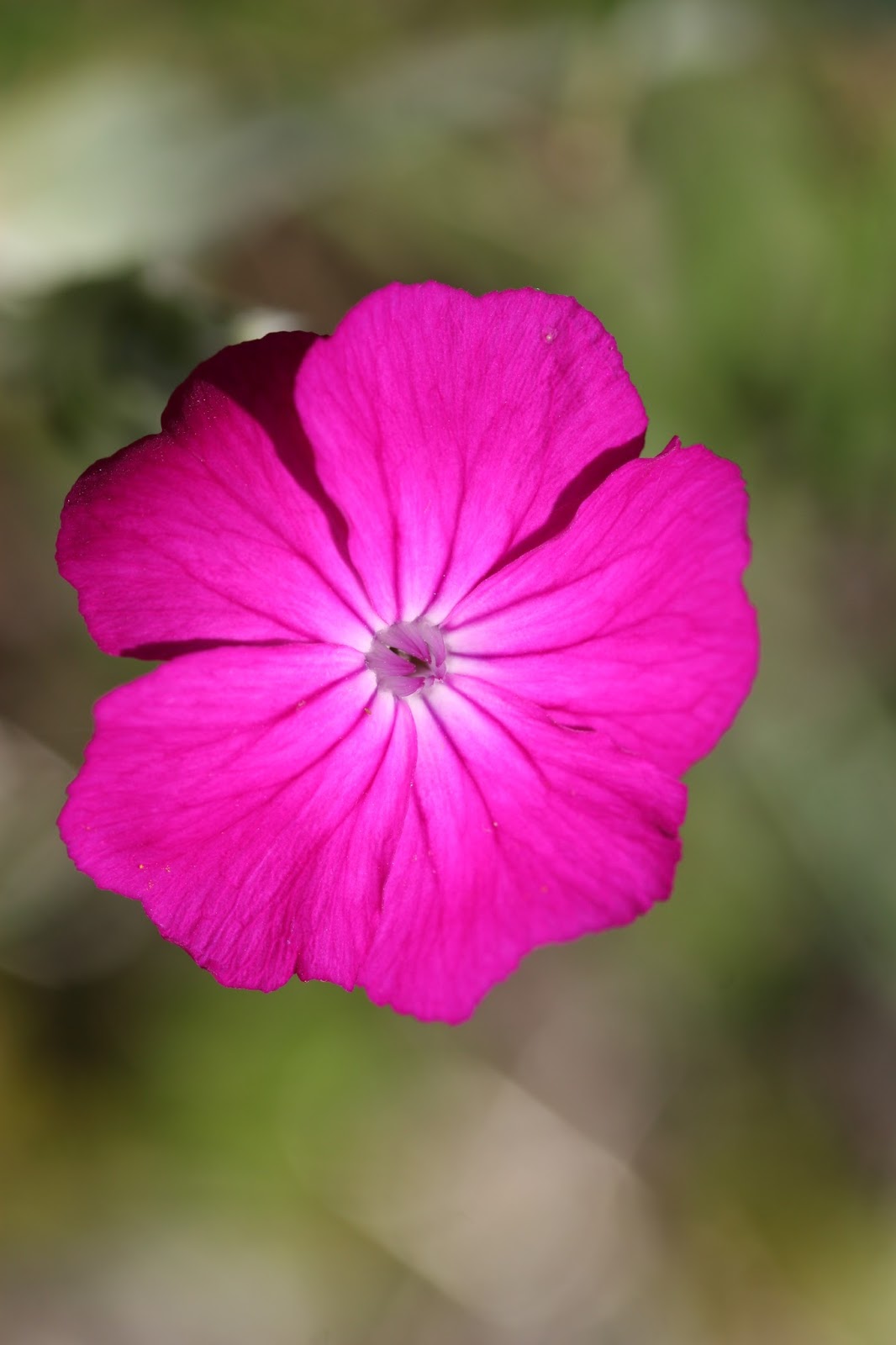
No idea what this is ... not a corn cockle as it has a very different thick-leaved plant structure.

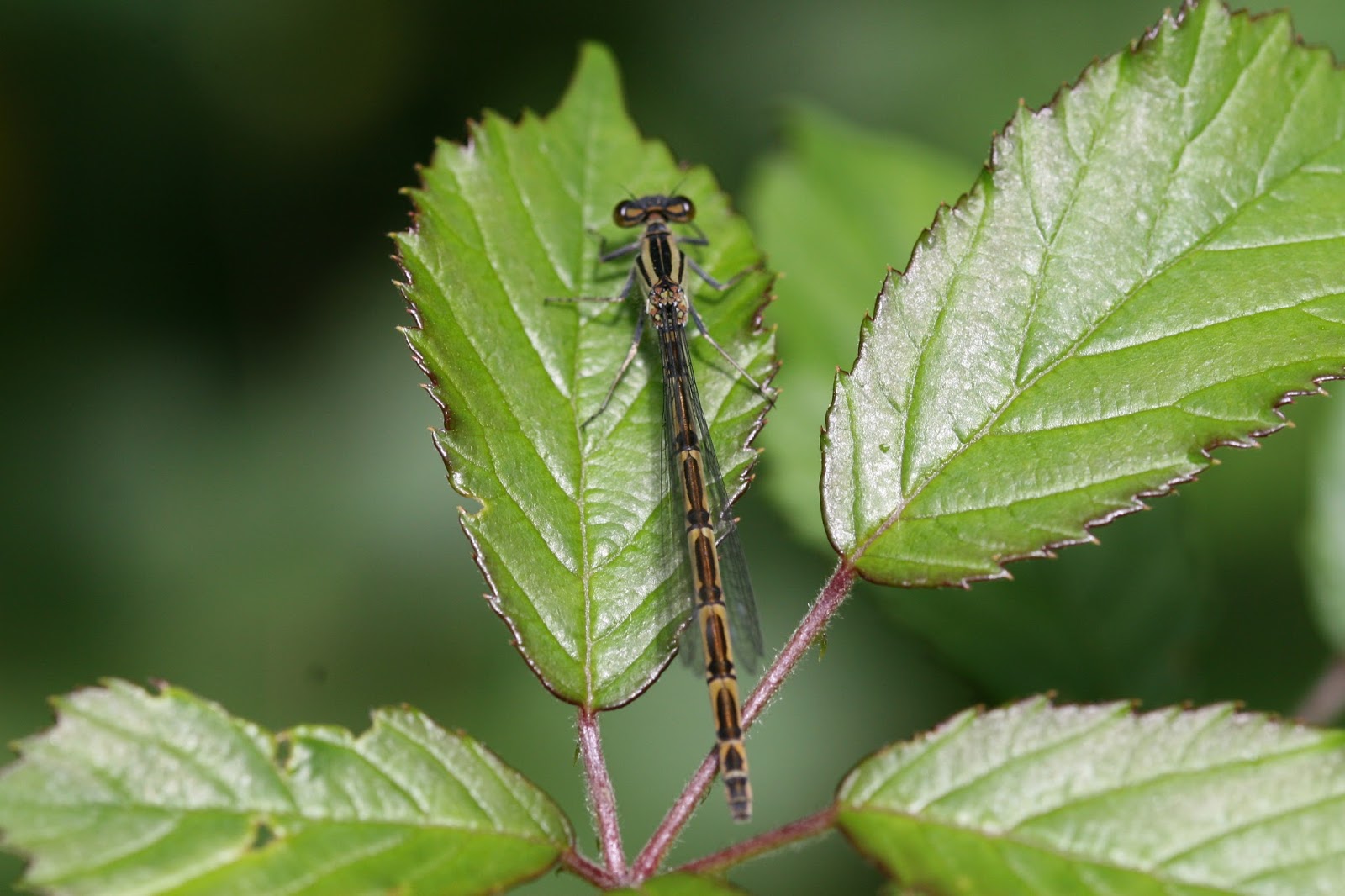
A Darter. It seems to have black legs so is a female Ruddy Darter?
Not sure where I saw this one, but it looks like a brown-form female Common Blue Damselfly so is really very common.
Hatfield Forest Wall Wood in a desperate hunt for decent butterflies, but came away empty handed. A nice Fallow Deer, and what I thought was a Hornet on close inception was clearly not one - the head was all wrong. I think it is Volucella Zonaria, the Belted Hoverfly. Scarce up to the 1940's, now quite common in the south.


A visit to Portland Bill in bright sunshine with some cloud. Some spectacular colours ...


At this time of year the Lulworth Skipper is a significant local species and with some guidance from the jobs I located one in the field between the jobs and The Pulpit. The main id feature seems to be its monumental dullness. Plain brown. None of that flashy bright-orange seen in other skippers.

Lulworth Skipper

more flashy Small Skipper


lots of dense webs in the brambles, all with tubes with a spider sat at the base.
a number of these post flowering ... an alum of some sort?


Thursday, May 05, 2016

Durlston Orchids

A leisurely trip down to Weymouth. Departure delayed to post 9am to avoid the M25, then detour through Bournemouth, Sandbanks, and the Chain ferry to Swanage. Poole Harbour and the Purbeck Hills looking fantastic in the bright spring sunshine.

And so to Durlston Country Park where I spend a couple of hours in search of Early Spider Orchids. eventually I find a couple of assistants in the shop who tell me, contrary to my experience, that they are all over the place, particularly in the Lighthouse field and in the top fields. Once you get your eye in of course ... so back I go and eventually I find a few by a pit. Little gems they are too, and close up quite scary little gems. Anywhere here's a few pics with my super new Sigma Macro lens.


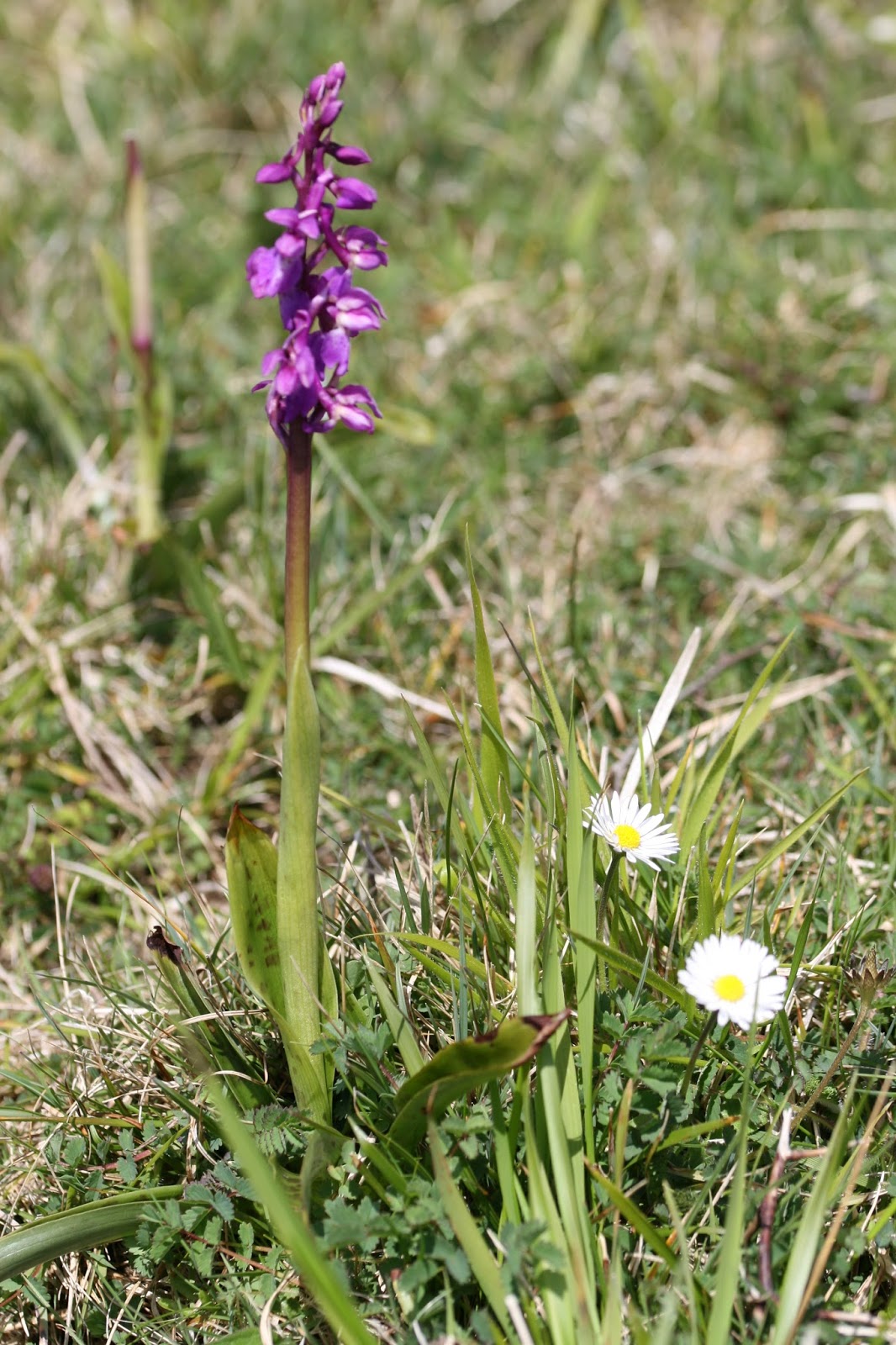
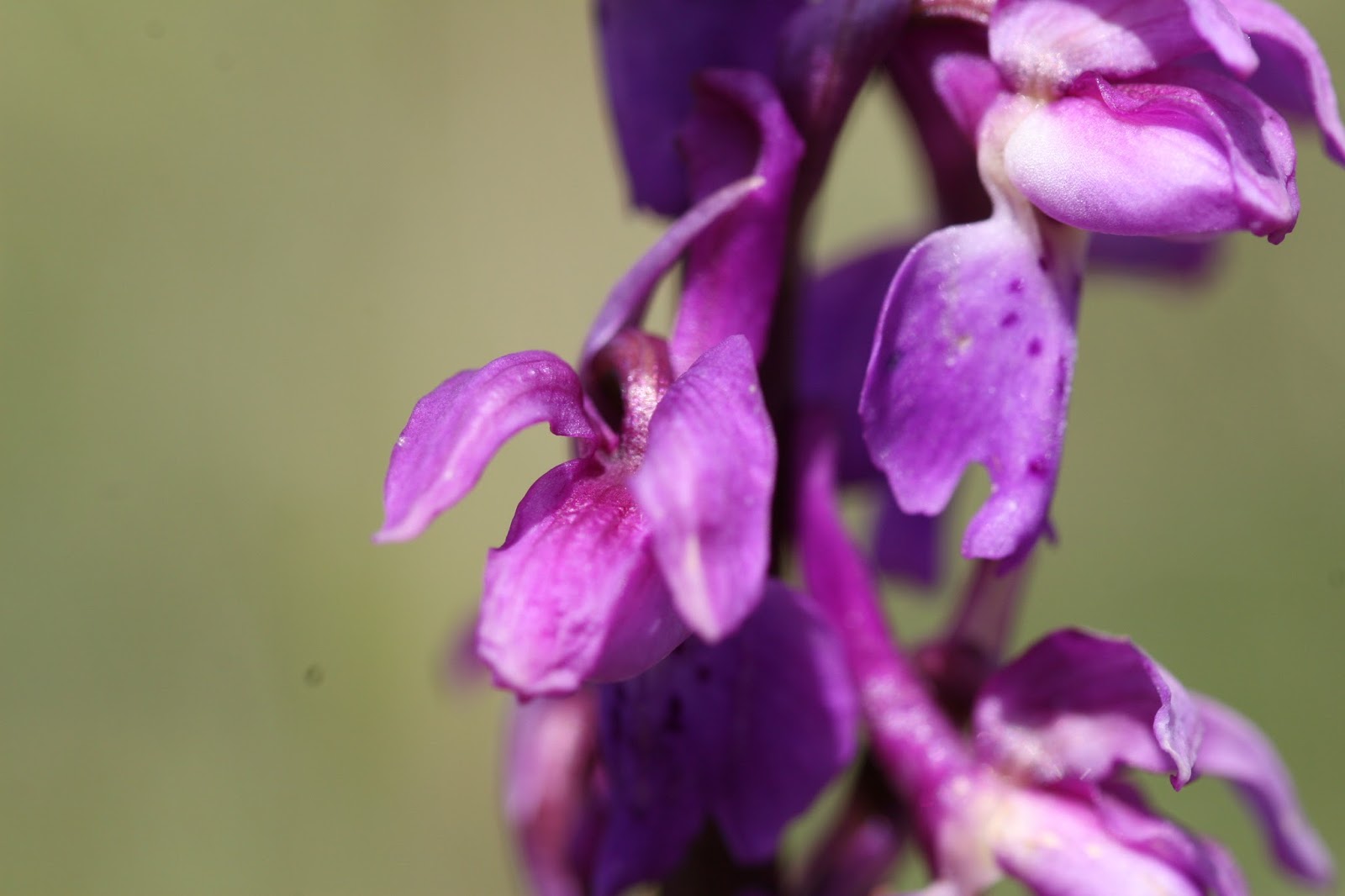
Other orchids were not hard to find. Early Purple Orchids were widespread with their longish purple spikes all over the site. 


I found a couple of orchids without spots on the leaves and more clustered flowers, and subsequent reading confirmed these as Green-Winged Orchids. Needless to say, it appears not to be a cast-iron rule that Early Purples have spotted leaves and Green-winged have unspotted leaves, just a general case with exceptions. But those wings with the veins are really something!


There were lots of Cowslips, in fact fields full of them, and some bees buzzing round. Photographing bees is proving to be quite a challenge as they are either whizzing round or else are deep in a flower with only their lower halves sticking out. Here's one, and I'm thinking Carder Bee but am open to suggestions.


Then off to Arne. at this time of year it is full of fantastic wildlife, but late on a windy spring day most of it is hiding. A few deer (I assume Sika Deer) at ease in the presence of people, and then in the car park a Fox. I stood still hoping it wouldn't notice me and run off, but inevitably it saw me. It looked at me, came over and stood two yards away looking impatiently at me as if to say "where's the food?". And so I met Derek the fox, famous resident of the Arne car park. Needless to say in this metro-sexual world, Derek is a vixen.


Finally I rolled into Ferrybridge in the early evening and in the low sun had 9 Wheatear, 6 Sanderling, 2 Whimbrel, 3 Little Tern on the mud with more flying around and lots of Dunlin and Ringed Plover. The Wheatears were looking quite soft-toned and plump, so I'm guessing Greenland Wheatear?


So overall not much of a bird list, but a cracking day overall. The main reason for coming down is that overnight the wind swings to the south. Migrants will pour onto Portland, seabirds will stream past, and from dawn tomorrow I will be in place and surely will absolutely clean up. 

Monday, April 18, 2016

Amazing Portland Day

Looking up the East Cliffs toward Purbeck
The sky was clear blue all the way down to Portland. Whilst undoubtedly making for a beautiful day walking the island, a clear night is usually the signal for migrants to depart. Would there be any migrants left? Would new ones arrive?

Male Ring Ouzel on the slopes near the neolithic site was a promising start. Then down to the Bill car park and Swallows were in off the sea in a constant stream. Probably low hundreds during the day, with a House Martin and 5 Sand Martins. There was a Wheatear near the bill - the first of 12 during the day and a hint of things to come. The sea was largely void as expected, with some Guillemots lounging near the cliffs. I thought a distant large brown bird was my first skua of the year, but no it was a Creamcrown Marsh Harrier making its way to landfall somewhere along Chesil beach.

Up the west cliffs to the Top Fields. A male Redstart was the first of 4 seen during the day, and a White Wagtail was present, identification of this presenting no problem now I am an expert (see previous post). On to the top fields proper, and more Wheatears, another Redstart, 3 White Wagtails on a strip of freshly ploughed field, and two Short-Eared Owls in a bush showing fantastically well. A Peregrine zipped around amongst some Buzzards and a Raven. the first of a number of views of Peregrine as they hunted over the bill area presumably looking to feed the growing chicks somewhere down the West Cliffs.

Shy SEO in bush
A lift to the Hump - thanks - where there were Blackcaps and a female Redstart (carefully studied for future reference) then a Hoopoe in Suckthumb Quarry. A fantastic bird, quite close, looking almost prehistoric with its crest. It picked out a few grubs then sat quietly under a bush. I called a Whinchat on a bush, but it was a smart male Wheatear, joining my small but rapidly expanding list of Birds That Sit In Bushes For No Other Purpose Than To Confuse Me. Thanks

Hoopoe heading off to the dusky periphery of my scope view.
At this point someone mentioned the Subalpine Warbler was showing well down by the huts, and Tick Fever kicked in strongly. I set a fierce pace, ignoring all possible migrants and arrived at a large crowd surrounding some low vegetation near the huts. Showing regularly round the fringes according to a departing birder. Two hours of watching several Willow Chiffs flitting around followed until the target bird flew in to give tantalisingly brief views. It showed once later for slightly longer. A really neat little bird, the back surprisingly olive-grey I felt, vivid purple face and breast. Some Mediterranean magic for our cold island.

The crowd waits for the Subalpine Warbler to appear ...
Off to the Privet Hedge to spend a couple of hours not seeing the Bluethroat, with just Wheatear, Redstart, and a very close male Sparrowhawk as reward, but even this dip could not take the gloss off a fantastic day. Finally a Little Owl in the jobs quarry to finish.

Great weather, great scenery, great birds, good chat with other birders. The kind of day that you wish you could repeat over and over, step for step, bird for bird. Fantastic.


Thursday, February 18, 2016

Two days in Dorset


Day 1 (16th) . A bright, cool day with some SW breeze. Portland Harbour held a Great Northern Diver, a Slavonian Grebe, and 5 Black-Necked Grebes. There were fewer Red-Breasted Mergansers than in previous winters, and a Shag was new for the year.  At Ferrybridge there was 12 Dark Bellied Brent Geese, a few Mediterranean Gulls, and a Sandwich Tern. And absolutely no waders. Then Lodmoor which was fairly quiet although there were 4 Wigeon which I don't often see here, a Marsh Harrier, and offshore a male Common Scoter

Shoveler at Lodmoor.

Portland Bill - Gannet, Fulmar, Guillemot and a single Kittiwake were all year ticks, onshore a flock of 10 Rock Pipits, the Obs quarry Little Owl, and up on the top fields a single Short-Eared Owl hunted the fields as the sun began to dip in the west.

Finally Raven. A bird of the wilderness, of the highest, remotest mountain tops, of sheer crags, and of tables at cafes.  I was quite taken aback to see a pair going through the detritus outside the cafe. If I had been sitting on a chair, I would have fallen off it. Close up, in the presence of Jackdaws, they were huge, great glossy black beasts. One flew off in that languid, relaxed way they have, as if they are making a point of it, but the other remained for some poor snaps.


Day 2. Dull, wet. I was going for the GGS at Wareham Forest, but gave that up as a bad job due to the rain. On to RSPB Arne for my first visit, but not, I hope, my last. A smashing reserve with a mixture of scarce habitats. The weather was awful; every time I looked at a bird it was a black blob against a white background through misted-up optics. Nevertheless I got what is a first for me, a Spoonbill that wasn't asleep. It flew in, did that swish-swish feeding thing, throwing up a few morsels in its spatula beak, and then flew off over a party of 20 Avocets. Otherwise it was some woodland birds including a  pair of Treecreepers chasing each other through the trees. One stopped and I guess saw me, because it froze at an awkward angle against a branch, seemingly waiting for me to move on, which I duly did.

Lots added to the YL which now stands at 114. The crawl round the M25 was made more passable by some appropriate music, and what could be more appropriate in they year of rain than When The Levee Breaks?


Sunday, May 01, 2011

BarWit Spectacular!


A weekend hit-and-run to Weymouth with D#1. Via the New Forest, which would not bother this blog if not for the fact that I nearly trod on an Adder. Small, just a foot long, but brilliantly black-and white, and quite nippy motoring across the grass. Thanks D#1 for aleerting me to that one ...

Portland on Mayday morning - just an hour's sea watching. I stuck myself on the end of a line and notched up a Pomarine Skua and 2 Arctic Skuas, with a cast of a few small flocks of Bar-Tailed Godwits, a couple of Whimbrel, some Commic Terns, and some close in Gannets plunging into the sea which I always find spectacular.

I find all my experience of sea-birds away from the sea is completely useless when faced with distant migrating birds going past a headland. The skuas leave me struggling, and whilst I can appreciate after the event that the Pom was steadier and more direct, and others did get the full cutlery on this one, I find the most reliable id feature is call. Specifically the excited call of "Pom!" that goes up when a Pom appears, and the slightly deflated "Arctic" that goes up when an Arctic appears.

On to Ferrybridge, where a roadside stop had about 100 Bar-Tailed godwits, many in deep russet finery, and a Whimbrel. Further out on the water line were 3 Little Terns.

Finally Lodmoor, and some spectacular close-ups of waders. The full list was:
Bar-Tailed Godwit - 27
Black-Tailed Godwit - 1
Whimbrel 2
Common Sandpiper 2
Dunlin 1
Grey Plover 2
Oystercatcher 2

and an adult male Whinchat - surely a candidate for the world's best bird - hopping around on a dry area.

The Barwit movement of the last two days is well documented elsewhere. deep rich russet birds are surely one of our most spectacular birds and it was great to get close views of some today.

I held my Powershot up to the scope and clicked away more in hope than in expectation. Here goes ...


Wednesday, April 13, 2011

Skua Hour

Portland Bill this morning. I was convinced it would be epic - southerly wind, rain on its way. And it was - epically barren. Skylark, Meadow Pipit, Pied Wagtail, Linnet on the land. Gannet, Kittiwake, Fulmar, Razorbill, Guillemot, and Shag on the water. I retreated to the obs, and commented on the lack of birds.

"It's not Skua hour." The theory, as relayed to me by one of the regulars, is that the Skuas spend the night in the western approaches, and leave at dawn. this brings them past the bill between 8:45 and 9:45 am. Needless to say, the theory was met with mirth and derision from other regulars, who no doubt had heard it all before.

We stood around and watched. And watched. And chatted some more.

"Skua!" And there it was. A dark phase Arctic Skua steaming through close in. "And what's the time?" 9:15. Smack in the middle of Skua hour. QED.

Goodbye ... and Hello

It's been a while. It's tested the patience of the most dedicated reader. As he told me on a number of occasions. So I've decide...