Today, surely, is the day when it all happens. The day I'm watching a Shrike, just above the Redstart, when a Wryneck pops out and I'm distracted by a passing Monties.
I've been out almost daily recently, and I'm getting into a decent rhythm. Taking more time, just standing watching the bushes. I've had a couple of Spotted Flycatchers, regular Lesser Whitethroat, and the Little Owl and Kingfisher have been refreshingly active. Willow Chiffs have been again in decent numbers with some Chiff-chaff singing, and Blackcaps are still active. Green Woodpeckers number about 5 round the patch including young ones, there's Nuthatch and Great Spotted Woodpecker in the woods and Buzzard overhead, Bullfinches and Greenfinches in the hedgerows, but these are all the standard sightings.
More irregular birds have been a Peregrine through from the south on 22nd, a patch first for me, a Ring-Necked Parakeet in a tree, a Hobby scything through and a leisurely Red Kite over the park on 29th, a Swift on 31st may have been the last of the year, and a smashing Whinchat in the overgrown Little Owl field 1st September, so there is migration action.
Then last night we had a sudden thunderstorm. It was light up like bonfire night with rain bouncing off the roads and thunder rumbling all around. Surely no self-respecting migrant would fly through that? Despite the lack of appropriate winds I set of with my scope confident of bushes heaving with Shrikes, Starts, Wrynecks etc.
There was a Spotted Flycatcher on the edge of the park, being given grief by a Chiffchaff that tried to spoil every sally from the wires. The Kingfisher was calling loudly and I got to see its rear end a couple of times as it motored away. The Little Owl, often just a fluffy child's toy discarded on a low branch, was this time busy flying around from perch to perch, and although I was at a distance it always seemed to be looking directly at me. Yellowhammer and Reed Bunting were on the patch, and a Cetti's Warbler song was the first for a few months. A first for the year was Jay with an acorn in its beak.
So a decent walk. Lots to admire, but not the big one. That'll be along soon for sure. And when it comes, you can read about it here.
Showing posts with label Patch 2017. Show all posts
Showing posts with label Patch 2017. Show all posts
Saturday, September 02, 2017


Tuesday, August 01, 2017
Murder on the patch
A mid-morning stroll round the patch on this the first day of August. A kingfisher the main avian sighting - a couple of months since I saw one of these on the patch - and a flock of 30 Swifts high over the park evidence of migration. Otherwise it was the camera not the binoculars that did the work again today.


Finally a hoverfly. This thing is tiny, under a centimetre. I think it is a female sphaerophoria interrupta, which is "common and widespread" as well as small and beautiful.

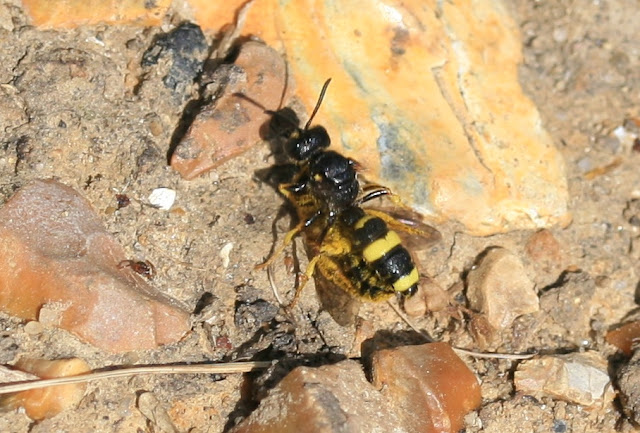
An Ornate Digger Wasp at the colony by the bridge, this time with paralysed prey about to be taken down the tunnel to feed a growing grub. Insect life is just brutal.

A couple of new dragons for the year on the patch today (for me). A black-tailed skimmer whizzed by and what I believe is a female common darter perched briefly.

Tuesday, July 04, 2017
Patch Summer Doldrums
A mid-day mid-summer walk round the patch. It's Groundhog Day. Everything that was here yesterday is here today, and will be tomorrow. So not much of note today? Well, that depends on your perspective.
Bird-wise it was hard. Reed Warbler, Sedge Warbler, Lesser Whitethroat all present singing away, but unseen. Reed Bunting and Greenfinch a bit more obvious. A Herring Gull over was noteworthy for the patch. Buzzard and a pair of kestrels less so. Plenty of young birds - family partiers of Chaffinch and Long-Tailed Tit, and a Little Owl in its usual tree was on its own, although I am told a pair fledged young here this year.
There were plenty of odonata by the river as well, but nothing new; Emperor, Brown Hawker, lots of Banded Demoiselle, and from the Damselflies there were Red-eyed, Azure and Blue-tailed. The canal had lots of vertical blue damselflies I guess ovipositing on vegetation - quite a sight.
There were butterflies too - a Marbled White, plenty of Meadow Brown, Ringlet, a Small Tortoiseshell, and Essex Skipper and Gatekeeper were new for the patch for the year.
 |
| Essex Skipper showing off those Black-tipped antennae |
 |
| Gatekeeper |
 |
| male Red-Tailed |
 |
| hairless-bumble or a mining bee? |
 |
| more of that hairless bee. |
then by the bridge over the canal some freshly dug holes, and some insects using them! There was a black-and-yellow wasp-like thing going in and out. Very hard to photograph but miraculously I got one hovering, and also one digging out the entrance to the burrow.
I think these are some kind of Field Digger-Wasp. They drag paralysed flies into the burrow for the young to feed on. I didn't see anything being dragged in to day, but I did see some smaller wasp-like things with reddish bodies. The closes I can find is a kind of Sawfly. Again I think these are parasitic.
UPDATE: having posted this I'm now not so sure about the ID. Field Diger Wasp has yellow on the thorax just behind the neck and at the base, but this has a completely black thorax.
SECOND UPDATE: tweeted the picture and got a great response back from Ian Beavis at @TWBC_Museum - Ornate Tailed Digger Cerceris rybyensis - isolated all-yellow segment is distinctive
 |
| in-flight hovering wasp |
 |
| digger wasp digging |
 |
| tiny wasp-like thing showing keen interest in the burrows. |
Tuesday, June 27, 2017
Bee IDs
I've been taking lots of photos of Bumble Bees recently. Here's a few that have me stumped, and one firstly that I'm reasonably happy about.
1. I think this is male Vestal Cuckoo Bee (Bombus Vestalis) due to the yellow on the edge of the white tail and the faint yellow midriff band. On the brambles near my house this seems to be the commonest bumble bee. Odd that a parasite should outnumber the host, but there we are.

2. Again on brambles in a local wood. Two shots of a completely smooth bee apart from a yellow frill. I think this is just a completely hairless worker bee of a common species, but only because I cannot find an alternative explanation.


3. And two more from the same area. Again, I think this may be a bumble bee with hair loss, but it may not be a bumble bee at all. I have no idea.


4. This was taken at Thursley Common in Surrey. A dark bee with a greyish white tail. On close inspection it has a faint collar and midriff so I suspect it is just a variant of a common bumble bee. There were at least two like this.

5. From a recent visit to Hatfield Forest. It looks like a common bee except for the profuse yellow on the head. I thought at first it might be Early Bumble bee but on looking in my book Barbut's Cuckoo bee also has lots of yellow on the head. So I'm confused, again.

6. And finally another from Hatfield Forest, and all black one. I couldn't get round the right side of the bush to get a decent photograph so sadly these will have to do. My book indicates there is a form of male Field Cuckoo Bee that is black, but I don't think there is enough on this to confirm an id.


Having spent a few decades watching birds and being pretty confident about identifying any British bird on a good view, its fun to go back to the start with a new group of creatures. I haven't yet got a feel for what is variation within a common species and what marks out a different species. And I still haven't been able to point at a bee and say "thats a Garden Bumble Bee" event though I'm sure they are all around.
Tuesday, June 06, 2017
Summer on the patch
Summer on the patch. Birds are busy raising young, so not much change to report, but insects are beginning to appear.
Bramble bushes in particular are insect magnets. Here's one in a wooded area so protected from wind, and it was alive with bees.


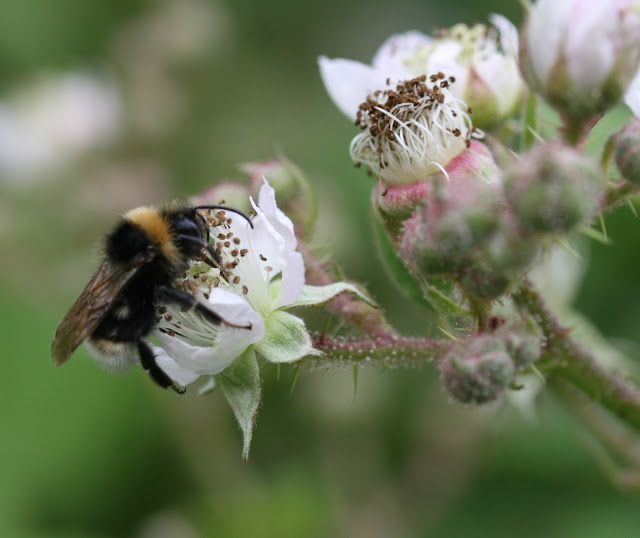


Bramble bushes in particular are insect magnets. Here's one in a wooded area so protected from wind, and it was alive with bees.


This looks like a male Vestal Cuckoo Bee (bombus vestalis). It has the distinctive yellow tinge to the edge of the white tail, and has a band round the top of the abdomen.

This and the one below look like a female Vestal Cuckoo Bee (no middle ring).


I don't know which this one is. It is a female worker bumble bee (has pollen baskets) but has no middle band.

This is a worker (pollen baskets again) and is straightforwardly either a buff-tailed bee or white-tailed bee.
Then a couple of hoverflies, both of which are I believe Volucella Bombylans. These mimic bumble bees, the first one mimicking red-tailed bee and the second white-tailed bee.


Now on easier ground. A male Large Skipper - first of the year.

Finally a Whitethroat, and then one of the more notable birds of the patch. Please leave a comment when you have found it!


Monday, June 05, 2017
Patch Mayfly
Out and about on the patch. More photos to follow but I came across this. It is, I believe, a Mayfly - I have no idea which one. Look at those wings! Amazing!

Friday, May 12, 2017
Patch update
So, its 12th May, approaching the end of spring migration. How is the patch doing?
By this time last year I'd seen 85 species. So far this year I've seen 79. Birds I saw last year that I haven't seen so far this year are Pied (and White) Wagtail, Lesser Redpoll, Siskin, Lapwing, Green Sandpiper, Black Redstart, Egyptian Goose, and Cuckoo. Birds I've seen this year but not last are ... Ring Necked Parakeet.
So on the face of it this year has been quite dismal. Basically, its the birds I saw last year, minus some interesting ones. However, as all us birders know, the list doesn't tell the full tale. In my view, its been a good year.
Part of the deal when you take on a patch is that the local is more important than the wider or national. It is a commitment to look out and record the ordinary. Every bird has the same status, irrespective of whether its an everyday commonplace or a national rarity; they are all unique on the patch.
Take today. I will admit I had high hopes; don't we all have every time we go out? but today in particular after seeming weeks of cold northerlies had produced a late and sporadic migration, finally the wind has turned and damp southerlies looked set to ring migrants flooding through. I set out mid -morning and headed for the pond where the recent lack of rain has produced some muddy fringes. No waders here but there was a Little Egret picking its way through the shallow edges, and a Reed Warbler finally showed itself after singing half-heartedly away. a Male Reed Bunting sang. Over head there were, for the first time this year, good numbers of Swifts - about 50 over the full panorama - and about 10 House Martins slowly drifting south.
Down to Feakes Lock, a small oasis of rural perfection, and once again it delivered; a pair of Grey Wagtails on the lock fence, a Buzzard drifting overhead, and a Cetti's Warbler singing from the undergrowth. Back along the path via an active Blue Tit's nest and home.
Other times this year I've had Barn Owl and Little Owl much more frequently and with better views than last year, Kingfisher around more often, more Cetti's Warblers, more Buzzards, more Shovelers, and a new place for House Sparrow, a species whose movements round the patch are intriguingly mysterious. So it has maintained interest on almost every visit.
I popped out shortly after to the Park to walk the dogs and of course birds that avoided me in the previous walk now came out; a Jay flew over, Willow Warbler and Garden Warbler sang and a Lesser Whitethroat rattled from a distant hedge. Of the Swifts and Martins, however, no sign. Birds riding the winds on their route to some distant place, just passing through.
From this point on last year there was not too much to add. Turtle Dove undoubtedly the highlight, and then a quite poor autumn. So there's still plenty of time.
By this time last year I'd seen 85 species. So far this year I've seen 79. Birds I saw last year that I haven't seen so far this year are Pied (and White) Wagtail, Lesser Redpoll, Siskin, Lapwing, Green Sandpiper, Black Redstart, Egyptian Goose, and Cuckoo. Birds I've seen this year but not last are ... Ring Necked Parakeet.
So on the face of it this year has been quite dismal. Basically, its the birds I saw last year, minus some interesting ones. However, as all us birders know, the list doesn't tell the full tale. In my view, its been a good year.
Part of the deal when you take on a patch is that the local is more important than the wider or national. It is a commitment to look out and record the ordinary. Every bird has the same status, irrespective of whether its an everyday commonplace or a national rarity; they are all unique on the patch.
Take today. I will admit I had high hopes; don't we all have every time we go out? but today in particular after seeming weeks of cold northerlies had produced a late and sporadic migration, finally the wind has turned and damp southerlies looked set to ring migrants flooding through. I set out mid -morning and headed for the pond where the recent lack of rain has produced some muddy fringes. No waders here but there was a Little Egret picking its way through the shallow edges, and a Reed Warbler finally showed itself after singing half-heartedly away. a Male Reed Bunting sang. Over head there were, for the first time this year, good numbers of Swifts - about 50 over the full panorama - and about 10 House Martins slowly drifting south.
Down to Feakes Lock, a small oasis of rural perfection, and once again it delivered; a pair of Grey Wagtails on the lock fence, a Buzzard drifting overhead, and a Cetti's Warbler singing from the undergrowth. Back along the path via an active Blue Tit's nest and home.
Other times this year I've had Barn Owl and Little Owl much more frequently and with better views than last year, Kingfisher around more often, more Cetti's Warblers, more Buzzards, more Shovelers, and a new place for House Sparrow, a species whose movements round the patch are intriguingly mysterious. So it has maintained interest on almost every visit.
I popped out shortly after to the Park to walk the dogs and of course birds that avoided me in the previous walk now came out; a Jay flew over, Willow Warbler and Garden Warbler sang and a Lesser Whitethroat rattled from a distant hedge. Of the Swifts and Martins, however, no sign. Birds riding the winds on their route to some distant place, just passing through.
From this point on last year there was not too much to add. Turtle Dove undoubtedly the highlight, and then a quite poor autumn. So there's still plenty of time.
Friday, April 07, 2017
More patch stuff
A walk round in the sun. Bird-wise it is fairly quite. Just a Red Kite soaring around a long way up, and a Kestrel a Sparrowhawk and several Buzzards all enjoying the sun and the heat. Closer to the ground there was a male Bullfinch, several singing Blackcaps and Chiffchaffs, a Shoveler and a Little Grebe on the pond, and down at Feakes Lock I could see Little Owl and Grey Wagtail whilst at the same time a Cetti's Warbler sang. Otherwise a male Reed Bunting looking quite spectacular, a Meadow Pipit over, and Green and Great-Spotted Woodpecker so once again a nothing-kind-of-day turns out to have quite decent list.
My first Speckled Wood Butterfly of the year, a number of Orange-tips, a few Small Tortoiseshells and a couple of Peacocks gave a decent butterfly list, and some Buff-tailed Bumblebee queens were flying around. I think I saw my first worker of the year (white/buff-tailed) and there was a Tawny Mining Bee on the hawthorn.
There were a few sites with lots of small piles of fine soil with holes in the middle. Generally these were in bare parts of the field on a slight slope. I watched for a while and saw no creatures come out of these. I wonder if they are Tawny Mining Bee nests that the adults have emerged from so they are no longer using them. Here's a typical one.

My first Speckled Wood Butterfly of the year, a number of Orange-tips, a few Small Tortoiseshells and a couple of Peacocks gave a decent butterfly list, and some Buff-tailed Bumblebee queens were flying around. I think I saw my first worker of the year (white/buff-tailed) and there was a Tawny Mining Bee on the hawthorn.
 |
| Buff-tailed queen |
 |
| standard close-up of Hawthorn/Blackthorn flowers |
 |
| Dreadful picture of a Tawny Mining bee |
There were a few sites with lots of small piles of fine soil with holes in the middle. Generally these were in bare parts of the field on a slight slope. I watched for a while and saw no creatures come out of these. I wonder if they are Tawny Mining Bee nests that the adults have emerged from so they are no longer using them. Here's a typical one.

Subscribe to:
Posts (Atom)
-
 The last ice age ended around 11,000 years ago. The temperature rose by several degrees over a period of around a thousand years to produce ...
 -
It's been a while. It's tested the patience of the most dedicated reader. As he told me on a number of occasions. So I've decide...