What makes a really good nature reserve?
Firstly, and most obviously, top wildlife. Minsmere has this. It gets rare stuff (I've seen the Purple Chicken, Citrine Wagtail, and Semi-Palmated Sandpiper in recent years), but also has a variety and quantity of nature that means even when there is 'nothing here' there is still lots to see.
Secondly, you need to be able to see it. Minsmere has a network of walks and hides that means just about everything is accessible to the public.
Thirdly, you need knowledgeable and enthusiastic staff. Minsmere has a number of people who fit this bill. From roving wardens in the hides to staff in the centre there is all the information and guidance you need to get the most out of the day.
I was meeting up with a friend who has an interest in wildlife so Minsmere was a suitable place. the day got off to a good start with a Little Owl perched on a sign post just off the A12, and then on the access road (taking care park by the watchpoint and not on the road as it is a criminal offence to do this on this stretch and cameras are positioned), 2 Stone Curlew and a small herd of 8 Red Deer.
Garden Warbler singing by the car park, then to the centre. Savis Warbler singing from the bushes left/opposite Island Mere hide. Little Terns on the south scrape. Friend arrived so we set off for Island Mere, and had the bird singing easy enough. And then eventually the bird itself in a bush exactly here the staff said it would be, distant but clearly a darkish locustella.
Then round the scrapes. Little Gull, several Little Terns, a few Knot, 2 Whimbrel flew off calling from south scrape. along the beach two Stonechat in gorse, so we looked for accomplices and found a pair of Dartford Warblers once again showing very well.
At this stage we looked inland and saw from our lofty sunlit point a thunderous (literally) dark grey cloud with a mass of swifts, martins and gulls feeding frantically in front. We thought we saw a couple of hobbies too. The clouds appeared to be getting nearer so we headed to the centre for a coffee, and as we were there the heavens opened.
Finally, friend having departed, the centre staff said a few hobbies had been sent from Bittern Hide, so a quick pre-departure visit and there were not just three hobbies hunting over the reed bed, but a Bittern sat just on the edge of the reeds.
Once again an excellent visit. Non-stop wildlife spectacle. Must be the best place in England for wildlife.
Thursday, May 16, 2019


Thursday, May 02, 2019
Year listing in Norfolk

Mike and Dave were in the car by not long after seven, and the Last of the Summer Wine Year-Listing trip to Norfolk was on.
We pitched up at Wells around 9;30ish and parked in a lay-by opposite the holiday camp just beyond the railway and walked down to a likely-looking wetland. We soon found the Wood Sandpipers (168), as always the epitome of avian elegance, People soon started to arrive and a couple pointed out Whinchat (169), freshly arrived and working their way along a fence. Lesser Whitethroat - the first of many - sang, Swallows swopped around, and distantly a Spoonbill (170) flew east although David failed to pick this one up. also lots of Avocets and a Wigeon.
Then on to Burnham Overy for the Purple Heron. As we were walking down to the crowd all looking determinedly into the marsh, David interrupted a long spiel about how he doesn't seem to pick up or see birds these days to point out a Bittern (171) on a reed. We duly watched this for a while until it flew off and dropped into the reeds. We arrived at the crowd to find them annoyingly and frustratingly blasé about the Purple Heron. Yes over there somewhere, been showing well, not showing at the moment, will no doubt be out soon. We scanned for a while, got distracted by a couple of Spoonbills very distantly circling, two Marsh Harriers and a Red Kite, and then it was out (172). Literally it climbed out of the ditch and wandered around. What a bird, even at a couple of hundred yards. All neck, and an enormous bill. Check out the photo at the top - yes its in there. David said it was like an Anhinga, and it was.
Duly relaxed we started looking around and had 3 Whimbrels in a field, a Little Egret and a Great White Egret, a Grey Heron making 6 heron species including the Spoonbills. The mewing/cawing of Mediterranean Gulls drew our attention, and then on the way out a pair of Grey Partridges (173). We bumped into some birders determinedly heading down to the Heron. Was it around? Yes. Over there somewhere, been showing well, not showing at the moment, will no doubt be out soon.
On to Titchwell for some lunch. Mike thought he heard Turtle Dove purring briefly round the car park. We went on to the reserve proper - a few Bearded Tits, lots more Avocets, a few (hundred) Brent Geese still, a single Little Ringed Plover, another Whimbrel, 19 Blackwits, a couple of Grey Plovers, a few Barwits and Sanderling on the beach and then on the Tidal Pool two feeding Spoonbills and nine Turnstone. Med Gulls everywhere, calling all the time. We walked through the fen trail and got our first dragon of the year - a single Large Red Damselfly, then 3 male Red Crested Pochard (174) in very fine plumage pursuing a single female, and another Lesser Whitethroat flying around, Mike thought he herd that Dove again, and then in the centre someone saying they'd had Turtle Dove walking round the car park at 6am.
To finish, Snettisham. We parked at the beach car park and walked north toward Heacham. My first trip to this open scrub and reed habitat - impressive. There were lots of warblers, many Whitethroat and several Lesser Whitethroat including one doing a song flight - we had no idea this species did this. A coupe of Willow Warblers and a Sedge Warbler. Also my first Speckled Wood and Small Copper of the year. Then Mike found a single female Wheatear, and a pair of Stonechats clearly feeding young. We got to the end, scanned the field north - there more Whimbrel and two more Grey Partridge, then walked back along the dyke - hunting Marsh Harrier being harried by Lapwings and a Red Kite, another Spoonbill, our sixth for the day at four sites, and two more Whimbrel bring the total to 9. Finally another pair of Grey Partridge and we were done for the day, heading back home via our regular stop at Sainsbury's cafe in King's Lynn to go through the list.
Final total just over 90. Another splendid day in Norfolk - good weather, great birds, great company.
Sunday, April 21, 2019
Bee cities
The patch is quite rewarding now with summer birds appearing, and insects increasingly part of the fauna. One particular area got my attention today.

It's a common enough sight - a patch of bare earth with a mass of holes and piles of finely tilled earth. I've seen this for the last couple of years and decided to have a good look.
In the morning it was a mass of small bees. I went back in the afternoon with my camera, and saw other things. Firstly, the bees. Here's one forlornly trying to dig a hole


It's quite a tiny bee, and clearly a mining bee, so I think I'm on firmer ground than the bee when I suggest this is a mini-miner. I'm happy to say its probably Common Mining Bee, given that they are, well, common.
In the afternoon there were other different bees. These were even smaller, with bright red abdomens that were only clearly visible in flight. These look like Nomad bees. These are kleptoparasites, and I'm going for Little Nomad Bee, as it is common, and a parasite of Common Mining Bee. Here's a photo of one in flight. Pretty amazing photo too, if I'm honest. It's out of focus, but you try snapping a photo of a tiny bee in flight!


and here's a nomad bee doing what nomad bees do - disappearing down a mining bee nest hole. What goes on down there is, according to wikipedia, as follows "The female cuckoo bee will lay her eggs in the host’s nest and leave. Nomada are known to leave specialized egg structures in the host cell. These eggs are placed into the innermost wall of the host cell, yet there is a lot of diversity among Nomadinae regarding the manner of egg insertion. Some species are known to bury the egg at right angles into the cell wall, while some only partially insert the egg. Nomada may sometimes leave multiple eggs into one host cell, a frequent trait of kleptoparasitic bees. Using their unique mandibles, the parasite larvae kill the host offspring and the conspecific larvae until only one is alive. This larva then steals the host’s allocation of pollen or nectar. "
There were other creatures too - spiders, ants, which I'm thinking are in some way connected with this. It's a pretty amazing thing to think of the lifeforms gathering round this patch of bare earth, and the depths at which life is happening. A veritable insect city, underneath our feet.
Finally a Digger Wasp. We know about these, having had a colony of Ornate Digger Wasps on the patch a couple of years ago. More deep nesting insects, more gruesome life histories. It's all going on.


Monday, April 15, 2019
more local bees
around Pishiobury Park. Birds have been decent, with yesterday a Peregrine, a Sparrowhawk, and a Red Kite before I even entered the park. Today it was bees.
This is, straightforwardly, I think, a female Tawny Mining Bee.



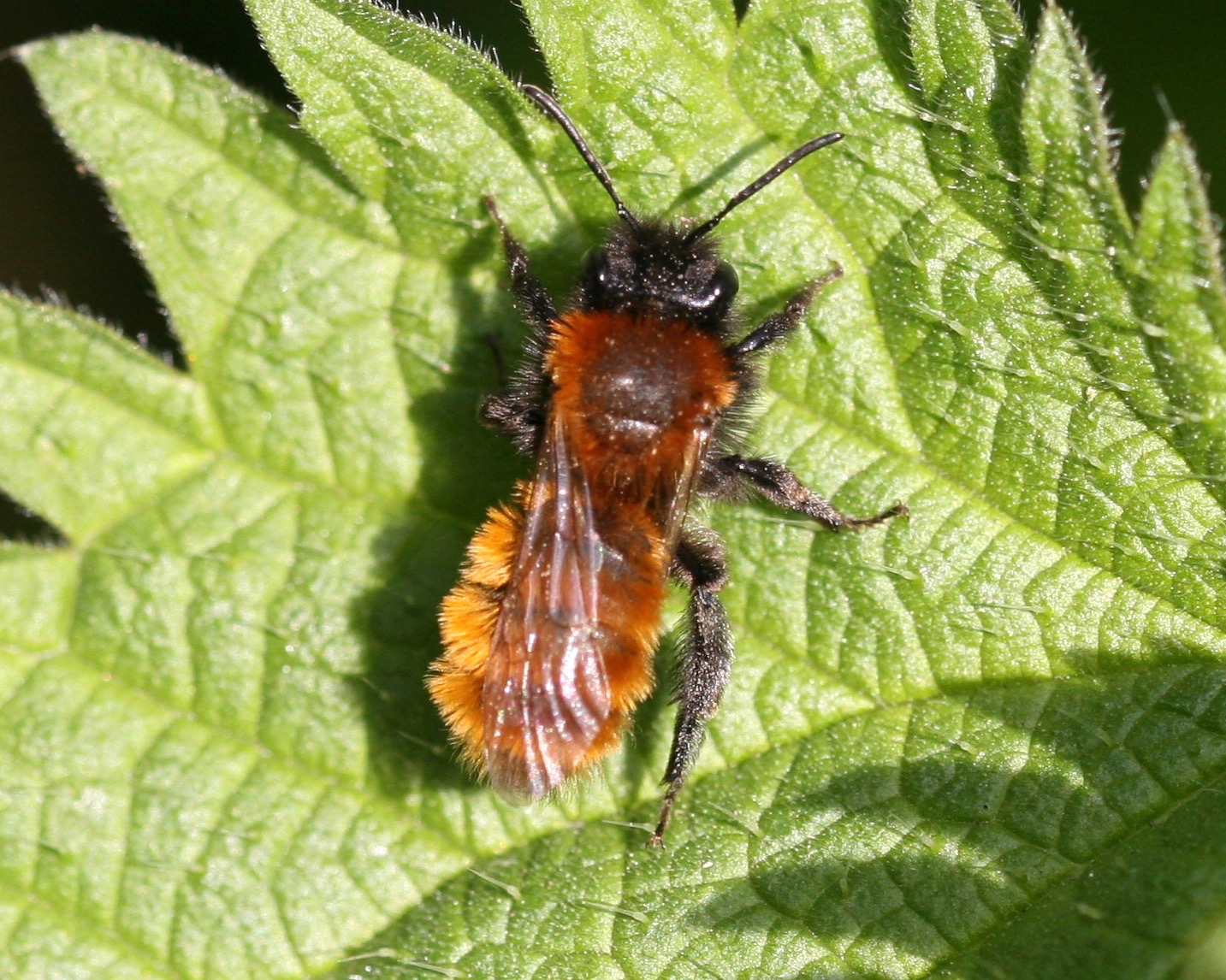 |
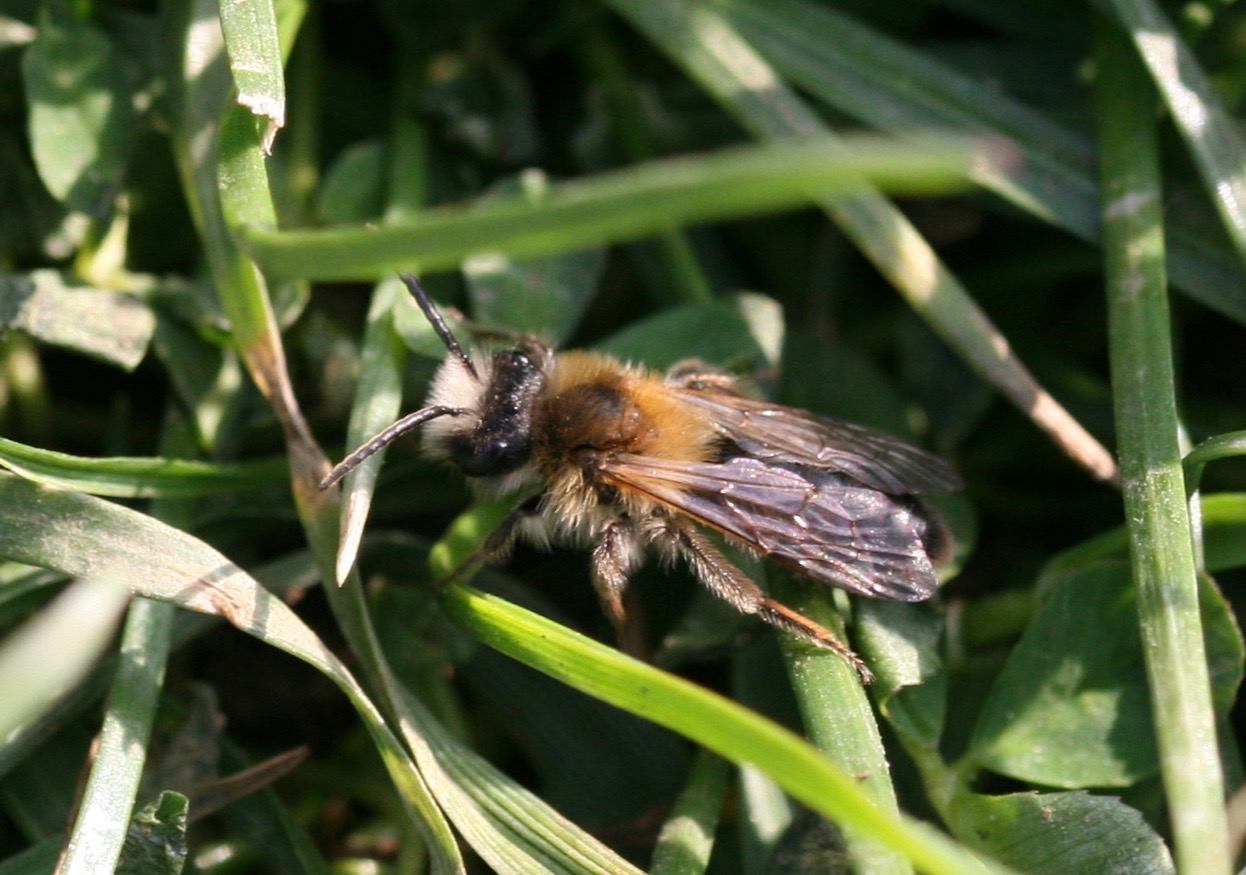
This is, less straightforwardly, a male Tawny Mining bee.

Quite a lot of these on the ivy in the garden. Small - I think these are Chocolate Mining Bee .

Now. With considerably less conviction, I think this might be female Gwynne's Mining Bee. Except it lacks the furry legs that Steven Falk's photos have.
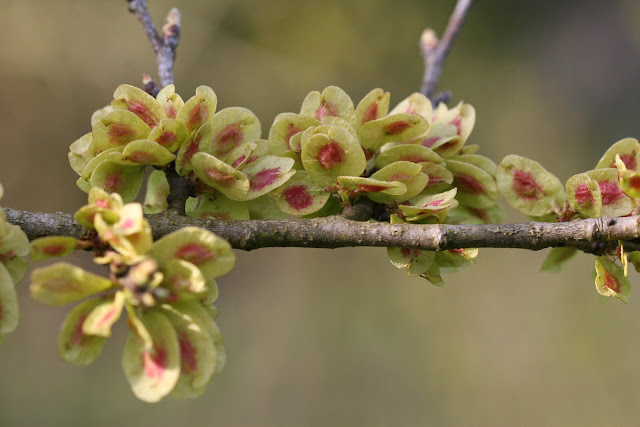
Finally I have started looking for local Elms, making a note so I can go along later and look for you-know-whats. There are a few clusters locally, one in a place I've been told previously where 'they' occur, and a couple of clusters in the park. Quite easy to see now with these slightly incongruous clumps of red-centred green lollipops on bare branches.

Very finally, because they are everywhere at the moment, some Wild cherry.


Friday, April 05, 2019
Not seeing Ring Ouzels
I have a thing about Ring Ouzels. More accurately I have a thing about not seeing them. I've seen enough over the decades, some quite well, and they never fail to excite. If I was to calculate the optimum migrant, the one that is not so rare you hardly ever come across them (think Hoopoe), nor so common you don't really rate them (think Yellow Wagtail or Wheatear), but the one with the best chance of giving you a memorable moment, it would be Ring Ouzel.
Recent Ring Ouzels at regular Herts hotspots gave me the impetus to trudge the intensively farmed and manicured fields of the local "high ground" centred round the Tharbies farm. 6 Fieldfare over as I parked up by the local cemetery, then really not much apart from a couple of Yellowhammers and Skylarks until I got to the top of the rise, and saw some promising brown clumps in a recently ploughed and levelled field. On arriving at a suitable roadside viewing position it was clear these were 21 Golden Plover. And what a sight. Always a neat bird, as they attain summer plumage they are spectacular. These were as close as you can reasonably get to such wary birds (ie the middle of the field from the edge) but nevertheless sparkled gold and solid intense black. Fantastic.
I went on up the road opposite to another high point, and had nothing on the ground but did have 4 Cormorant ploughing their way north through the patch, and a couple of Buzzards rode the thermals.
Back to the Goldies, and more time spent enjoying them. The Buzzards came closer with one over the field, then a raptor behind - Peregrine! It shouldn't be a surprise to see these here, I've seen them here before and they breed within a couple of hours flight, but it was a great sighting. For ten minutes it cruised around with a bit of rapid flight, eventually drifting over my head and away.
Well, after that I was well and truly in the zone; every bird seemed better. Two very charming Blue Tits low over a field to avoid the wind, and another pristine Yellowhammer. All now seemingly significant, not everyday sightings.
So a smashing local trip, with some great views of notable birds, and not a Ring Ouzel anywhere in sight. Next time.
Recent Ring Ouzels at regular Herts hotspots gave me the impetus to trudge the intensively farmed and manicured fields of the local "high ground" centred round the Tharbies farm. 6 Fieldfare over as I parked up by the local cemetery, then really not much apart from a couple of Yellowhammers and Skylarks until I got to the top of the rise, and saw some promising brown clumps in a recently ploughed and levelled field. On arriving at a suitable roadside viewing position it was clear these were 21 Golden Plover. And what a sight. Always a neat bird, as they attain summer plumage they are spectacular. These were as close as you can reasonably get to such wary birds (ie the middle of the field from the edge) but nevertheless sparkled gold and solid intense black. Fantastic.
I went on up the road opposite to another high point, and had nothing on the ground but did have 4 Cormorant ploughing their way north through the patch, and a couple of Buzzards rode the thermals.
Back to the Goldies, and more time spent enjoying them. The Buzzards came closer with one over the field, then a raptor behind - Peregrine! It shouldn't be a surprise to see these here, I've seen them here before and they breed within a couple of hours flight, but it was a great sighting. For ten minutes it cruised around with a bit of rapid flight, eventually drifting over my head and away.
Well, after that I was well and truly in the zone; every bird seemed better. Two very charming Blue Tits low over a field to avoid the wind, and another pristine Yellowhammer. All now seemingly significant, not everyday sightings.
So a smashing local trip, with some great views of notable birds, and not a Ring Ouzel anywhere in sight. Next time.
Saturday, March 30, 2019
Old Blue-eyes are back!
its a sunny day in early spring and that means - Adders. So off to Fingringhoe Wick.
I stomped around for a while not seen much apart from a fair selection of early-season butterflies, saw a man who sent me down a particular path, went down that path and had a look at a particularly promising south-facing leaf-litter strewn bank, saw nothing and stomped off. I rudely interrupted a couple on account of their large camera and asked if they'd seen any, whereupon they took me right back to that promising bank I'd just been looking at and pointed out two adders lying camouflaged in the leaves round the base of a bush!
We soon had a crowd of people looking at these splendid creatures. It was a complete range of people, all enthralled to see these creatures basking in the sun, even if well hidden. Several times there was a "no ... no .. can't see it, no ...yes! wow!!"
Another one was seen closer to the path, and I eventually got eye-ball to eyeball with it. Here's my "record shots"

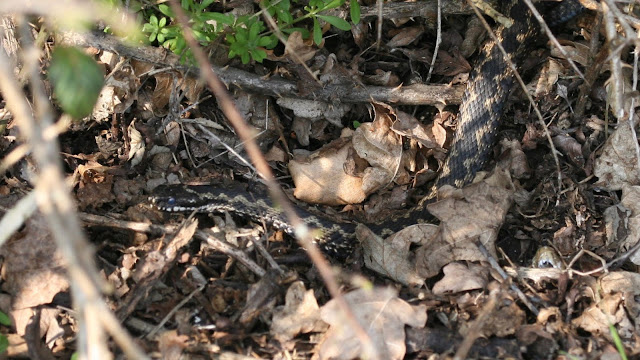


I stomped around for a while not seen much apart from a fair selection of early-season butterflies, saw a man who sent me down a particular path, went down that path and had a look at a particularly promising south-facing leaf-litter strewn bank, saw nothing and stomped off. I rudely interrupted a couple on account of their large camera and asked if they'd seen any, whereupon they took me right back to that promising bank I'd just been looking at and pointed out two adders lying camouflaged in the leaves round the base of a bush!
We soon had a crowd of people looking at these splendid creatures. It was a complete range of people, all enthralled to see these creatures basking in the sun, even if well hidden. Several times there was a "no ... no .. can't see it, no ...yes! wow!!"
Another one was seen closer to the path, and I eventually got eye-ball to eyeball with it. Here's my "record shots"

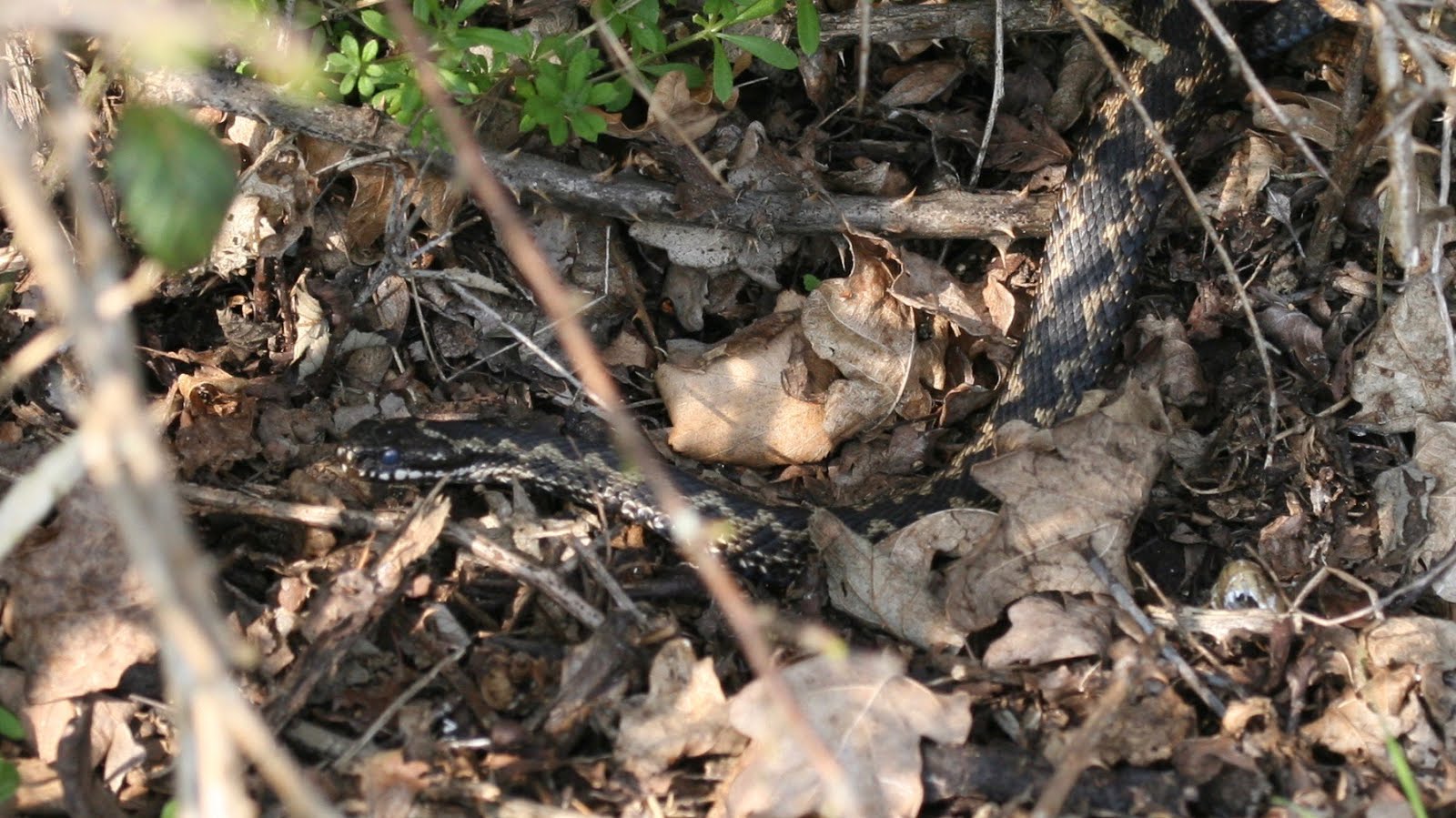


And since when have Adder's eyes been blue? I guess a lid of some description being pulled down.
whilst concentrating on these, various bird noises were slowly percolating through my common bird filter. It took a while to realise I'd just heard a summer visitor, so a Sand Martin went through unseen, and then a Blackcap started up. It's all happening.
Thursday, March 28, 2019
Here comes summer - and bees -
Insects are beginning to appear, so an increasingly significant part of my wild-life interest is kicking into gear.
Posts will become a bit different from now over the summer I expect. Most wildlife blogs have pictures of wildlife that the author has confidently identified. I have no idea what I'm photographing in many cases, so I will be posting photos and then trying to identify them as time goes by.
Here's a few from Wall Wood, Hatfield Forest today.

This thing is tiny. Less than a centimetre. I think its a species of mini mining bee. Looks very dapper, and with reddish body and those legs should be easy. Suggestions gratefully received.

here it is on a primula/oxlip for size with more detail,.

on surer ground here. Dark-edged Bee Fly.
Posts will become a bit different from now over the summer I expect. Most wildlife blogs have pictures of wildlife that the author has confidently identified. I have no idea what I'm photographing in many cases, so I will be posting photos and then trying to identify them as time goes by.
Here's a few from Wall Wood, Hatfield Forest today.

This thing is tiny. Less than a centimetre. I think its a species of mini mining bee. Looks very dapper, and with reddish body and those legs should be easy. Suggestions gratefully received.

here it is on a primula/oxlip for size with more detail,.

on surer ground here. Dark-edged Bee Fly.
Friday, March 08, 2019
Counting waders
1,2,3,4,5. 6,7,8,9,10. 11,12,13,14,15. 16,17,18,19,20. 21,22,23,24,25. 26,27,28,29,30.35,40,45,50.55,60,65,70,80,90,100.110,120,130,150. 160,170,..200. 250,300,350,400,450,500.600,700,800,900,1000. 1100,1200,1300,1400,1500.1600,1700,1800,2000. 2500, 3000,3500,4000,4500.
and 200 on the spit, and 13 next door to them. So that's 4713 in total.
and 200 on the spit, and 13 next door to them. So that's 4713 in total.
Thursday, March 07, 2019
Farewell to the Impenetrable Forest
I wrote about the Impenetrable Forest here in 2016. It was a small field left to go wild. Over the years a few hawthorn bushes sprang up, then shot up, until it became a dense copse of ten-foot high trees and bushes. A brook runs along the lower northern edge with reeds, so there is some variation. It is good primarily for Warblers, with currently the patch stronghold of Garden Warbler and Willow Warbler, but also Whitethroat, Lesser Whitethroat, Blackcap, and Chiffchaff seen regularly. In previous years Sedge Warbler and even Grasshopper Warbler have sang from here. In winter it is good for tits, Bullfinch, Greenfinch, Song Thrush, Redwing, as well as other more regular birds. It is good too for bees and butterflies, with a couple off years ago large numbers of Vestal Cuckoo Bee. Quite an amazing gathering of wildlife, with high density and in spring quite a racket.
But no more. Today I passed the field and saw bushes stacked up, heavy tracks of trucks, and a digger. I went on and chatted to the farmer. He used to grow wheat and barley on it but couldn't get the harvester up the road anymore, so had neglected it. He is putting it back to grass to grow for hay, which he can easily harvest.
It was always an anachronism. Quite odd. It is unreasonable in the south east of England to expect land to be just left, and we should be grateful it is still being used for agriculture. At least now I may be able to see the birds I can hear.
Time to bid a fond farewell to the old birds, and extend a welcome to the new ones.
But no more. Today I passed the field and saw bushes stacked up, heavy tracks of trucks, and a digger. I went on and chatted to the farmer. He used to grow wheat and barley on it but couldn't get the harvester up the road anymore, so had neglected it. He is putting it back to grass to grow for hay, which he can easily harvest.
It was always an anachronism. Quite odd. It is unreasonable in the south east of England to expect land to be just left, and we should be grateful it is still being used for agriculture. At least now I may be able to see the birds I can hear.
Time to bid a fond farewell to the old birds, and extend a welcome to the new ones.
Monday, February 18, 2019
Missing the Glaucous at Rainham.
Glaucous Gull is one of my favourite birds. Such a powerful, menacing bird. Unfortunately I haven't seen one for years, so when two turned up at Rainham, it was a no brainer. I set off on Friday morning straight down to Coldharbour Point.
Long story short - I didn't see them. Lots of large gulls, even more small gulls, and a few downcast birders. It was my first time doing a circuit of the tip, and I did eventually get views of loads of gulls on the top of the tip from just east of Coldharbour Point at a considerable distance, but nothing doing. somehow, a fly-though Peregrine, Marsh Harrier, Avocet, Black-tailed Godwit, Pintail, Wigeon, and even 8 Snipe on the foreshore were scant consolation.
So Sunday morning, and why not try again? Well, because the tip is shut on Sundays so its the gulls' day off and they leave the area generally is why not. I turned up to find a second winter had been seen flying NE about thirty minutes earlier, which is funny because as I was driving down the M25 NE of Rainham about twenty minutes earlier a large pale gull had flown high across the motorway, and as I glanced up and saw sunlight through translucent primaries I thought to myself Bollocks Bollocks Bollocks I bet that's it.
Peregrine again, Marsh Harrier, c40 Golden Plover, c200 Dunlin, Avocets, plus the usual stuff all viewable from the mound. There was a time when such a list would have been an epic day out. No more. I guess you know when you've arrived as a birder when you get a list like that and leave disappointed.
Long story short - I didn't see them. Lots of large gulls, even more small gulls, and a few downcast birders. It was my first time doing a circuit of the tip, and I did eventually get views of loads of gulls on the top of the tip from just east of Coldharbour Point at a considerable distance, but nothing doing. somehow, a fly-though Peregrine, Marsh Harrier, Avocet, Black-tailed Godwit, Pintail, Wigeon, and even 8 Snipe on the foreshore were scant consolation.
So Sunday morning, and why not try again? Well, because the tip is shut on Sundays so its the gulls' day off and they leave the area generally is why not. I turned up to find a second winter had been seen flying NE about thirty minutes earlier, which is funny because as I was driving down the M25 NE of Rainham about twenty minutes earlier a large pale gull had flown high across the motorway, and as I glanced up and saw sunlight through translucent primaries I thought to myself Bollocks Bollocks Bollocks I bet that's it.
Peregrine again, Marsh Harrier, c40 Golden Plover, c200 Dunlin, Avocets, plus the usual stuff all viewable from the mound. There was a time when such a list would have been an epic day out. No more. I guess you know when you've arrived as a birder when you get a list like that and leave disappointed.
Thursday, February 07, 2019
A Day in The Brecks
On my tod today as my usual partners in crime are otherwise engaged or ill. I often find the Brecks difficult and I underperform expectations, so a chance to put in some time researching the favoured places, specifically Santon Downham. There has been a regular Great Grey Shrike, but other Brecks specialities such as Crossbill, Firecrest, and Woodlark I often find hard or impossible so maybe a chance to get some of these on the list here or elsewhere. Goshawks would have to wait for another day with less wind and more sun.
The omens weren't great as a gusty wind was blowing low cloud and intermittent rain across the sky as I pulled up at St Helens, but straight out of the car up by the railway line a large flock of Great tits with a few Chaffinches and Coal tits and a couple of Bramblings. I bumped into a couple of others looking for the Great Grey Shrike, and we looked round the eastern edge of the car park drawing a blank on GGS but did get a couple of Crossbills that turned into a male, an imm male, and two females. We spent a time watching these superb birds in a birch tree, although obviously I was not too excited as for me these are a common garden bird.
After that I headed west along the river. My first time along the river, and what a great piece of habitat. Several sightings of Kingfisher and permanent accompaniment of Siskins. Great views of quite a few including a pale one, which if such a bird existed would surely be an Arctic Siskin. Nuthatch showed well, and then across the bridge at Santon Downham and more Bramblings on the opposite bank. By this point there were many other birders looking for the Great Grey Shrike, but we drew a blank as after a brief sighting in the morning it had not been seen since. There was little else to be seen here as the drizzle had set in, just another couple of Crossbills as I walked back to the car.
Then off to the old reliable of Lynford Arboretum for Hawfinch. Immediately on arrival there were a couple of Bramblings, then a few more down by the bridge, and then at the Paddocks a Hawfinch at the top of a tree. A half hour watch finally delivered five birds with splendid scope views in a tree and a few flight views, as well as a couple of Redwings and a Marsh Tit. It seems hard to believe that just a year ago I was watching sixty Hawfinches in the local wood.
Chat with a couple about Firecrest, and yes they are seen but rarely. Then back to the car, but coming back by the puddle (you know, the small puddle by the feeders about 100 yards down the path) a flock of Bramblings. About 40 birds in a range of plumages with some getting blackish heads. Very skittish flying up and then drifting down. What a sight! Surely there's nothing better in birding then a flock of these fantastic finches.
Just as I was leaving these birds and heading back to the car there was a shout and a wave from the couple I had been chatting to earlier. They were looking intently into the foliage by the entrance. I knew instantly what they were looking at and dashed up there to see a male Firecrest picking its way through the ivy. Ten minutes just a few yards away from this terrific little sprite picking its way through foliage with a few spells of total visibility out in the open was a great way to end the day, and a big thank you to the couple who found this gem and put me and several other birders onto it.
The omens weren't great as a gusty wind was blowing low cloud and intermittent rain across the sky as I pulled up at St Helens, but straight out of the car up by the railway line a large flock of Great tits with a few Chaffinches and Coal tits and a couple of Bramblings. I bumped into a couple of others looking for the Great Grey Shrike, and we looked round the eastern edge of the car park drawing a blank on GGS but did get a couple of Crossbills that turned into a male, an imm male, and two females. We spent a time watching these superb birds in a birch tree, although obviously I was not too excited as for me these are a common garden bird.
After that I headed west along the river. My first time along the river, and what a great piece of habitat. Several sightings of Kingfisher and permanent accompaniment of Siskins. Great views of quite a few including a pale one, which if such a bird existed would surely be an Arctic Siskin. Nuthatch showed well, and then across the bridge at Santon Downham and more Bramblings on the opposite bank. By this point there were many other birders looking for the Great Grey Shrike, but we drew a blank as after a brief sighting in the morning it had not been seen since. There was little else to be seen here as the drizzle had set in, just another couple of Crossbills as I walked back to the car.
Then off to the old reliable of Lynford Arboretum for Hawfinch. Immediately on arrival there were a couple of Bramblings, then a few more down by the bridge, and then at the Paddocks a Hawfinch at the top of a tree. A half hour watch finally delivered five birds with splendid scope views in a tree and a few flight views, as well as a couple of Redwings and a Marsh Tit. It seems hard to believe that just a year ago I was watching sixty Hawfinches in the local wood.
Chat with a couple about Firecrest, and yes they are seen but rarely. Then back to the car, but coming back by the puddle (you know, the small puddle by the feeders about 100 yards down the path) a flock of Bramblings. About 40 birds in a range of plumages with some getting blackish heads. Very skittish flying up and then drifting down. What a sight! Surely there's nothing better in birding then a flock of these fantastic finches.
Just as I was leaving these birds and heading back to the car there was a shout and a wave from the couple I had been chatting to earlier. They were looking intently into the foliage by the entrance. I knew instantly what they were looking at and dashed up there to see a male Firecrest picking its way through the ivy. Ten minutes just a few yards away from this terrific little sprite picking its way through foliage with a few spells of total visibility out in the open was a great way to end the day, and a big thank you to the couple who found this gem and put me and several other birders onto it.
Subscribe to:
Posts (Atom)
-
 The last ice age ended around 11,000 years ago. The temperature rose by several degrees over a period of around a thousand years to produce ...
 -
It's been a while. It's tested the patience of the most dedicated reader. As he told me on a number of occasions. So I've decide...