Saturday, August 25, 2018

Chobham Common

D#3 wanted a lift to and from Thorpe Park. So, a day SW of London. David suggested Chobham Common, and that's where we went. Well, we actually went to Cobham, but soon realised our mistake.

Bird-wise it was quiet; a few glimpses of Dartford Warbler, several Stonechats, and a flock of about 40 birds that had Willow Warblers, Blue, Great, Coal and long-tailed tit, and a Spotted Flycatcher. But we did find Grayling butterflies all over the place, much to our surprise.

This was the first time for me I've seen them close too without a strong wind, so the first time I got to see their upper parts - in flight only. A really nice if unspectacular butterfly. After a while David noticed something about their behaviour, mainly because as we moved to take the best side-on shot our shadows were in danger of impinging on the butterflies. We eventually worked out what we think was going on.

The butterflies land with their fore-wing up revealing the eye, then slide that down, then slowly shuffle round until their wings face the sun, and then lean slightly so their wings are perpendicular to the sun's rays. Then they soak up the maximum heat they can. Quite something!

just landed. Giving us the eye.
Settling. No eye
note the location of the shadows. Side on to the sun.

A few more nameless insects. Possibly Heather Mining bee (really should stop thinking that every dark slim bee is a honey bee), no-idea on the wasp, oh, and a bumble be that deserves a post of its own ...


Does this bee get more interesting? Well, yes and no. Mainly no.

Tuesday, August 21, 2018

Breaking the mid-August doldrums at Minsmere

Mid August can be a difficult time as migration begins in fits and starts. However a Semi-Palmated Sandpiper at Minsmere ticked the automatic "lifer within 100 miles" box so I was on my way, by myself this time as my usual birding companion was not available.

The bird was soon ticked, quelling pre-tick nerves, and I managed to get decent if somewhat distant views (see here for typical views). It showed the various features that my pre-trip reading had indicated were diagnostic - lack of v stripes, short-tailed projection, slightly heavy black bill etc but I fancy if I'd seen that by myself I might have ticked an adult Little Stint. And whilst it is nice to get a lifer, careful steady of this peep only confirmed that a juvenile Little Stint is a beautiful bird in its rich tan and pinkish hues in a way that a semi-p isn't. Roll on September and a few of those for the list!

Otherwise on the scrapes there were 60 Little Gulls - an amazing numbers, 6 Spotted Redshanks, 4 Ruff, 3 Green Sandpipers, 2 Greenshanks, a Little Tern and an early Wigeon.

Another lifer turned up in the form of a Wasp Spider. It was easy to find, having been told to go to the place with the trampled-down grass, and was very impressive - larger than I had imagined.

One of the pleasures of birding is meeting other birders. At the Sluice bushes I got chatting with a chap from the midlands when he noticed a flycatcher-like bird popping up from the bushes there. We gave it a while and eventually he picked up a Pied Flycatcher briefly in the depths of the foliage. It disappeared but returned later to chase off a different bird that suddenly appeared, so at least one and possibly two Pied flys. If I hadn't been chatting to him I would have been long gone I think before this turned up.

So there we have it. Nearly time for migration to really kick-in. Come on winds, please just swing round for us.

Thursday, August 09, 2018

Insect hunting at Thursley Common and Oaken Wood

A day out with David hunting insects, a few weeks later than ideal. In retrospect, with searing heat on Tuesday and drizzle today, Wednesday was a serendipitous choice although when the breeze got up on Thursley it didn't feel like it.

It took a while for the dragons to appear, but when they did they were in number. Lots of Black Darter (new for me), Keeled Skimmer, Black-Tailed Skimmer, Emerald Damselfly, Common/Azure damselfly, Blue-Tailed Damselfly.


On a couple of occasions we noticed female Keeled Skimmers ovipositing and a male hovering just over; this seems to be a recognised part of their behaviour.

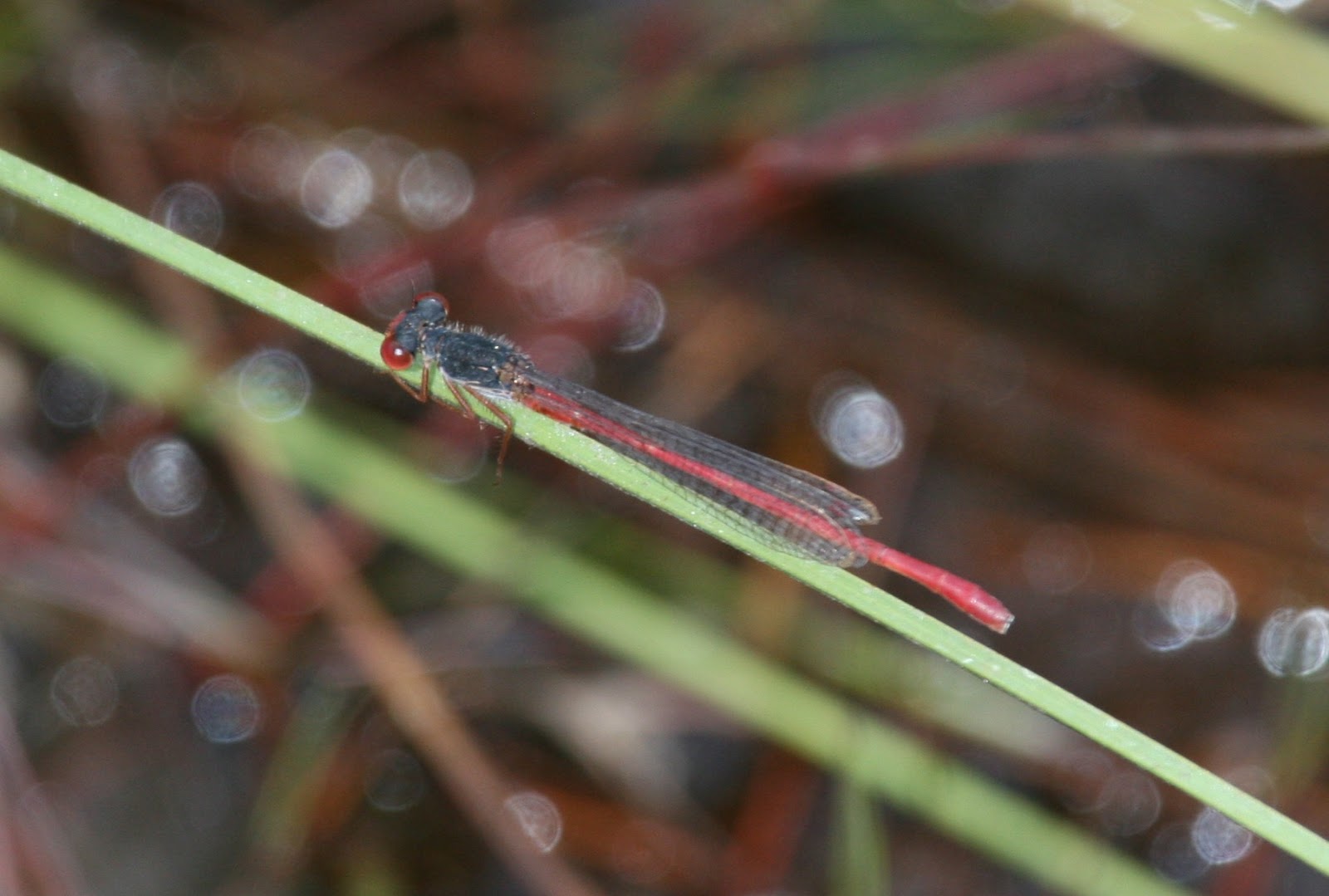
We got lucky with Small Red Damselfly as a couple fluttered briefly whilst we were watching a Black Darter. Wow, they are really small! Very hard to see when not flying as they look like bits of grass.


On to Oaken Wood. Not the visual feast of White Admirals we had experienced on our previous visit,  still lots to go at.

We saw a Blue which was so small, wings literally the size of a little-finger nail, we were left stumped as to what it is. Reviewing the photos, I think it is just a very small Common Blue. Perhaps the drought has resulted in smaller butterflies in the second brood?


The star butterfly was undoubtedly the Wood White, of which we saw six. David picked out the first (and most of the others), males just permanently flying a couple of feet off the ground. Such a small and dainty butterfly with those tear-drop wings! Photographing these on a plant was obviously impossible so I was reduced to trailing around trying to get a flight shot. The one below is the best of the bunch and shows the pale spot on the upper fore-wing.


David found a (presumably) female settled on a thistle and quietly fed, so an opportunity to get the macro lens doing the job it was designed for.


There is something very therapeutic about looking for insects. You are in their hands, and if they decide not to appear, that is something you just have to accept. In contrast to some aspects of birding, the slow pace and careful looking required for looking for insects is quite calming. I guess its almost over for this year but am looking forward to next year already.

Tuesday, August 07, 2018

Rye Meads

Dipping reached new heights at Rye Meads this morning. Not only were there no birds to be seen, but I missed the Willow Emeralds and Wasp Spider, despite there now being a big sign saying "Wasp Spiders are right here!" Nevertheless, got into pleasant conversation with a fellow birder and saw a few insects so a worthwhile and enjoyable outing. The best of the photos here.

Male Migrant Hawker. Lots of these here today along with Southern Hawker.
I think this is Green-Veined White?
lots of Blue-tailed Damselflies out day.
Female Common Blue

Saturday, August 04, 2018

Relaxing at Oare Marshes

A free day. Oare marshes has been on a good run, so with high tide at half 4 I set off in good time to navigate the many road works and arrived at 2pm ish to find I (almost) had the place to myself.

The Red-Necked Phalarope was soon pointed out by the one other birder. A study in sepia and white, it really is tiny. Soon the air was filled with a cacophony of wader yelping and two flocks of Whimbrel both numbering about 20 appeared and flew away. Whimbrel were to be present throughout the day in small numbers, with one further flock of 10.

Further scanning yielded about 50 Golden Plover, lots of Lapwing, 3 Snipe, a number of Avocets, a dense flock of 150 Redshank (plenty of plumage variation giving challenges for the unwary - I think I saw 5 Wood Sandpipers and a Tatler today), and a large flock of Black-Tailed Godwit which slowly increased to around 1000 birds. Searching produced a few Ruff, and on the edge of a spit a mixture of Turnstones, summer plumage Red Knot and some Dunlin and running around with the Dunlin a Little Stint.

At this time a flock of Common Tern descended from toward the estuary. I eventually counted 123. These birds were with us for several hours until as the tide fell they began to disappear. About 10% were juveniles. The rest full summer plumage adults. These were quite the spectacle and a highlight of the day,

I walked round to the hide on the southern edge and from there was a winter-plumage Spotted Redshank and I was shown two sparkling summer plumage Curlew Sandpipers.

On returning I stopped to look at the dragonflies in the ditch and it soon became clear that the larger ones were Southern Migrant Hawkers. I saw about four. The clinching evidence was the fact that the grass round the path was trampled flat so clearly a lot of photographers had been here.

Back for another sit and view; I couldn't find the Bonapartes Gull, but did find a consolation Mediterranean Gull, a Little Ringed Plover, a couple of Ringed Plovers and a distant Greenshank. 

So quite a spectacular day. The birds were a bit far for my camera skills, but just to show that the last set of photos was a fluke here's a few from today.

some of the Common Terns on the ground ..

... and leaving back into the estuary


I think the club-shaped abdomen makes this a Ruddy Darter

an 'action shot' is all I could manage of the SMH.


Wednesday, July 18, 2018

Therfield Heath again

A gap between appointments in Hertford ... so Therfield Heath again.

I'd not seen Chalkhill Blues before. What a butterfly! Some of them have the most intense azure next to the body, but the rest of them are beautiful sculptures of pale blue with brown surrounds. There were quite a few too by the path from the car park across the road and up to the mounds. I would estimate 50-100.


Also Dark Green Fritillary. I got my first decent view, and very nice it is too. Almost a black-and-white effect on the wing edges. There has been a record reported from Hatfield Forest so I need to do some careful studying here.


Otherwise, a Knapweed Broomrape (no photo) and a Skylark.


Friday, July 06, 2018

In Search of His Majesty

Purple Emperors are doing well all over, and our local stronghold Hatfield Forest has had up to 9 seen there. I've been there on a few occasions to see them and so far ... nothing.

It may be that I've been there mid morning and its been too hot, or it may be that I'm just not very good at finding butterflies that fly round the top of tall trees.

I met a helpful chap who told me where to find them in an Oak along the main plain, and that there are White-Letter Hairstreaks in Elms along the edge of the plain. Needless to say I didn't see them either.

Despite this, I'm quite enjoying the cool of some of the rides, and there are tens, possibly hundreds of Silver Washed Fritillaries. Here's a few photos of some other insects.

female SWF. Noticeably smaller than the males.
Purple Hairstreak - common round oaks. This was the closest I could get.
 Ringlet, Meadow Brown, a few Marbled Whites and various other whites and skippers.

There were a few dragonflies too. Brown Hawkers and the usual small blue damselfly things, and these.

Southern Hawker in one of the more shaded rides 
a skimmer? not near water so a bit confused on this one.
I refound the colony of White-Legged Damselflies pretty much in the same place I last had them. Noticeably paler, seemingly slightly slower in flight and a tad longer than the more common damselflies.


Saturday, June 30, 2018

The Importance of Parking

What makes for a successful day out? After yesterday's trip with David round the insect hotspots of Essex, I'd say Parking.

First stop was Langdon Hills, a large area of woods and meadows with a number of recent records of butterflies of interest. I had pre-selected an excellent place for parking for this venue - or so I thought - the Essex Wildlife Trust Langdon Visitor Centre. We had excellent parking close to the centre, and then found out that the areas of interest were a forty minute walk away. We relocated a bit nearer and wandered off to investigate, but long story short we had lots of glimpses of butterflies and dragonflies in the meadows but never made it to Marks Hill for the Purple Emperors.

We cut our losses and headed to Canvey Island for the dragonflies. We had some excellent parking at West Canvey RSPB and saw what was probably a Southern Migrant Hawker, but after walking around had only Common Darters, Black-tailed Skimmers, 4 Black-Tailed Godwits and a Lesser Whitethroat. We headed off to the mecca of Douthern British odonata, a ditch opposite the domestic waste centre on the Benfleet Road.

There was a pull-in by a gate with a few cars but no spaces, so we spent a while driving round and eventually parked in the public car park behind Benfleet Station. Having navigated the administration involved in paying for three hours rather than the whole day, (short-stay bays, yellow button) we then walked back through the mediterranean heat to the ditch to find some mediterranean dragons. In the comparatively brief time we had left we managed to find a few dragons, and even managed to take photographs of them. David, our official photographer, will have better, (and anyone looking for odonata photography excellence will of course look at Marc Heath's wonderful site),  but here are my efforts including some "atmospheric" (i.e. out of focus) shots.  I am informed these are Southern Migrant Hawker, Scarce Emerald, and Southern Emerald. If I go to my guide book published a mere 21 years ago, it has the Scarce Emerald in it, mentions the Southern Migrant Hawker with one picture, and doesn't mention the Scarce Emerald. 

Southern Migrant Hawker in flight

mating Scarce Emerald. The reason I know these are Scarce Emeralds and not Emeralds is because a bloke at the top of the ditch said "there's lots of Scarce Emeralds down there mate."

Southern Emerald
Southern Emerald close-up

Thursday, June 21, 2018

Summer on the patch


Spring has been and gone with hardly a migrant to mark it. We are into summer now and everything is settled, although I could do with the Garden Warbler that sings in the impenetrable forest to show itself so I can get it properly on the list, and for a local Hobby to appear at some point.

Today there was Common Tern fishing along the river, Grey Wagtails at the lock, and some Swifts and House Martins overhead. The Marbled Whites have emerged in decent numbers, and I added Large Red Damselfly to the patch list - long overdue.


Goodbye ... and Hello

It's been a while. It's tested the patience of the most dedicated reader. As he told me on a number of occasions. So I've decide...