To Minsmere with David. A windy and cloudy day after yesterdays sunshine. Nothing too much of significance; Bittern from the Bittern hide, the usual Marsh Harriers at Island Mere and just a fly-through Hobby for variety. Spotted Redshank at East Hide the pick of the waders, Kittiwake and fly-over Fulmar at South scrape, a few Mediterranean Gulls, a Greenshank on North Levels, another flying Bittern from West hide, a pair of Stone Curlews as we left the reserve and then a trudge round Dunwich had just one sighting of Dartford Warbler. An average visit.
Lets replay that as it doesn't seem to do justice to the variety of birdlife on show. The Bittern flew close to and slowly past Bittern hide and landed in the reeds, so as good a view as I've had in the last couple of years. There was a constant stream of birds crossing the levels with flocks of Black-Tailed Godwits, Shovelers, and a few Little Egrets. From Island Mere hide at least 4 Marsh Harriers, some coming quite close, and the Hobby gave an exhibition of hunting as it did a fast-pace circuit of the hide. East Scrape was a mass of bird-life, with Mediterranean Gulls everywhere; a male Pintail, an intriguing Knot in a strange brown-and-white plumage, and Spotted Redshanks in glorious summer plumage giving views as good as I can remember. South scrape was a mass of birds again with 300 Black-Tailed Godwits huddled together, sparkling summer plumage Grey Plover and Turnstone, and an unexpected flock of about 30 Kittiwakes. The beach was pretty empty apart from a fly-over Fulmar. Good views of the Greenshank and then another close-up of a fly-by Bittern. On departing, an RSPB ranger told us where to park to see one of the pairs of Stone Curlews in the area which we duly saw, if rather distantly. We then walked round Dunwich Heath, heard a distant female Tawny Owl, and then had excellent views of Dartford Warbler in heather, and then with a young bird. So all in all, an excellent day's birding at Minsmere.
Showing posts with label Mediterranean Gull. Show all posts
Showing posts with label Mediterranean Gull. Show all posts
Thursday, June 21, 2018


Sunday, July 31, 2016
Local Med Gull.
Gull flocks on freshly ploughed fields are always worth a look at this time of year. Several hundred gulls had gathered adjacent to the main Sawbo-Stortford A road so I went through them from a safe distance. They are always on the move as the tractor goes to and fro, and this lot spent quite a time over the horizon, all of which is just an excuse for saying I might have missed quite a lot.
Hundreds of Black-headed Gulls, lots of Lesser Black-Backed Gulls, low tens of Herring Gulls including a couple that generously dangled their legs in flight showing them to be Yellow-Legged Gulls. about 10 Common Gulls and one juvenile Mediterranean Gull.
Local birder Alan has some fantastic shots of juvenile Med Gull from Rye Meads on his blog. This may have been the same bird. My photos are inevitably nowhere near as good, but I like to think give a flavour of the reality of scanning through a distant flock. It is in focus - honest. It's just the heat haze giving it that blurred look.
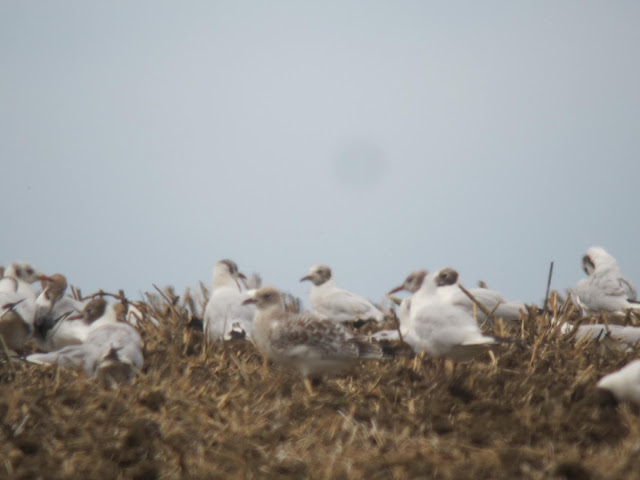
Hundreds of Black-headed Gulls, lots of Lesser Black-Backed Gulls, low tens of Herring Gulls including a couple that generously dangled their legs in flight showing them to be Yellow-Legged Gulls. about 10 Common Gulls and one juvenile Mediterranean Gull.
Local birder Alan has some fantastic shots of juvenile Med Gull from Rye Meads on his blog. This may have been the same bird. My photos are inevitably nowhere near as good, but I like to think give a flavour of the reality of scanning through a distant flock. It is in focus - honest. It's just the heat haze giving it that blurred look.

Sunday, August 09, 2015
Local early August
the extra time has paid dividends. Not just in more time in the field, but a more relaxed approach, more time to stop and observe, not just tick and move on.
In reverse order ... I returned to the house after a walk in Pishiobury Park to find this on the buddleia

Its a Jersey Tiger, which I believe is spreading out of its South London stronghold, and with a 2011 record for Herts being the first for a while this is still a good find, but should be less scarce in a few years.
I had just returned from a leisurely stroll round Pishiobury Park. It was hot, mid afternoon, and windy, so anything with wings was staying put. It was a day of missed opportunities; a large orange butterfly shot past, too big for a comma. Silver Washed Fritillary? I hung round to try for another glimpse, but it had gone. And then a falcon between the trees. Small, direct, surely a Hobby? But it moved on out of site without a clinching view.
The definate items were predictable. Butterflies - a large number (18) of large whites, a small number (1) of small coppers, 4 "blues", Ringlet, many Gatekeepers, some Speckled Woods and a Red Admiral. There were some bees, a surprising number of queens - what are they doing out now?


Magpie was the commonest bird, but there was a Willow Chiff, two Kestrels, and three Common Buzzards talon grappling.There was also these, doing what they do best.
Earlier in the morning I had popped into Pincey Brook on my way top Stortford. Back in the spring there was some decent mud, and I had birds such as Wood Sandpiper, 200 Golden Plover, Shelduck, and Little Egret, quite an impressive list for a flooded inland brook. My heart sank when I saw the field was heavily flooded and the mud gone, but I my worries disappeared when a Creamcrown (prob juv) Marsh Harrier rose from the flood and quartered the area, even diving toward the ground at one stage. A Red Kite appeared and the Harrier flew off toward a neighbouring field, but in its brief time airborne it had put up c50 Lapwing, 2 Teal, and caused some consternation amongst the c40 Greylag Geese.
Yesterday was Rye Meads, an RSPB that has benefited from some recent effort to atrract intersting birds. There were 2 Green Sandpipers at thge Draper Hide, and at the Gadwall Hide a local had identified a juvenile Meditrerranean Gull amongst the 50-100 Black Headed Gulls. He offered to direct me but I took the challenge and ended up finding 2. Here is a very poor shot of one of them. It's the one on the right. Clearly.

In reverse order ... I returned to the house after a walk in Pishiobury Park to find this on the buddleia

Its a Jersey Tiger, which I believe is spreading out of its South London stronghold, and with a 2011 record for Herts being the first for a while this is still a good find, but should be less scarce in a few years.
I had just returned from a leisurely stroll round Pishiobury Park. It was hot, mid afternoon, and windy, so anything with wings was staying put. It was a day of missed opportunities; a large orange butterfly shot past, too big for a comma. Silver Washed Fritillary? I hung round to try for another glimpse, but it had gone. And then a falcon between the trees. Small, direct, surely a Hobby? But it moved on out of site without a clinching view.
The definate items were predictable. Butterflies - a large number (18) of large whites, a small number (1) of small coppers, 4 "blues", Ringlet, many Gatekeepers, some Speckled Woods and a Red Admiral. There were some bees, a surprising number of queens - what are they doing out now?


Magpie was the commonest bird, but there was a Willow Chiff, two Kestrels, and three Common Buzzards talon grappling.There was also these, doing what they do best.
 |
| Born to munch ... |
Yesterday was Rye Meads, an RSPB that has benefited from some recent effort to atrract intersting birds. There were 2 Green Sandpipers at thge Draper Hide, and at the Gadwall Hide a local had identified a juvenile Meditrerranean Gull amongst the 50-100 Black Headed Gulls. He offered to direct me but I took the challenge and ended up finding 2. Here is a very poor shot of one of them. It's the one on the right. Clearly.

Subscribe to:
Comments (Atom)
-
We are fortunate in the UK in that the commonest orchids are also amongst the most beautiful. I spent a morning photographing some on the lo...
-
 The last ice age ended around 11,000 years ago. The temperature rose by several degrees over a period of around a thousand years to produce ...
