Showing posts with label Dragonflies. Show all posts

Wednesday, May 22, 2024

Great Reed Warbler at RSPB Ouse Fen

We had pencilled in Tuesday for Minsmere, but with cloud and then rain on the schedule and a trio of notable birds the other side of Cambridge we had a change of plan, so just before 9 we pulled into the car park at RSPB Ouse Fen for our first visit with Great Reed Warbler the target.

It wasn't long before we were at the mound listening to what sounded like an old diesel car slowly getting started. Finding it was another matter, but David got us onto it near the top of a reed and we had a good half hour or so of fantastic views. I'd seen one many years ago, but not like this. I even managed some photos down my scope. The views were so good this wasn't just a matter of getting it on a list, it also crossed it off a list. I'm not going to get views like that again unless someone puts a bird in my hand. It's unlikely I'd go for another one unless it was very near or there was something else on the day. What would be the point?


We carried on round the reserve. It's an excellent place and we resolved to come back, not imagining that our second trip would be the same day. Nevertheless we got great views of Cuckoo, Bearded Tit, Marsh Harrier, Great White and Little Egrets, heard several Bitterns booming, and lots of other fenland stuff too. We gave a large pit by the entrance a quick going over but saw only Redshanks and Oystercatchers.

Odonata started to come out and Mike identified many of the blue damselflies as Variable Damselflies. Mike explained the key is the segment just behind the head S2. On a Variable it has a U shape with a couple of blue spots each side but it is variable. You can see that on the photo below;  also shown is an Azure from a later visit on the day with a very different S2 with a narrow black line.


But back to that Great Reed Warbler. Two things strike me.

Firstly, hands up everyone who has seen a male GRW in the UK? That's both most of you I would think. Now hands up who has seen a female GRW in the UK? That's none of you I would guess. There's an obvious reason - most GRWs are picked up on song. But does that mean that at this moment there's a few females going unseen in reed beds? How do we know they aren't breeding somewhere? That a singing male doesn't manage to attract a female and breed? Or can females give a song too when they need to?

Secondly, why is there a GRW at all? Birds in reedbeds all seem to be the same size; the many varieties of acrocephalus warbler, bearded tits, reed buntings, all the same size. I assumed because reeds can only sustain birds or bird nests of a certain size. But then there's a bird the size of a song thrush that lives in reeds. So why aren't there lots of birds the size of song thrushes that live in reeds? Or is that why they don't breed in Britain - because we don't have the right reeds to support a nest?

GRW was only the first item on our list. Would we be as fortunate with the others? You'll have to wait for the next instalment.


Thursday, July 02, 2020

Canvey Island Jewels

June/July crossover, wind and clouds. What a rubbish combination. Nevertheless Mike and I decided to have a go at that ditch at Canvey.

There was limited variety - no sign of any Southern Migrant Hawkers, but we had 100+ Ruddy Darters, and a few Emeralds to brighten up the day.

I took my trusty macro lens to help with the id, although Mike was on the case so we had no issues there. Just one small problem - my iMac has become almost completely useless since I casually and naively clicked on Yes to install the Catalina operating system. However I managed today by judicious Googling to find out how to load photos, so here goes.

First up is local speciality the Southern Emerald. Just look at those bicoloured pterostigma! And on further inspection, yellowish behind the eyes, smooth flank with no mark. Very pleased to have come across this one again.


There were plenty of Scarce Emeralds too - some really nice males. This one had me confused as it have white edges to the pterostimga but I think this is Scarce not Southern as the other features seem to be Scarce - no yellow behind eyes, slight tick mark on the side of the body.

We thought we'd finish off with a visit to Blue House Farm at North Fambridge, but the car park was closed and the alternative parking arrangements were lacking, so that was it. Short, but productive.

Tuesday, June 23, 2020

Spending Time at His Majesty's Pleasure - Knepp Estate, 23rd June

For those interested in natural history, a visit to Knepp Estate is becoming essential. The story of the Knepp Estate, not far from Gatwick airport, moving from an intensive farm largely devoid of wildlife to a livestock farm offering a haven for all wildlife is well known and is described in detail in the Excellent book 'Wilding' written by landowner and farmer Isabella Tree.

But there's nothing like seeing it for yourself. Still not able to go birding with others I drove down to Knepp, and was delighted when completely by coincidence Mike pulled in next to me. What are the chances of that randomly happening?

We parked at the temporary car park opposite the entrance to the farm (£5) and were given a map (see here) Walked down to the farm and then the fun started. We took the white path round to the SW corner where the UK's first nesting White Storks for years were present in a large tree in a field. Two good size young and an adult on a neighbouring branch and a good crowd. As we walked on we saw a flock of 12 Storks in the air, an amazing spectacle for the UK. We walked on up toward the west side where the white and purple walks meet, and there spent a couple of hours watching Purple Emperors. We eventually settled on a total of 11 individuals, mainly flying round the tops of oaks and then perching. Once a lower trip gave us decent views. We didn't get any on the ground but were very happy with the views we had seeing these magnificent creatures establishing and protecting their territories.

If you are going, I would suggest going to where white path meets purple at the NW corner of the white walk, from there carry on a hundred meters clockwise until there is a branch off left in the path. Take this and you will see the path extending ahead with a long open strip, a mass of sallows on the left and oaks on the right. You can see it on the aerial photo on the map as a vertical strip. Walk up to where two dead trees have fallen over, and there look into the oaks.

The story is that these butterflies suddenly and unexpectedly appeared here. But to my eye, this is a massive area of perfect Emperor habitat. The many enormous oaks are decades old, and I suspect there were sallows here for a while, so my guess its the old story that they were there all the time, but unless someone who knows their stuff goes at the right time of year on the right day and looks in the right place at the right time, no-one sees them.

This general area gave us the best wildlife sightings. In addition to His Majesty we had Silver Washed Fritillary (two distantly), White Admiral (two close up), and a variety of other more common butterflies including many Marbled White. Best for me was a male Beautiful Demoiselle that settled on a bramble - a first for me. A stunning creature, all metallic blues. And a Turtle Dove singing unseen in the distance.

We headed back to the farm, with a few Storks feeding in a field, and then just by the farm stopped at a brook and saw Large Red Damselfly and Mike picked up a slightly odd blue damselfly in flight which when it settled was clearly a White-Legged Damselfly.

The farm-related wildlife is present too - Fallow Deer, Tamworth-like russet piglets, Horses, Cattle, but not everywhere.

All in we spent about 4 hours plus walking round. It is an impressive place, and quite big. Apparently a Red-Backed Shrike spent some weeks there a couple of years ago - well there could be several pairs there and you wouldn't know. The many Turtle Doves were well hidden and of the Nightingales there was unsurprisingly no sign. But nevertheless, it is a fascinating look into the natural environment, what it might have been in centuries past, and what it may become in the future.

Wednesday, May 27, 2020

Saved by Insects - Weeting on Bank Holiday

Travel relaxations implemented, so blew the dust off the scope and headed off to Weeting for some summer sun and birds. By sheer coincidence Mike was there too! I had a target list of Stone Curlew, Tree Pipit, Turtle Dove, and coincidentally so did Mike.

We knew the reserve would probably be closed, and it was. We had hoped Stone Curlews would be in the field opposite but they weren't, or at least not visible to us. I assume we were a bit early, in that the Stone Curlews are probably still happily raising chicks on the reserve, blissfully unaware they are not raising young birds to fly back to wherever next year, but simply spending all their time and energy making a snack for Mr Fox. Soon the inevitable will happen and the birds will spend the rest of the summer in the field over the road rooted to the spot in a state of catatonic existential misery. 

We got Cuckoo, Lapwing, Curlew, and loads of Rooks, but nothing else. We then headed up the path in the woods north, and soon had a dragonfly. Clearly a Chaser, I went through my mental check list - four spots on the wings? No. Broad depressed body? No. Well I guess that just leaves Scarce Chaser. Fortunately Mike was on the case and was soon confirming that wow yes that absolutely was a Scarce Chaser! Long story short there were quite a few, over 10 in total across the woods. We did get some great views of those chevrons down the spine and the clear yellow flush at the base of the wings. I even saw one 'breathing' in that the two halves of its abdomen rhythmically slightly separated. No idea what that was about. (From twitter it seems Monday was the day when lots emerged).

A little further on we saw our first Green Hairstreak. We went on to see a further ten or so, with some nice views of closed wings on broom. Another first for the year. Smashing butterflies.

We walked over to Hockwold Heath which looked splendid but in the heat the birds were hard to come by. We had a nice pair of Stonechats and more Curlew, and were pretty sure we heard a Stone Curlew but couldn't see one. 

We walked back with Mike picking out some Roe Deer hiding on the wood - very hard to see - to complete an excellent list despite not having seen any of our target birds.

We though we would try Santon Warren, and to our surprise found that whereas in March you more or less have the place to yourself apart form a handful of birders, on a May bank holiday it is heaving.  We parked (luckily just two spaces), dodged the picnics, walked out our usual walk west and found a Tree Pipit immediately flying up and doing its song flight. Hard to come by now in the south we were very pleased. That was just about the last decent bird we saw, but we to a Broad-bodied Chaser perching nicely, showing us the clear difference in shape to Scarce, and a nice row of yellow flank spots. Then on the way back a Light Emerald Moth, which I think is quite common but was nevertheless a nice surprise for us.

So, that was it. Great to be out and seeing nature in full flow across many different classes. Birding is back!

Wednesday, July 17, 2019

In search of dragons

A couple of local trips: Firstly to Canvey Island, where we spent time in a ditch. You know the one.

Male Blue-Eyed Hawkers (normally Southern Migrant Hawkers, but I like the new name) were regularly spaced. Mainly in flight, but one did perch up. This is heavily cropped etc etc but those eyes ...


Lots of Scarce Emeralds. Mainly deep in the ditch vegetation but one kindly flew up to be photographed.


Then onto Hatfield Forest in each of Emperors. I was too late in the day, but a few compensations. Our local White-legged Damselfly population still going. The width of those eyes makes it look like a mini hammer-head shark. 


black legs ... going for Ruddy Darter here.

Thursday, July 11, 2019

On the trail of the Red-Veined Darter.

With lots of people seeing Red-Veined Darters it seemed to be a good idea to visit Stansted Airport Lagoons, a traditional site for this species in invasion years and a top spot for local odonata, so when Mike gave me a call it was a no brainer to join him to try and find what for me would be a lifer.

We got to the lagoons, now carefully manicured to remove practically all vegetation, and started the search. It was all quiet until we got to the corner out of the wind in the NW when the mayhem started.

Several Emperors, lots of Black-Tailed Skimmer, a few four-Spotted Chasers and two Broad-bodied chasers. Lots off azure/common, a few blue tailed, and a couple of large-red-eyed damselflies, were all whizzing around in the corner, and in the midst of these several bright red darters. We spent a while looking at these, but it was hard. They were territorial on the edge of the water, but were constantly chasing away larger dragons so getting a good view was difficult. One alighted on the grass with better views, but it didn't have much red in the wings - was it a Common Darter? I got a few shots of a few of them, got excited by some reddish on the wings and list fever was beginning to set in. Mike was as always the voice of calmness and sense so we carefully looked for the evidence, but much was dependent on the quality of my photos, taken with a long lens hand-held. Regular readers could be forgiven for having some scepticism as to the outcome at this point.

It was evident as soon as I downloaded them and checked the photos against my new copy of Dijkstra that we had the Darter! here's some photos. they show the key features, a reddish hue at the base of the wings, pale pterostigma, and on a couple a blue colour to the lower eyes. Fantastic! And that bright red colour will remain in my memory for a while.


the first photo I looked at .... the red in the wings, and the pale pterostigma are really noticeable.
blue colour of the lower eyes here
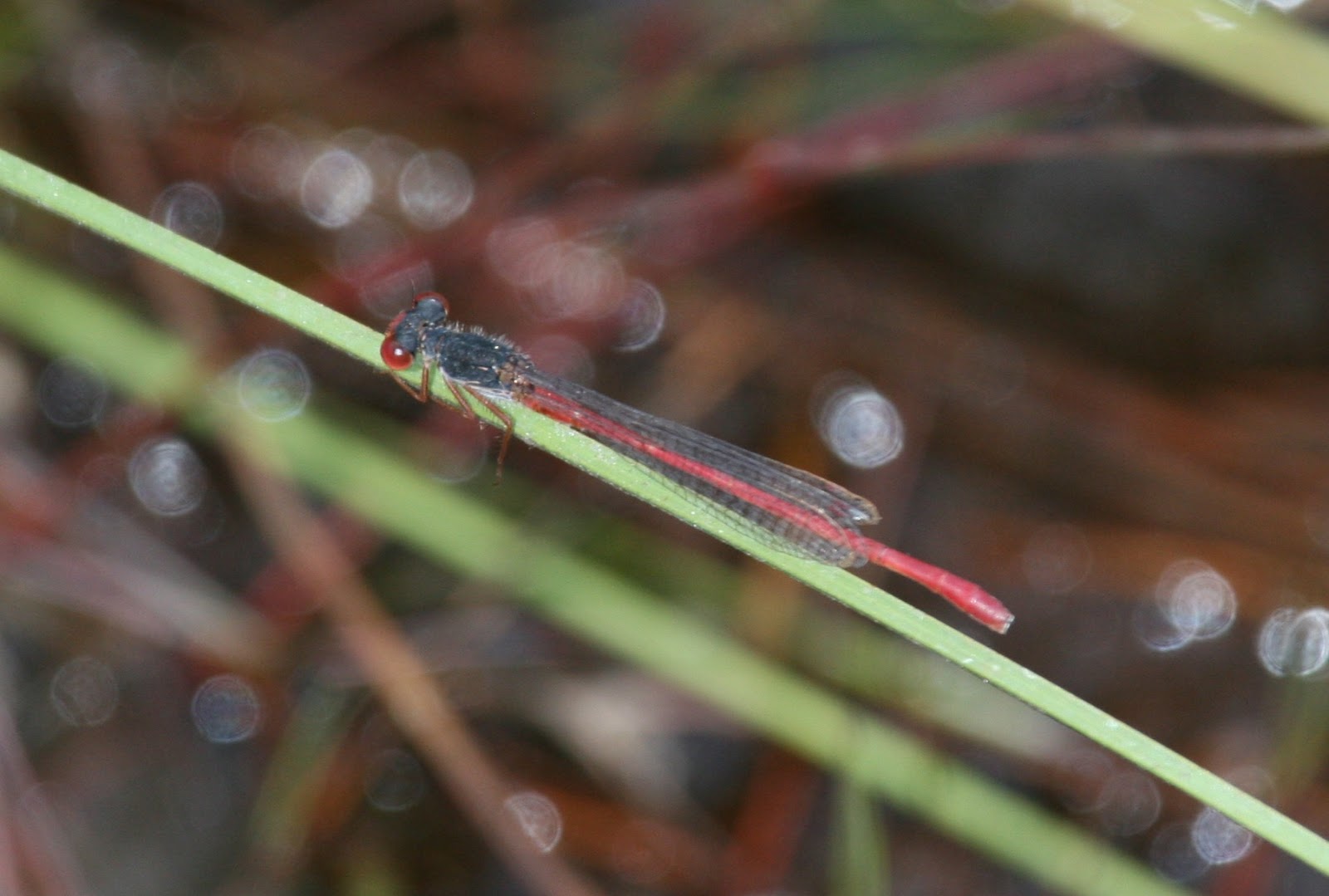
we wondered about this as it had very little red in the wings, but pale pterostigma and blue lower eyes seal the id of this one too.
Overall there were about five darters of red colour of which we are happy with the identification of three as red-veined.

Whilst all this was happening a Banded Demoiselle flew by and we saw a couple of Small Red-Eyed Damselflies on some vegetation. A Common Tern spent some time, and also 15 Lapwings, Tufted Duck, Little Grebe and a family of Greylag Geese. We had several Marbled Whites on the fields, as well as Ringlet , Essex and Small Skipper, Small Heath, Meadow Browns, a couple of feeding huddles of mainly Large whites but also small and green-veined whites, a Small tortoiseshell and as no list is currently complete without a Painted Lady we had one of those, and also two forms of Latticed Heath Moths

Literally, a red-letter day.

Sunday, July 07, 2019

Three go Mad in Suffolk

Minsmere in mid summer. No better place to be. Back in the depths of winter we had promised ourselves this trip with a particular purpose in mind, and weather and opportunity was just right so Mike David and I set off on another magical mystery tour.

Arrived just after 11, straight down to the dragonfly pool where we duly got the first few of many Norfolk Hawkers, a couple of early Willow Emeralds, and Broad Bodied and Four-Spotted Chasers. Then on to digger alley, and Bee Wolfs and Pantaloon Bees. I assume these are not particularly scarce, and I know digger wasps occur in all sorts of paces, but the good folk of the RSPB have got information boards here so it makes appreciating the creatures so much easier.


Then onto the North Wall, and following reading the RSPB blog, we looked for and found Six-Banded Clearwing. a small digger-wasp-like moth. As the blog said, you had to get your eye in, and realise that the small yellow-and-black thing flying around was not a wasp. The method of flying was distinctive, and  when it settled the moth-nature was apparent. There are some great photo's here, and here's mine which is crummy but is mine. Next time I find a mass of birds-foot trefoil I'll know what to look for.


A Bittern flew over, then from the scrape hides 6 Spotted Redshank, 3 Green Sandpipers, 2 moulting male ruff, 6 Little Gulls, and a few Little Terns, Avocets, Mediterranean Gulls, 2 Stonechat families then back to the centre with a Marsh Harrier on the way, and lunch.

Six-Spotted Burnet moth 
Then the woodland walk. An early quiet and shaded walk, we had 6 White Admirals, 2 Silver Washed Fritillaries, 3 Purple Hairstreak, lots of Norfolk Hawkers and Ruddy Darters, Ringlets, and a pair of Marsh Tits.

White Admiral. The best I could do was from this side.
Despite an excellent list across all wildlife classes, we weren't finished. Our two main objectives were yet to come. I enquired in the centre where we might see these, and a very helpful ranger got a large scale map, and marked two areas with a pen. We went to the first, Westleton Common. I thought the late hour may be against us, but soon David was frantically waving, and on coming over we saw he had some Silver-Studded Blues. The underwings were much in evidence, and a tatty male with lead-blue and brown upper wing was showing. (for better photos see David's blog) Also amongst the heather was a large Queen bee. It was huge, over an inch long. It clambered slowly round the heather as if it had all the time in the world, which in a sense it had, its life cycle being the epitome of free-riding. The shiny back, and yellow fur edgings on the tail indicted cuckoo bee, and I assume, as it is the commonest in my area, Vestal Cuckoo Bee.


an absolute unit. Presumed Queen Vestal cuckoo Bee
After a visit to the Eel's Foot at Eastbridge for an excellent meal, we went to our last venue,  Westleton Heath for much hoped-for Nightjar, my previous experience being of just one brief view many years ago. We waited for a while, and at 8:50pm churring commenced, and then a repeated frog-like call. Mike, with more experience than I, called this as the flight call, and after a frantic scan we managed to locate one flying round the area and into a group of trees - result! But then more calls, and the bird came back, flew just a few yards from us, and settled on a branch about 30 yards away where it started to churr! We got the scope on it and even though it was now 9:30ish, still got excellent scope-filling views of the bird churring. It didn't seem possible to fit those elegant long wings and tail so evident in flight into the compact log-like apparition sitting on the branch. What a fantastic sight, and I now realise why so many birders are fanatical about Nightjars!

There was lots of other wild-life around too. We saw 10 Red Deer - mainly young but some large hinds, move slowly through, a Hobby flew over, a Dartford Warbler sang unseen, and we could hear the weird calls of Stone Curlews in the distance, and then David called one flying over. As a magical hour drew to a close we walked back down to set off on the two hour journey back to Stortford.


Thursday, August 09, 2018

Insect hunting at Thursley Common and Oaken Wood

A day out with David hunting insects, a few weeks later than ideal. In retrospect, with searing heat on Tuesday and drizzle today, Wednesday was a serendipitous choice although when the breeze got up on Thursley it didn't feel like it.

It took a while for the dragons to appear, but when they did they were in number. Lots of Black Darter (new for me), Keeled Skimmer, Black-Tailed Skimmer, Emerald Damselfly, Common/Azure damselfly, Blue-Tailed Damselfly.


On a couple of occasions we noticed female Keeled Skimmers ovipositing and a male hovering just over; this seems to be a recognised part of their behaviour.

We got lucky with Small Red Damselfly as a couple fluttered briefly whilst we were watching a Black Darter. Wow, they are really small! Very hard to see when not flying as they look like bits of grass.


On to Oaken Wood. Not the visual feast of White Admirals we had experienced on our previous visit,  still lots to go at.

We saw a Blue which was so small, wings literally the size of a little-finger nail, we were left stumped as to what it is. Reviewing the photos, I think it is just a very small Common Blue. Perhaps the drought has resulted in smaller butterflies in the second brood?


The star butterfly was undoubtedly the Wood White, of which we saw six. David picked out the first (and most of the others), males just permanently flying a couple of feet off the ground. Such a small and dainty butterfly with those tear-drop wings! Photographing these on a plant was obviously impossible so I was reduced to trailing around trying to get a flight shot. The one below is the best of the bunch and shows the pale spot on the upper fore-wing.


David found a (presumably) female settled on a thistle and quietly fed, so an opportunity to get the macro lens doing the job it was designed for.


There is something very therapeutic about looking for insects. You are in their hands, and if they decide not to appear, that is something you just have to accept. In contrast to some aspects of birding, the slow pace and careful looking required for looking for insects is quite calming. I guess its almost over for this year but am looking forward to next year already.

Friday, July 06, 2018

In Search of His Majesty

Purple Emperors are doing well all over, and our local stronghold Hatfield Forest has had up to 9 seen there. I've been there on a few occasions to see them and so far ... nothing.

It may be that I've been there mid morning and its been too hot, or it may be that I'm just not very good at finding butterflies that fly round the top of tall trees.

I met a helpful chap who told me where to find them in an Oak along the main plain, and that there are White-Letter Hairstreaks in Elms along the edge of the plain. Needless to say I didn't see them either.

Despite this, I'm quite enjoying the cool of some of the rides, and there are tens, possibly hundreds of Silver Washed Fritillaries. Here's a few photos of some other insects.

female SWF. Noticeably smaller than the males.
Purple Hairstreak - common round oaks. This was the closest I could get.
 Ringlet, Meadow Brown, a few Marbled Whites and various other whites and skippers.

There were a few dragonflies too. Brown Hawkers and the usual small blue damselfly things, and these.

Southern Hawker in one of the more shaded rides 
a skimmer? not near water so a bit confused on this one.
I refound the colony of White-Legged Damselflies pretty much in the same place I last had them. Noticeably paler, seemingly slightly slower in flight and a tad longer than the more common damselflies.


Saturday, June 30, 2018

The Importance of Parking

What makes for a successful day out? After yesterday's trip with David round the insect hotspots of Essex, I'd say Parking.

First stop was Langdon Hills, a large area of woods and meadows with a number of recent records of butterflies of interest. I had pre-selected an excellent place for parking for this venue - or so I thought - the Essex Wildlife Trust Langdon Visitor Centre. We had excellent parking close to the centre, and then found out that the areas of interest were a forty minute walk away. We relocated a bit nearer and wandered off to investigate, but long story short we had lots of glimpses of butterflies and dragonflies in the meadows but never made it to Marks Hill for the Purple Emperors.

We cut our losses and headed to Canvey Island for the dragonflies. We had some excellent parking at West Canvey RSPB and saw what was probably a Southern Migrant Hawker, but after walking around had only Common Darters, Black-tailed Skimmers, 4 Black-Tailed Godwits and a Lesser Whitethroat. We headed off to the mecca of Douthern British odonata, a ditch opposite the domestic waste centre on the Benfleet Road.

There was a pull-in by a gate with a few cars but no spaces, so we spent a while driving round and eventually parked in the public car park behind Benfleet Station. Having navigated the administration involved in paying for three hours rather than the whole day, (short-stay bays, yellow button) we then walked back through the mediterranean heat to the ditch to find some mediterranean dragons. In the comparatively brief time we had left we managed to find a few dragons, and even managed to take photographs of them. David, our official photographer, will have better, (and anyone looking for odonata photography excellence will of course look at Marc Heath's wonderful site),  but here are my efforts including some "atmospheric" (i.e. out of focus) shots.  I am informed these are Southern Migrant Hawker, Scarce Emerald, and Southern Emerald. If I go to my guide book published a mere 21 years ago, it has the Scarce Emerald in it, mentions the Southern Migrant Hawker with one picture, and doesn't mention the Scarce Emerald. 

Southern Migrant Hawker in flight

mating Scarce Emerald. The reason I know these are Scarce Emeralds and not Emeralds is because a bloke at the top of the ditch said "there's lots of Scarce Emeralds down there mate."

Southern Emerald
Southern Emerald close-up

Thursday, July 13, 2017

July photos

A couple of trips. Firstly Rainham Marsh RSPB. Marsh Harrier and Bearded Tits notwithstanding, it was all about the insects. There were masses of workers on the Lavender in the car park and I think these were Brown-Banded Carder Bees, mainly because at least one of them was a carder bee with a brown band. Difficult to photograph in a suitable pose, I am nevertheless quite pleased with the art in these photos.


Then a few Shrill Carder Bees, an Emerald Damselfly in the Cordite area that I am told is a Willow Emerald, and some more common stuff - the Hornet Mimic Volucella Zonaria which I now see more often than I see Hornet.

Shrill Carder Bee worker
Willow Emerald


Then with David today to Stansted Airport Lagoons for waders followed by another trip to Hatfield Forest to see Purple Emperors. Needless to say this did not go as planned. There was a lone Lapwing at a very full lagoons, but there were up to ten damselflies on algae pads on one of the lagoons. David was sure these were Small Red-eyed Damselflies and having looked at photos the step on the end of the abdomen does match the photos and is quite distinctively different from Red-Eyed. A flicker in the foliage turned out to be another Willow Emerald.  We left the lagoons quite happy with our haul and went to the Forest. We walked round the NW corner of Hatfield Forest finding little new in the way of Butterflies, and no sign of the Emperors but did see plenty of Ringlets and Gatekeepers sunning themselves. We paused from looking down long enough to see a Raven fly over which is a good record for the forest.

Willow emerald

Gatekeeper sunning itself
Finally a reminder that wildlife is exploding all over. David's eagle eyes spotted a freshly emerged Six-Spotted Burnet Moth. Quite fantastic it is too, with its damp wings still creased.

Goodbye ... and Hello

It's been a while. It's tested the patience of the most dedicated reader. As he told me on a number of occasions. So I've decide...