Thursday, June 01, 2023

In Kent with the Ladies (part 1)

To Kent to see orchids. If you have an interest in wildlife beyond just birds, then Orchids appear on your horizon, and then the reserves in Kent near Canterbury and their fantastic flora get mentioned, so it was very much an ambition to visit at the right time. 

We got excellent directions from Peter Alfrey's blog here and also consulted Orchid Hunter's video. These made all the difference and meant the day went smoothly. Thanks to both of those.

And what a day. First up Bonsai Bank in Denge Wood.

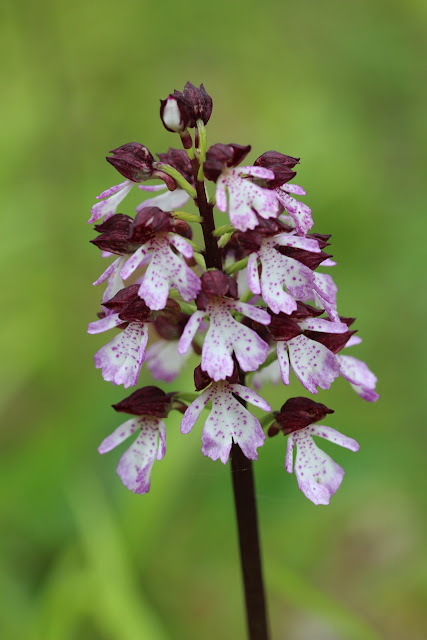
There were Lady Orchids well scattered in excellent condition throughout the bank. It is frankly weird and wonderfully bizarre to go into an English woodland and see flowers like this in this number. As if a stately home over the fence had accidentally seeded some exotic flowers. And in close-up the ladies in their bonnets are a real picture.


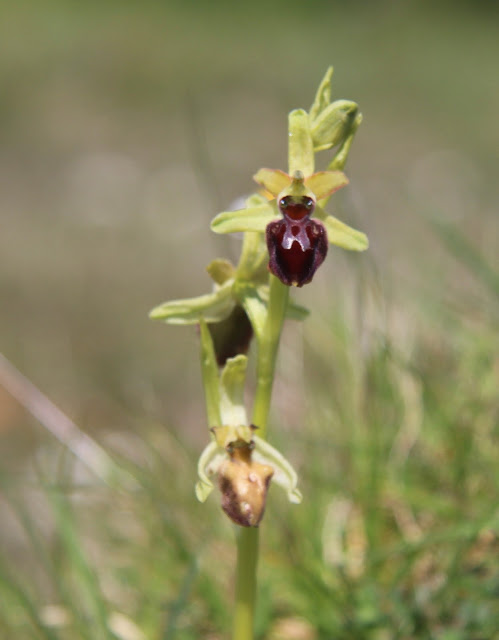
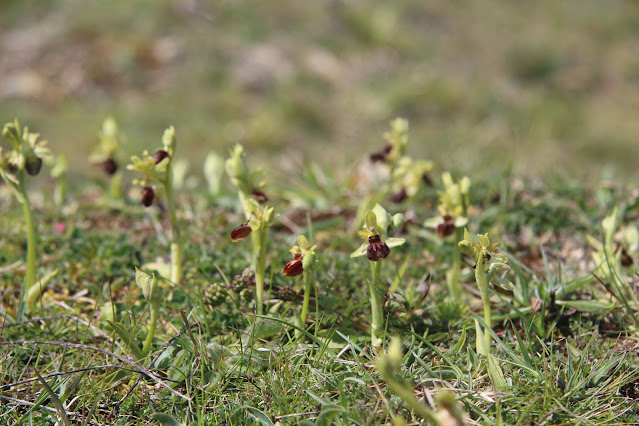
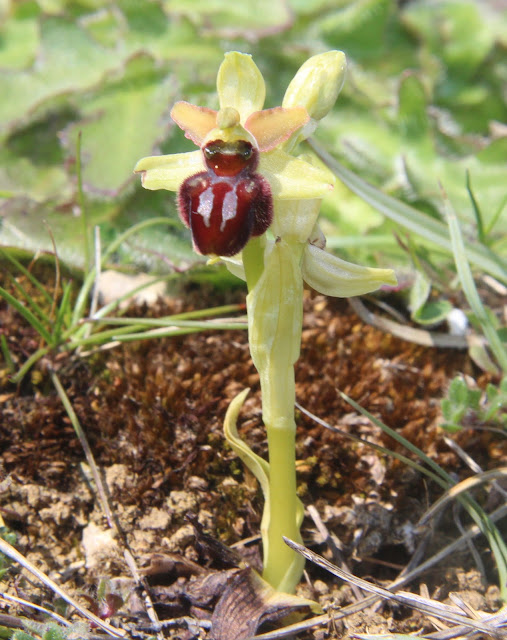
We had been hoping to see Fly Orchids and we were told of a couple of spikes just round to the left after entering. We saw those and more. Orchid Hunter (see above) says when you see a Fly Orchid get down and look carefully, and by following that advice we ended up with twenty spikes in clusters throughout the area. A cracking flower.


There was more to see, which I will reveal in a second post


Sunday, May 28, 2023

Year list. Bird 172. A lump of flint.

First trip this year to the Norfolk Coast, and with both Mike and David. Would we get a special bird for a special day?

First stop was North Point Pools to get our bearing and check Birdguides. Twenty Blackwits, Avocets, Redshank, Shelduck, a couple of Little Ringed Plovers and a Common Sandpiper. A wing-tagged Marsh Harrier and distantly a Cuckoo calling. A decent first stop. 

Titchwell seemed to be our best bet so we headed west. But first we stopped at Choseley Barns for the remaining Dotterel that had been reported that morning. We scanned with no luck but were saved when a birder found it sat down. We could just see a very peachy breast and a darker head but the heat haze made getting more detail difficult, but even in the heat haze I could see it turn its head.

With year tick 172 in the bag we went on to Titchwell. The three 1st year Little Gulls put on a decent display both on the ground and in flight. Our search for more birds was rudely interrupted by Mike who had found a Grey-Headed Wagtail on the bank. This bird had been seen yesterday but not so far today. We managed to get terrific views, even down to the gorget of dark feathers indicating its first year plumage. We managed to get a few others on to telescope views of this before it flew off over the reserve centre.

We got a few more birds - Mediterranean Gulls, Spoonbills, a couple of Little Terns on the tidal lagoon, Sanderlings on the beach, and then sat down on a bench by the reed bed; three old men on a day out, talking nonsense and pulling each others legs, and inbetween whiles we got first class views of Bearded Tit and Reed Warbler. So often birds ticked on sound not sight.

Just time to go back and check on the Dotterel. We decided that if it was still sat in the same place I would have to admit defeat. And there it was. Number 172. A lump of flint.


Phone scope pic of Grey Headed Wagtail

Thursday, May 04, 2023

Stellar Day at Frampton

We chose RSPB Frampton as our venue on the basis of a stellar list from the previous day. We arrived at a packed car park and saw the fantastic wader habitat that now stretches from the car park to the back of the reserve. We had two Wood Sandpipers on a small near-by pool before we'd even got out of the car, and went on to add a Spotted Redshank in dusky summer plumage, many Ruff, a pair of mating Little-Ringed Plovers (the first of five pairs on the reserve) and as we moved towards the centre added two Black-Winged Stilt in the corner. Frankly we could have gone home then more than happy. 

Down the path on the NW side we added Lesser Whitethroat singing, Cetti's and Sedge Warbler, then on the walk along the western edge we added Whimbrel, Common Sandpiper, a few Yellow Wagtails, many Whitethroats, along the sea-wall a few Mediterranean Gulls flying around, a line up of birders fruitlessly searching for the Blue-Winged Teal (see previous post), a few Pale-Bellied Brents amongst the thousand plus Dark-Bellied out on the marsh then along the road back to the centre we had about fifty Dunlin and a cracking Spoonbill feeding in a channel. 

Lunch then back for another go at the Teal which proved successful, and that was more or less our list for the day, but we had two further sightings of the kind that make birding a challenge not just wildlife tourism. The Temminck's Stint had been seen the previous day rom the road, and as we went through the Dunlin I picked up a likely candidate; nice pectoral band, spangly back, all white belly, and called a few people over as a likely. But on comparison with a Dunlin thats arrived it was the same size and had a longer curved bill than the Stint, so we had to write that one off as a Dunlin. 

Almost back at the centre and a large bumble bee appeared, a real whopper and all black. On checking this later it matches the black form of Bombus Ruderatus, the Large Garden or Ruderal Bee. I'm not going to claim it as I know from experience bees are tricky creatures and you have to get very good photos to be sure, but exciting to see this beast nevertheless. 

The lasting impression was not the list but the quantities. I haven't even mentioned the Shelduck, Shovelers, a few Wigeon, flocks of Black-Tailed Godwits, the many Avocets, the vast gull colony; the feeding Brents across the fields, and the 60+ Ruff, many males in splendid black and orange. One was so near even I could get some photos. Just imagine if these were taken by a decent photographer, or even someone with a basic knowledge of the settings


Wednesday, May 03, 2023

Birding Etiquette Fail at Frampton

RSPB Frampton Marsh. A stellar list of birds (more of that in the next post) was topped by Blue-Winged Teal. It had been seen early somewhere on the vast expanse of channels and ditches that is Marsh Farm Grassland but by early afternoon despite many people looking (including myself and Mike) there was no further sign. 

So it was with some excitement that, on encountering the chap who had re-found it, we walked to the knot of birders on the sea wall staring through scopes at the target bird. And it was with some horror that as we and others were making our way to this group we saw them pick up their tripods and head off. 

We managed to get the last one off to try and help us locate it, but on that plane where everything looks the same, and with our only references being cows which were all moving, we were left cluelessly back at square one scanning the ditches in the vain hope of somehow reconnecting with a bird that had evaded birders for the most part of the day.

I was furious, loudly quietly complaining to anyone unfortunate enough to be near me. To me, when a rare bird which is not co-operating is pinned down, you don't walk away until you pass the location on. Particularly when you yourself have been given the location by someone else.

This state of Meldrewesque grumpiness continued unabated until, by sheer chance, the target duck appeared swimming in a channel, whereupon I was deeply grateful to the departing birders for giving me the opportunity to experience the excitement and joy of rediscovering the bird. Even at this considerable distance it was a cracker, all white blaze and white thigh spot. It gave distant but reasonable views as it swam around, flapped once, and waddled around on the bank. And the biggest pay-off for me, never having seen one outside of a collection before, is that given its behaviour and circumstances the bird is clearly unequivocally 100% wild. Fantastic.

Tuesday, April 25, 2023

Durlston Deja Vue

Durlston. I've been here before, and I managed to persuade D#2 that it would be a great idea to stop off here again. 

This time I managed to sprint round before the rain came down snapping the key species. First off the Early Spider Orchids. I had forgotten how small they are (we've done this detour to see those?) and also how like Spiders they are. The numbers had improved since last time. 


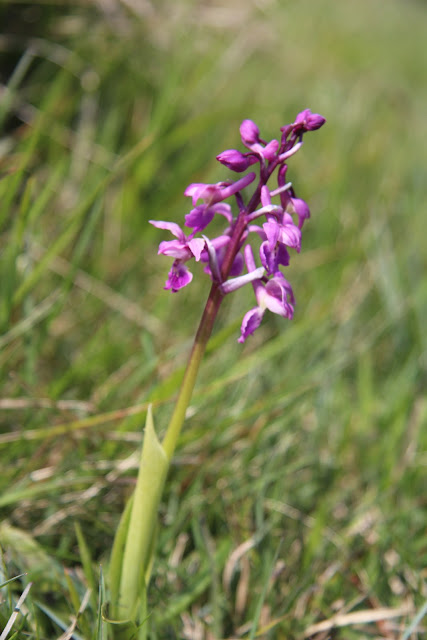
Early Purple Orchids were everywhere, but particularly on the lower slopes. they were approaching their peak but not quite there. 


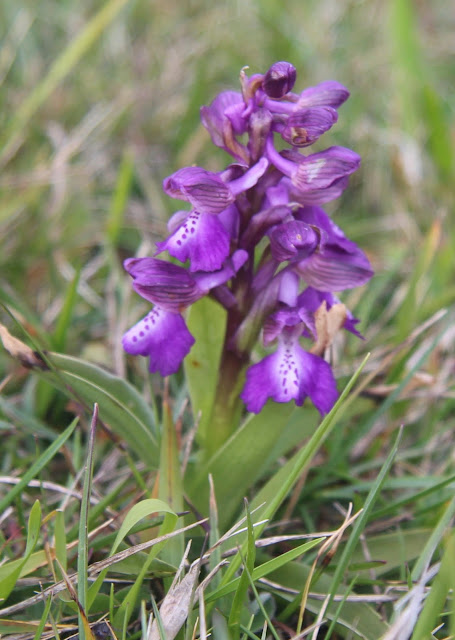
But of the third target species Green-Winged Orchid there was no sign. I made up for this by photographing some of the dumpier more solid looking Early Purples. 


and as you will have noticed, this is in fact a Green-Winged Orchid. Those big wings, whilst not being at all green, are fairly diagnostic.

The strange thing is this mistake is exactly what happened last time I was here. Clearly a lesson not learned.

Monday, April 24, 2023

On Chesil Beach

Sat high on the shingle. The sweep of the Jurassic coast stretching out all the way to East Devon , bookended on my left by the majestic cliffs of the Isle of Portland. Is there a better place to be? Back to where this blog started. 

My relationship with Weymouth is based round this being Mrs D's ancestral home. We were regular here for a while, then we weren't, and now I'm back for just one weekend only. Hence Saturday evening and I'm parked at Ferrybridge.

Wheatears all over the vegetation, Sandwich Tern, Bar Tailed Godwit, then that walk up the Chesil beach shingle ridge. Two steps up two steps down. I'd forgotten how hard that was. There was a birder on a seat with a scope so I went and imposed myself on him. More Sandwich Terns, Gannets, Guillemot. Strangely after ten minutes of interrogation about local stuff the other birder left and me and my bins were left by ourselves ... some dark geese came in from the west which local social media later informed me were Brent Geese, but in front was a flock of six birds slowly making their way east. Could have been skuas ... I'll never know. A Whimbrel flew past and then that was it.

Sunday morning I managed to grab a couple of hours at Portland. It was pretty quiet by recent standards, but back on the top I found several years of patch watching had slowed down my approach to birding, taking time to watch fields for movement, and I was pretty pleased with my haul of several Wheatears, female Redstart, Sedge Warbler, Yellow Wagtail, and a handful of Whitethroats and Blackcaps as well as Willow Warblers in every bush. Little Owl in its usual place and a Peregrine over completed the set. 

Great to be back, and fingers crossed there might be more such trips. But over too soon and D#2 and I were heading back to Hertfordshire with just one more location on our itinerary.

My Little Patch of Joy

I've had my foot off the pedal this year, and that includes the local patch. Just a few visits with Barn Owl and Lesser Redpoll the highlights. But with spring migration in full flow I thought it time to get out and walk the well worn path once again.

The walk was predictably quiet and I got to the limit with not much to show. I looked up the rough track towards the local B road and had my usual 'Why isn't there a Wheatear on this track?' thought when I noticed up at the far end a promising blob on an old concrete slab, and a few moments later I was a watching a male Wheatear from a comfortable distance. It's a common enough bird elsewhere in spring (see next post) but is a jewel of a bird in my landlocked area and I spent a happy half hour watching it flick around the patch.

I enjoyed it so much I went back next evening. The Wheatear had moved on, but the field was being ploughed and a scan showed c20 Lesser Black-Backed Gulls, no less then 5 Buzzards sat in the field and plenty of corvids. Then on the scan back two gulls flew in with solid black heads and vivid red legs and beaks and whahay 2 Mediterranean Gulls were flying around the field! One a full adult and one a near-adult with a couple of spots on the wing tips. I've had them on the patch twice before but not prolonged views in sunshine like this! A fantastic half hour was spent on this unexpected delight until they drifted high and north. A Treecreeper, Water Vole and Raven completed a spectacular patch list.

The always enjoyable and wise Steve Gale blogged about his local patch with the title Comparison is the Thief of Joy and he is as so often absolutely correct. The ability to enjoy what is in front of you and not think about what its in front of some other birder somewhere else is an essential mental capability for any inland local patch watcher. These two visits delivered the best of local patch watching.

Sunday, April 16, 2023

Windy day in the Brecks

We headed to the Brecks in cloudy weather conscious of incoming wind and rain in the afternoon. No time for hanging around.

First stop Lakenheath. The water levels were very high following heavy and persistent rain. I assume that in these conditions muddy margins are found on puddles and boggy areas of the surrounding farmland so no surprise not to see any Garganey and very few waders; we did pick up a loan Avocet, and a flock of c30 Sand Martins with a couple of House Martins and a Swallow

At the Joist Fen lookout we connected with a Bittern in-flight and I caught a tantalising glimpse of a languid flick of enormous wings disappearing in the distance - surely my fourth Common Crane sighting of the year. But the Marsh Harriers were putting on a display with at least four males and as many females patrolling the reserve. 

With the sun out we headed for Lynford. We did our usual walk round the tall pines, but the wind was making finding Firecrests difficult until Mike picked one up in a pine. It eventually gave great views at head height in a holly bush, just a stunning bird. We are lucky to have reasonable numbers at this 'local' site. 

At the beginning of the year we had resolved in a half-hearted way to spend less time on the usual spots and try some unexplored areas. In that spirit we headed north from the car park and found some very promising open areas. We got Stonechat, Willow Warbler singing in plain sight in a tree, the first Blackcap of the year for me, and a single Woodlark.  A thrill to be searching through a new area for us for birds with each sighting a notable event. We will be back.

Finishing up at Weeting. The weather was closing in now with a lone Stone Curlew on show looking miserable as a burst of rains and hail came horizontally across the field. We finished at the feeding station with a lone Brambling. And not just any Brambling; this was a male in spring plumage. The head and shoulders a solid black, and the rest of the plumage vibrant orange with deep brown and black markings. I've seen hundreds of Brambling and never seen one like this. The kind of bird you expect in North America or Africa. just fantastic.

I keep reminding myself I'm a birdwatcher because I like watching birds. So wherever I am, just watch what is in front of me and enjoy. On days like today, that philosophy worked out fantastically well.

Wednesday, March 08, 2023

Gull ID. Lumpers and Splitters.

In the last post I queried the ID of the Kumlien's Gull at Dernford. Why is it not a straightforward Iceland Gull given the complete lack of any spots or marks on the primaries?

The answer, so far, is that this is a returning bird, and in its juvenile plumage it had features which identify it as Kumlien's rather than Iceland.  Although in its adult plumage it looks exactly like the nominate Iceland, its plumage when a juvenile marks it out as a Kumlien's.

This is a clear unsatisfactory position. We can no longer find a bird and identify it from the plumage we see at that time. We have to know the history of the plumage of that individual. This now leaves us in the position that a birder seeing an adult Iceland Gull drifting past on a sea watch cannot identify between Iceland and Kumlien's because they have no knowledge of that bird's history. 

Furthermore, the decision to make the Dernford bird a Kumlien's on the basis of the juvenile plumage raises the obvious question; why is the juvenile plumage the one that determines the race classification? Why is it not the adult plumage that determines the race and we accept that individual juvenile plumages may vary?

Species is objective (nearly), but race is a matter of opinion. Two creatures are different species if they cannot mate and produce fertile offspring. Although gulls (why is it always gulls) seem to test this as I believe there are chains of gull species/sub species that can breed successfully with nearest neighbours but not with further species/sub species. But race? Humans have many 'races', but they can all interbreed successfully, and they have gradation of features not binary division of features, hence where one draws the line between race A and race B is a matter of opinion and conjecture. 

And so we are back to Lumpers and Splitters. Splitters seek to divide a species into many races; /Isabelline/Daurian/Red-Tailed/Turkmenestan etc. Lumpers say there is one species, features may vary according to region, but differentiation is not sufficiently robust to assign all individuals conclusively to a given name. My personal inclination as you can probably guess is to favour the Lumpers.

I suppose my biggest bug-bear is Caspian Gull. No sooner had I learnt the essential criteria for this new race/species than people starting encountering 'hybrids' supposedly from colonies somewhere in central Europe that showed 'features of both'. What happens when the intermediates start breeding with pure birds and we get quarter-birds? It just becomes impossible to assign all individuals to a race, hence the notion of a 'race' becomes less useful. 

But back to this gull at Dernford. It has to be the case that a birder seeing a bird can, on the basis of the features visible on that day, arrive at a species identification in the absence of the plumage history of that particular bird. And on that basis the bird we saw at Dernford has to be an Iceland Gull. Simple as that really.        

In search of four year ticks.

It's that end-of-winter period where we are waiting for the temperature to rise and the birds to stream in. But there were four on-off decent birds within a couple of hours reach so Mike and I set off in search of year-ticks.

First was the Stanborough Little Bunting. Having handed over my children's inheritance to the car park machine we followed Birdguides directions and found ourselves at the reed-bed feeder. After two hours of intensive study of about fifteen Reed Buntings, we gave up. It was fun, watching them slowly work their way out of the reeds into the bushes then onto the feeder. And a chance to admire the variety of their plumage. But when we reached the point where we felt we knew every Reed Bunting we were seeing personally and with no change in the population, we cut our losses and headed off. 

Next up the Bedfordshire Waxwings. A flurry of sightings on BG gave us hope, but when we turned up  was no-one there - not a good sign. Slowly people arrived with cameras large and small, and we assembled at a corner and waited ... we reasoned we could wait all day and they might not show, so we cut our losses and headed off.

The on-off Great Grey Shrike was on again. We headed off into heaven-knows-where and having located a line of cars we deduced we had arrived at the site. Again, birders and telescopes in profusion, looking everywhere, but no firm news for a couple of hours. We have history with Great Grey Shrikes and large stretches of farmland, none of it good. So we cut our losses and headed off.

It was mid-afternoon now and just one target left, the Dernford Res Kumlien's Gull. Could we make it a full fat four-out-of-four Dip? As we took our position on the bank with the sun over our shoulder we noticed a distinct absence of birds, but as a flurry of snow swept around Mike shouted it was there, and we spent the next hour admiring this bird at close quarters. Wow, what a stunning bird. 

Just one issue. This had been touted as a Kumlien's Gull, but as we watched it at rest, preening, flapping, flying, neither of us could discern any features that made this anything other than a full one-hundred percent Iceland Gull. The primary tips were complete white. There was not a hint, anywhere, of the primary spots  or shading I would associate with a Kumlien's Gull. If this is a Kumlien's, every adult Iceland I have ever seen is a Kumlien's.

Just time to admire a couple of Yellow-Legged Gulls and we were on our way.

It sounds like a fiasco, but it was a great day. We were looking, searching, for most of the time, and had a great hour with a fabulous bird. I'd do it all again tomorrow. 

Postscript

Decided to post it in Birdguides as an Iceland Gull, but at the time of posting it hasn't appeared on the site.

Here's a couple of very poor photos, as you would expect,  but you can see the primaries. Not a hint of grey in there.


Monday, January 30, 2023

Casual Year Listing.

It's been a while. And I guess that does reflect a certain loss of enthusiasm, a change of tack. 

Not that I haven't been out. A couple of trips to Hanningfield Res at the tail end of last year were notable for the excellent camaraderie and banter in an almost birdless hide (Goosander, Goldeneye, Grey Wagtail) and it did finally deliver excellent views of a Spotted Sandpiper.

2023 opened up with a leisurely trip to Abberton, and Bewick's Swan, Black Necked Grebe, Scaup, Long-tailed Duck, Great-Northern Diver, Smew, a brief Merlin and a dashing Peregrine. Oh, Abberton, with this list, you are surely spoiling us.

Then a semi-birding trip to a flooded Welney with Friends; a walk round Lady Fen produced three Short-eared Owls briefly, a lovely sparkly Spotted Redshank, great views of Barn Owl, and of course Whoopers and Tree Sparrow.

A visit to Eldernell for the UK's most photographed Long-Eared Owl (is there a better bird?) plus its two mates, a fantastic male Hen Harrier (is there a better bird?) , a Water Rail on the ice, and a couple of Common Crane flying across (is there etc etc). We finished up at Dernford Farm Res for the gull roost, but had chosen a no-show day for the Kumlein's but found a Caspian Gull and two Mediterranean Gulls.

Then a couple of days ago a walk round Old Hall which was excellent for its classic coastal birds but had no particular outstanding birds, then a couple of new sites: Rolls Farm then Goldhanger, both on the Blackwater estuary. We added Slavonian Grebe, Red Breasted Merganser, Common Scoter, and Corn Bunting to the year list with another Peregrine dashing through a flock of Golden Plover.

So its been good, nice and relaxed. Fun

But I am doing less, for a variety of reasons. Norfolk is great for some star birds, but I've done that a few times in recent years, and if I went I'd have done it again. So I'm looking for something a bit different, a new angle to keep things fresh and challenging. Will let you know how that goes.

Goodbye ... and Hello

It's been a while. It's tested the patience of the most dedicated reader. As he told me on a number of occasions. So I've decide...