After weeks of solid west, the wind swung round through south(ish) to a brisk easterly. so I went to Canvey in anticipation of a stream of seabirds.
One hour and one peregrine later I learnt:
if it's East
without north
then don't
set forth.
After weeks of solid west, the wind swung round through south(ish) to a brisk easterly. so I went to Canvey in anticipation of a stream of seabirds.
One hour and one peregrine later I learnt:
if it's East
without north
then don't
set forth.
It's been an absolutely sh*** week. Not for birds; visit with friend to Minsmere and Westleton; 10 Stone Curlews roosting, Dartford Warblers, Bittern, Raven, Woodlark calling, Bearded Tits erupting. That was great. No it was crap politically for people of my particular persuasion. I'm angry and feel like having a rant.
Lets consider, briefly, sewage, and water extraction. Feargal Sharkey and others have done a great job on highlighting instances of raw sewage being pumped into rivers and lakes, and the sea. It's shocking, and to those of us who enjoy nature completely unacceptable.
Why has this state of affairs arisen? Well, that's a good question. I would suggest a possible reason is that since 2007, 5 million Europeans have moved into the country.
You may have views on that. You may, like many bird people I follow on twitter, think Freedom of Movement was a good thing and regret its passing. That's fine, we all have opinions. But it is, clearly, a thing. For scale, its the population of Yorkshire. Leeds, Bradford, Sheffield, York, Hull, and many glorious towns. All turned up in fifteen years, and they all drink water and use the toilet.
Did you notice a water infrastructure the scale of Yorkshire being built? Did you notice the Derwent valley reservoirs, the Washburn Valley reservoirs, Gouthwaite, Scar House, Grimworth, Chelker, Tophill Low being constructed? No, me neither.
I don't think it is unreasonable to ask the question as to whether importing Yorkshire to do mainly minimum wage jobs generates sufficient tax revenue to build the necessary supportive infrastructure. I don't think it is unreasonable to ask where that leaves our food security, our energy provision.
But no. These questions never get asked. If they do get asked they get dismissed out of hand.
I don't mind people having different opinions to mine. But I would like, at some point, people's political opinions to join up. To think that those who support for mass immigration might like to consider that importing a small European nation might have consequences. That it might put a strain on infrastructure. That there might be trade offs. And to be prepared to debate that, not to dismiss it. That's all.
Arrived 9am ish at Cley Coastguards. A light Northerly wind. We spent a couple of hours scanning and saw Arctic Skua, Gannets (year tick!), Wigeon, Sandwich Tern, Arctic Tern, Common Scoter. And a distant bird, large gull sized, brown above, white below, heavy persistent flight. Hard to avoid the conclusion this was an Osprey. Hard to admit there wasn't enough to put it down definitively in my notebook. I have a hard and fast rule that I only have records in my book I can positively ID. No exceptions.
A walk along the shingle to East bank. Mike found a couple of Wheatears and a Whinchat, then at East Bank a Pintail, 100+ Curlew, 120+ Golden Plover in a distant flock, and a couple of Yellow Wagtails. Back along the beach and this time 3 Arctic Skuas reasonably close in. A lovely gingery juvenile, all subtle barring, and two dark phase birds. So often a distant silhouette, a real treat to get a proper view of these birds.
Back to the car and check Birdguides. A ringtail Hen Harrier at Holkham (how soon before that becomes a Pallid? I quip to Mike) and a Greenish Warbler at Weybourne Camp. We head east and I make my one and likely only visit to Weybourne. The Muckleburgh Military Collection has fenced off a large area of prime habitat (and mined it too according to signs!). We add a couple of cracking Mediterranean Gulls (adult and 1st winter) and a Stonechat, but this is unbirdable. Make mental note to never chase a rarity reported here.
Lunch then back west. We stop at North Point Pools, add 30 Ruff, a Greenshank and an overhead Hobby. Birdguides duly reports a Pallid Harrier gone west through Holkham.
We stop off at Wells Woods. It has been a relatively quiet day, bright sunshine not conducive to dropping migrants in, and we walk through a birdless Dell until we hit The Flock and have a pleasant hour getting 10+ Chiffchaffs, 2 Willow Warblers, a Lesser Whitethroat, and a supporting cast of Treecreeper, Coal tit, Goldcrest, Long-Tailed tit.
Birdguides shows the Pallid Harrier has come back east of Lady Anne Drive! We scan from the Dell. Nothing. We stop off on the way. Buzzard, Marsh Harriers. Stoat. We are blocking a drive so move on to Lady Anne Drive drive itself and join a largeish crowd and wait for an hour and then there it is, quartering the reeds and banks, A vivid orange breasts and head, white rump, and classic harrier shape, then down into a field. Another half hour and it is up heading west at pace, just brief views as it rises over the bank. We head off to the lookout, get a nice Green Sandpiper and two close up Grey Partridges, but hear that as we were driving up it had flown high and west.
Clearly in the brief time I saw it I didn't get chance to tick off the key features. I guess it looked too small for a Hen and too big for a Monty's, but seriously who am I kidding? So what about that rule about hard and fast ID's? No Exceptions? Well, every rule has its exceptions.
A trip to Canvey for sea birds on the Easterlies was rudely interrupted by Birdguides, and Mike and I instead found ourselves at Cliffe, joining a surprisingly small crowd looking for Lesser Sand Plover. In summary, it had been present for a short while and had gone, but there was some optimism it would return.
We saw some decent birds. The annual autumn arrival of juveniles Curlew Sandpiper and Little Stint is one of the highlights of the birding calendar, and we saw plenty of those, plus a Pectoral Sandpiper, a Hobby, and some Pintail.
We cut our losses and went for Canvey. We were way too late for the long-tailed skua, but had Common Scoter, distant Black Tern, and an Osprey that seemed to set off from the Kent coast and fly low towards Southend. Even at that distance, on 60x, I could make out the dark back, some white underneath, and that protruding head poking low from the body.
Then back to the car, and a quick check of Birdguides.
What do you want to see at that point? Do you want to see the Lesser Sand Plover has returned? Or it has not been seen again?
I think I've reached some kind of zen on the subject of missing rarities. I cannot be everywhere all the time. I make choices about where I'm going to be and when, and those choices mean I will miss some, or many rare birds. Ultimately I think most birders reach this point because it is pretty much impossible to do this activity on any reasonably regular way without consistently missing rare birds, so to preserve one's sanity and remain a reasonable person around the family, you have to reach a peace with that.
I'm sorry the Plover didn't return. Sorry that the birders we left on the mound didn't get the opportunity to see the bird and get it on their lists.
A chance, after some initial chores, to get down to Rainham for a Wryneck. It's been a while since I've seen one, and a long while since I had good views of one.
But first, my phone pings with a local Redstart. How lucky am I? I pop up to the patch and local birder Laurence has kindly hung on to show me the bird. Or, as it happens, the stretch of bushes where it was. Never mind, Laurence is a very knowledgeable and genial birder who works hard in the local area, and as always it is a pleasure to spend time with him.
And then Rainham. A forced march round to Numbers. Someone coming away tells us (I've found company on the way round the reserve) that it is showing really well. We get to the spot, and yes its been high in the bush and feeding on the path all morning. Birders are showing each other their frame-filling photos. It's just popped out of sight but no doubt will be back in a minute.
You can guess the rest. We are treated to a couple of hours of Classic Wryneck Behaviour before a phone call requesting my presence puts and end to this fiasco. I passed the time entertaining the crowd with my opinions and observations, something I suspect I enjoyed a lot more than they did.
Birdguides reports the Wryneck seen again this morning. I suspect that what the bird is doing, as I think Shrikes and others do, is to feed up first thing, and when it has eaten for the day it sits up quietly out of sight.
Some lessons are clearly in order here:
Honey Buzzard. My UK record is two sightings back last century. A few in France of a similar vintage, and then nothing until a brief but clear view near Lisbon a couple of years ago. The fantastic news they had returned to Swanton Novers saw me getting up at 7am on the first available morning and driving the 100+ miles to see them.
A breakfast at the excellent Waitrose cafe in Swaffham - my new favourite place - and then it was quiet roads, then almost deserted country roads until I pull into a field rammed full of cars and old men with telescopes. Something told me I was in the right place.
You know when there's nothing happening at a twitch. People just stand around chatting. That's how it was. I spent my time scanning, and picked up distant raptors, mainly Buzzards, but a Sparrowhawk did throw me for a while. Someone called out a Hobby behind us, but other than that just chatting, as you do. Apparently from photos five different Honey Buzzards have been identified.
An hour passed, I guess, then a shout and there it was. Despite the number of people present, it just seemed to appear high up and heading in our direction.
I'd taken the precaution of scouring You Tube the night previously, and found this fantastic video by Mark Mallalieu, hosted by the Sussex Ornithological Society. So when I had my first decent view of a Honey Buzzard in flight, I was reminded of the comment that (I paraphrase) whereas a Common Buzzard looks quite stocky and heavy, a Honey Buzzard is all wings and tail. And that's how it looked as it lolloped along in our general direction. Scope view showed some barring but the light didn't help, and someone said 'its the one with a notch in the wing' which it had.
Then it climbed up and clapped its wings behind its back. There was an audible purring from the crowd, a spontaneous collective appreciation of the display, as if we were watching some special section of an Attenborough documentary. In a way, we were, this display behaviour from a large raptor is special stuff, and it treated us to this for a while, circling its area, before gliding back towards the wood.
And that was it. Possibly five minutes at most.
I left, as there didn't seem anything to be gained by waiting possibly another few hours. But that was a pulsating exciting display, something I'd not witnessed before, of a bird that has a special place in my list for no good reason other than it is spectacular and, on these islands at least, scarce.
Madness? I'm not sure what the maddest aspect of this is. Driving over 200 miles, standing an hour in a field, all for five minutes viewing at most, or thinking that it was absolutely worth it and I'll do it again soon.
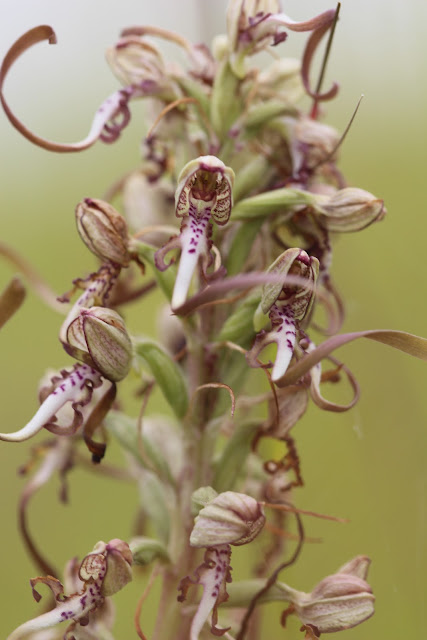
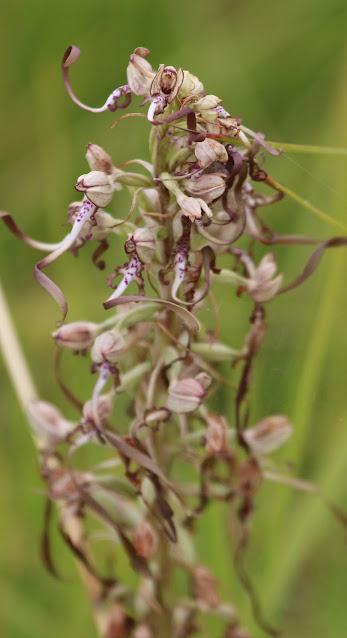
But not today. Mike and I pitched up at a small car park just west of Hitchin and made our way to Knocking Hoe reserve. A piece of hillside grassland festooned with flowers. We spent an hour plus marvelling at many species we were unable to name.
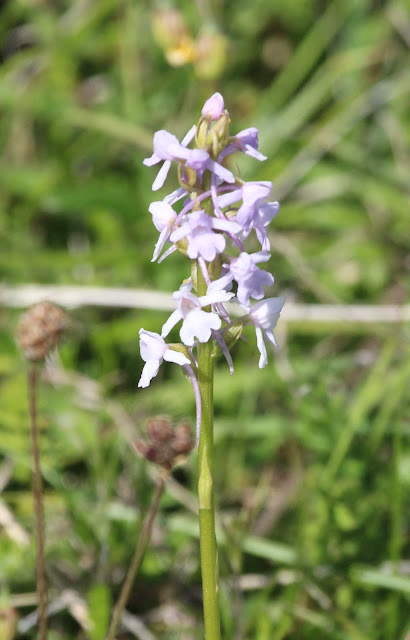
Some we were, mainly the orchids. Common Spotted Orchid in a fine stand where we entered, then hundreds of Pyramidal Orchids scattered around, and amongst them many Fragrant Orchids. Apparently DNA analysis has shown there are three species of fragrant Orchid. Lacking my DNA testing kit I was unable to say which ones these were.
Our target was Burnt Orchid, or Burnt Tip Orchid. A lifer for the two of us. We eventually worked out that the tiny stems with dessicated seed heads next to Orange flags were Burnt Orchids two weeks or so beyond their flowering life. Fortunately a couple of examples were still making a fist of it. Next year, beginning of June ...
My prospect for more orchids has been significantly enhanced by discovering Orchid Hunter on YouTube. Clear explanations of where to go and what to look for, and a genuine feel for the ups and downs of the hunt that is familiar to birders as well as other naturalists. Recommended
Here's some photos.
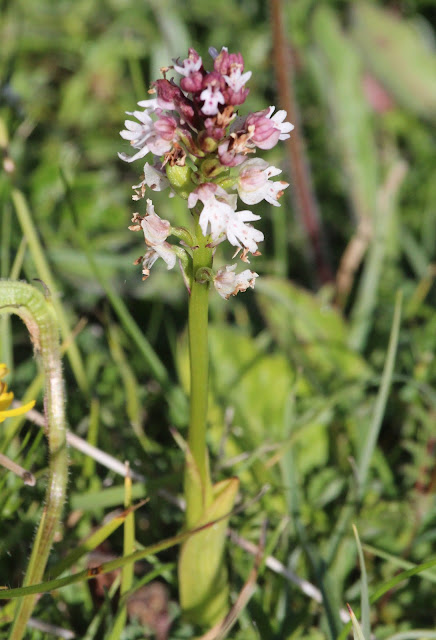 |
| One of the few Burnt Orchids still standing. |
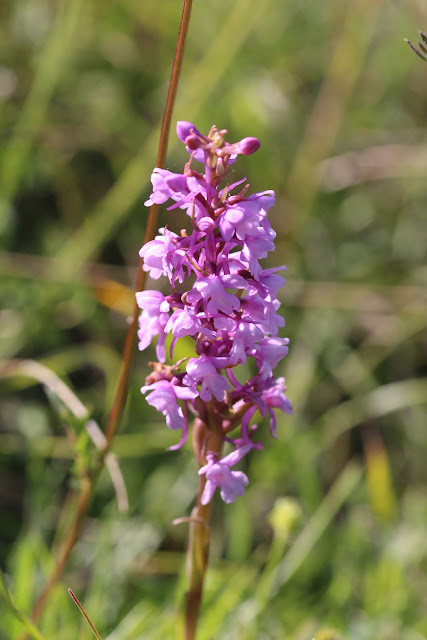 |
| Fragrant orchid. |
 |
| A white/very pale pink Fragrant orchid. Just the one noticed. |
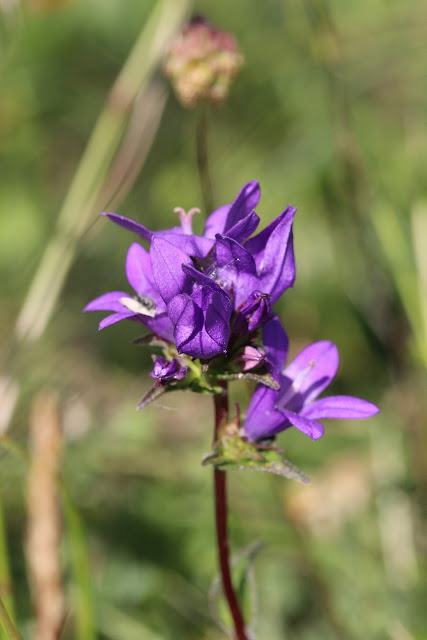 |
| Nice. A few of these. No idea what it is. |
Mike and I had a few common gaps in our year list that could be filled at some sites in the Brecks. We started our treck at RSPB Lakenheath, and were soon getting decent birds. Two Knot on the Washlands, one just coming into summer plumage, a Hobby hunting back and forth; then a flyover Bittern, first of a few, that gave great views as it slowly flopped into the riverside and wandered through vegetation. At Joist Fen we had more hobbies, a hovering Kingfisher, and a few Marsh Harriers. Three cuckoos called, but we couldn't see any.
The board in the centre had mentioned Variable Damselfly, a species of Odonata of which I was only dimly aware. We wandered down a mowed path with small blue damselflies zipping everywhere. Mike had mentioned that close up they are a slightly different blue to Azure, so when I saw an electric blue one I said there that's it and Mike soon corrected me - no its Azure John. Then a slightly darker duller one landed and I said there that's definitely one, and much to my astonishment it actually was! A greyish tinge to the blue, darker terminal segments, and the clincher through Mike's monocolar was the wine-goblet shape S2.
Next up was Weeting, where after an anxious ten minutes from the hide with just Curlew and Shelduck, I located four Stone Curlew lounging around. (I mention that I found them because otherwise the casual reader may conclude that mine and Mike's days out simply consist of Mike finding birds and me going great thanks Mike nice one). The staff showed us a Pine Hawkmoth from the trap.
Two year ticks down and onto Santon Downham. A couple of singing Tree Pipits were the third year tick for me, and as we admired them two doves flew past and into trees; rufous, blue grey, with distinctive white tail edgings, a pair of Turtle Doves! Otherwise a Stonechat, and distantly a cuckoo called.
We'd cleaned up, so a last short trip to Lynford Arboretum for a coffee and a possible Firecrest. I heard plenty as I sipped my Cappuccino, but could see none. We had a short walk round and stopped at a rhododendron bush to admire the insect life. Suddenly Mike was onto a Hawkmoth, but not the standard orange-tinted Hummingbird kind either. I was way beyond my experience here, but registered a lime-green colour, with a russet-brown band, yellow tail with a couple of black blobs. I took some phone footage and photos, and googling indicated one of the Bee Hawkmoths, and yes we could now make out the red borders to the translucent wings. We must have stayed for an hour marvelling at this creature whizzing back and forth.
Eventually we headed off, just a few minutes eventually tracking down a Firecrest, heard a cuckoo calling distantly, then home.
On checking the literature we agreed on Broad-Bordered Bee Hawkmoth. Apparently well distributed in Norfolk! I've attached a video from my phone. I don't know where the sound comes from - the moth did not make the sound of a tractor.
I'm pretty sure I'm not the only birder who intends to spend less time on the patch this year. The previous two years of national house arrest saw me give the fields, hedgerows, damp corners and river that make up my favoured area a thorough going over. And to be realistic, after six years of thorough birding I'm not going to add new species to the patch list.
Or so I thought. I have so far this year added three species.
First was Brambling. An omission that stood out like a sore thumb has been corrected. There was an historic record of one before I started a regular walk, And Howard Vaughn of RSPB Rainham wandered onto my patch when his car was being fixed in nearby Harlow and scored a fly over. But for me, nothing.
I knew just where one should appear. The farmer had put down some spare grain in an overgrown corner of a field and about 50 Yellowhammers and 30 Chaffinch were there, and as there seems to be an iron law that any gathering of over twenty Chaffinches must contain at least one Brambling I searched hard, but in vain. I was walking away frustrated and downcast when a flick in an elder bush and bingo, a bright female Brambling. Patch tick #1
I've seen loads of Brambling, but every time I see one its like I'm seeing them for the first time. Yes, still impossibly colourful. that bright white lower breast and orange breast band, and those jazzy upperparts.
Subsequently I saw two there and another one at a larger finch flock elsewhere on the patch. And a couple of other birders got them too. I got the impression that whilst Chaffinches and Yellowhammers are continually flying down to feed and back, Brambling hang back in the bushes.
Then a couple of weeks ago I was walking through a small wood when whirrrr and explosion of wings from under my feet. No sooner had the thought 'that's a strange place for a pheasant' formed in my mind than the deep russet plumage and location brought me to Woodcock. As it flew round I got a clear view of long bill and round wings. Patch tick #2.
How pleased was I? It's a difficult one again because they do occur in all sorts of places, and its not a surprise, but when the farmer told me there was a patch that had held Woodcock on the other side of he railway line I incorporated that into my regular walk in the hope of finding one. And here it is, on the list.
As if that wasn't enough, I was taking the dogs out just now when I noticed way up in the clear blue a gull circling. I put the bins on for no other reason than I like looking at gulls in the sky, and hang on that's got some distinct non gull-like brown markings on the wing there, that's a bit too stocky for a gull, and so Osprey made it patch tick #3. I managed to get the word out and Mike saw it from his garden. Excellent.
So that's a surprisingly good return from the patch and its only just into April. Who knows what else is going to appear?


