Thursday, August 09, 2018

Insect hunting at Thursley Common and Oaken Wood

A day out with David hunting insects, a few weeks later than ideal. In retrospect, with searing heat on Tuesday and drizzle today, Wednesday was a serendipitous choice although when the breeze got up on Thursley it didn't feel like it.

It took a while for the dragons to appear, but when they did they were in number. Lots of Black Darter (new for me), Keeled Skimmer, Black-Tailed Skimmer, Emerald Damselfly, Common/Azure damselfly, Blue-Tailed Damselfly.


On a couple of occasions we noticed female Keeled Skimmers ovipositing and a male hovering just over; this seems to be a recognised part of their behaviour.

We got lucky with Small Red Damselfly as a couple fluttered briefly whilst we were watching a Black Darter. Wow, they are really small! Very hard to see when not flying as they look like bits of grass.

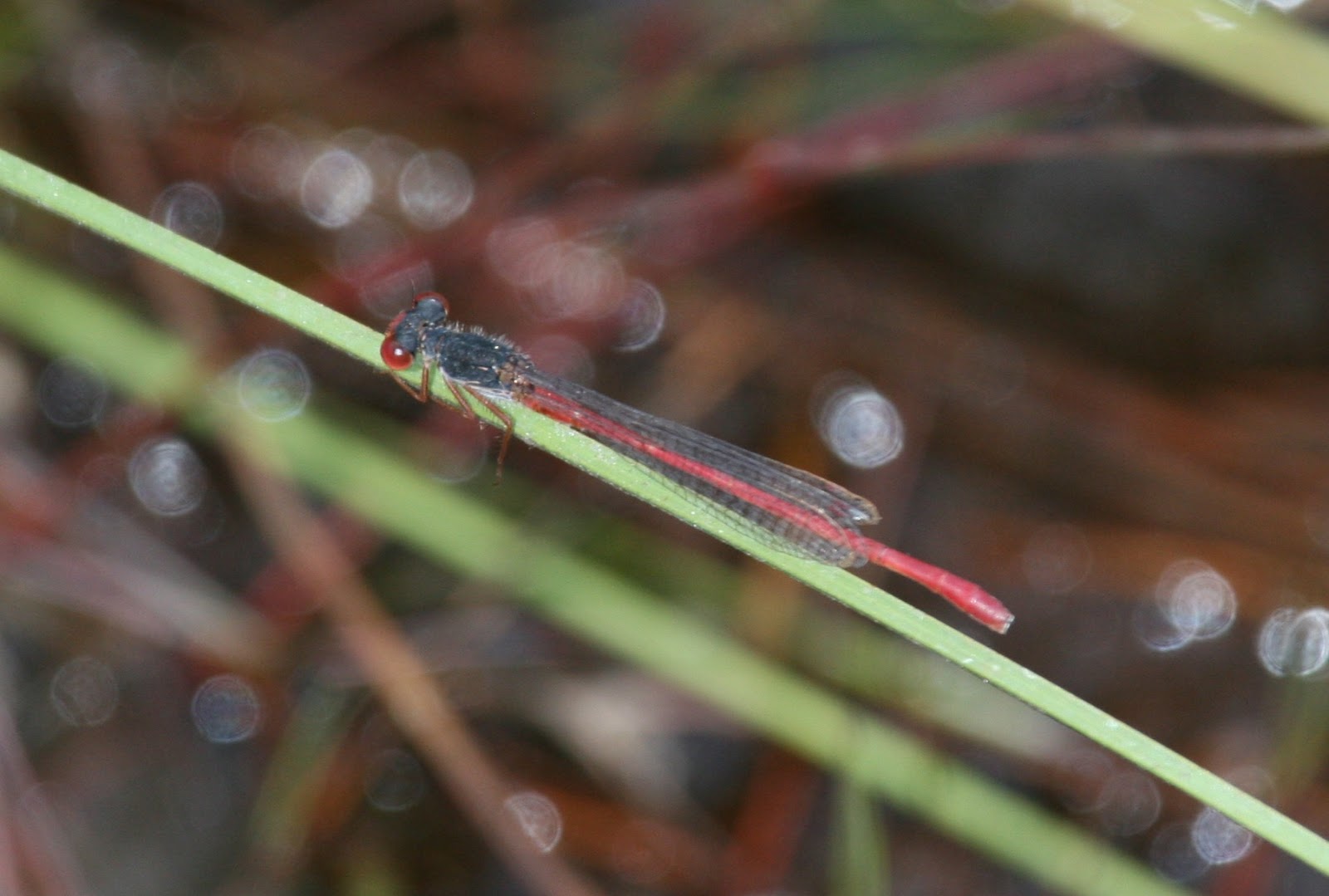


On to Oaken Wood. Not the visual feast of White Admirals we had experienced on our previous visit,  still lots to go at.

We saw a Blue which was so small, wings literally the size of a little-finger nail, we were left stumped as to what it is. Reviewing the photos, I think it is just a very small Common Blue. Perhaps the drought has resulted in smaller butterflies in the second brood?


The star butterfly was undoubtedly the Wood White, of which we saw six. David picked out the first (and most of the others), males just permanently flying a couple of feet off the ground. Such a small and dainty butterfly with those tear-drop wings! Photographing these on a plant was obviously impossible so I was reduced to trailing around trying to get a flight shot. The one below is the best of the bunch and shows the pale spot on the upper fore-wing.


David found a (presumably) female settled on a thistle and quietly fed, so an opportunity to get the macro lens doing the job it was designed for.


There is something very therapeutic about looking for insects. You are in their hands, and if they decide not to appear, that is something you just have to accept. In contrast to some aspects of birding, the slow pace and careful looking required for looking for insects is quite calming. I guess its almost over for this year but am looking forward to next year already.

Tuesday, August 07, 2018

Rye Meads

Dipping reached new heights at Rye Meads this morning. Not only were there no birds to be seen, but I missed the Willow Emeralds and Wasp Spider, despite there now being a big sign saying "Wasp Spiders are right here!" Nevertheless, got into pleasant conversation with a fellow birder and saw a few insects so a worthwhile and enjoyable outing. The best of the photos here.

Male Migrant Hawker. Lots of these here today along with Southern Hawker.
I think this is Green-Veined White?
lots of Blue-tailed Damselflies out day.
Female Common Blue

Saturday, August 04, 2018

Relaxing at Oare Marshes

A free day. Oare marshes has been on a good run, so with high tide at half 4 I set off in good time to navigate the many road works and arrived at 2pm ish to find I (almost) had the place to myself.

The Red-Necked Phalarope was soon pointed out by the one other birder. A study in sepia and white, it really is tiny. Soon the air was filled with a cacophony of wader yelping and two flocks of Whimbrel both numbering about 20 appeared and flew away. Whimbrel were to be present throughout the day in small numbers, with one further flock of 10.

Further scanning yielded about 50 Golden Plover, lots of Lapwing, 3 Snipe, a number of Avocets, a dense flock of 150 Redshank (plenty of plumage variation giving challenges for the unwary - I think I saw 5 Wood Sandpipers and a Tatler today), and a large flock of Black-Tailed Godwit which slowly increased to around 1000 birds. Searching produced a few Ruff, and on the edge of a spit a mixture of Turnstones, summer plumage Red Knot and some Dunlin and running around with the Dunlin a Little Stint.

At this time a flock of Common Tern descended from toward the estuary. I eventually counted 123. These birds were with us for several hours until as the tide fell they began to disappear. About 10% were juveniles. The rest full summer plumage adults. These were quite the spectacle and a highlight of the day,

I walked round to the hide on the southern edge and from there was a winter-plumage Spotted Redshank and I was shown two sparkling summer plumage Curlew Sandpipers.

On returning I stopped to look at the dragonflies in the ditch and it soon became clear that the larger ones were Southern Migrant Hawkers. I saw about four. The clinching evidence was the fact that the grass round the path was trampled flat so clearly a lot of photographers had been here.

Back for another sit and view; I couldn't find the Bonapartes Gull, but did find a consolation Mediterranean Gull, a Little Ringed Plover, a couple of Ringed Plovers and a distant Greenshank. 

So quite a spectacular day. The birds were a bit far for my camera skills, but just to show that the last set of photos was a fluke here's a few from today.

some of the Common Terns on the ground ..

... and leaving back into the estuary


I think the club-shaped abdomen makes this a Ruddy Darter

an 'action shot' is all I could manage of the SMH.


Wednesday, July 18, 2018

Therfield Heath again

A gap between appointments in Hertford ... so Therfield Heath again.

I'd not seen Chalkhill Blues before. What a butterfly! Some of them have the most intense azure next to the body, but the rest of them are beautiful sculptures of pale blue with brown surrounds. There were quite a few too by the path from the car park across the road and up to the mounds. I would estimate 50-100.


Also Dark Green Fritillary. I got my first decent view, and very nice it is too. Almost a black-and-white effect on the wing edges. There has been a record reported from Hatfield Forest so I need to do some careful studying here.


Otherwise, a Knapweed Broomrape (no photo) and a Skylark.


Friday, July 06, 2018

In Search of His Majesty

Purple Emperors are doing well all over, and our local stronghold Hatfield Forest has had up to 9 seen there. I've been there on a few occasions to see them and so far ... nothing.

It may be that I've been there mid morning and its been too hot, or it may be that I'm just not very good at finding butterflies that fly round the top of tall trees.

I met a helpful chap who told me where to find them in an Oak along the main plain, and that there are White-Letter Hairstreaks in Elms along the edge of the plain. Needless to say I didn't see them either.

Despite this, I'm quite enjoying the cool of some of the rides, and there are tens, possibly hundreds of Silver Washed Fritillaries. Here's a few photos of some other insects.

female SWF. Noticeably smaller than the males.
Purple Hairstreak - common round oaks. This was the closest I could get.
 Ringlet, Meadow Brown, a few Marbled Whites and various other whites and skippers.

There were a few dragonflies too. Brown Hawkers and the usual small blue damselfly things, and these.

Southern Hawker in one of the more shaded rides 
a skimmer? not near water so a bit confused on this one.
I refound the colony of White-Legged Damselflies pretty much in the same place I last had them. Noticeably paler, seemingly slightly slower in flight and a tad longer than the more common damselflies.


Saturday, June 30, 2018

The Importance of Parking

What makes for a successful day out? After yesterday's trip with David round the insect hotspots of Essex, I'd say Parking.

First stop was Langdon Hills, a large area of woods and meadows with a number of recent records of butterflies of interest. I had pre-selected an excellent place for parking for this venue - or so I thought - the Essex Wildlife Trust Langdon Visitor Centre. We had excellent parking close to the centre, and then found out that the areas of interest were a forty minute walk away. We relocated a bit nearer and wandered off to investigate, but long story short we had lots of glimpses of butterflies and dragonflies in the meadows but never made it to Marks Hill for the Purple Emperors.

We cut our losses and headed to Canvey Island for the dragonflies. We had some excellent parking at West Canvey RSPB and saw what was probably a Southern Migrant Hawker, but after walking around had only Common Darters, Black-tailed Skimmers, 4 Black-Tailed Godwits and a Lesser Whitethroat. We headed off to the mecca of Douthern British odonata, a ditch opposite the domestic waste centre on the Benfleet Road.

There was a pull-in by a gate with a few cars but no spaces, so we spent a while driving round and eventually parked in the public car park behind Benfleet Station. Having navigated the administration involved in paying for three hours rather than the whole day, (short-stay bays, yellow button) we then walked back through the mediterranean heat to the ditch to find some mediterranean dragons. In the comparatively brief time we had left we managed to find a few dragons, and even managed to take photographs of them. David, our official photographer, will have better, (and anyone looking for odonata photography excellence will of course look at Marc Heath's wonderful site),  but here are my efforts including some "atmospheric" (i.e. out of focus) shots.  I am informed these are Southern Migrant Hawker, Scarce Emerald, and Southern Emerald. If I go to my guide book published a mere 21 years ago, it has the Scarce Emerald in it, mentions the Southern Migrant Hawker with one picture, and doesn't mention the Scarce Emerald. 

Southern Migrant Hawker in flight

mating Scarce Emerald. The reason I know these are Scarce Emeralds and not Emeralds is because a bloke at the top of the ditch said "there's lots of Scarce Emeralds down there mate."

Southern Emerald
Southern Emerald close-up

Thursday, June 21, 2018

Summer on the patch


Spring has been and gone with hardly a migrant to mark it. We are into summer now and everything is settled, although I could do with the Garden Warbler that sings in the impenetrable forest to show itself so I can get it properly on the list, and for a local Hobby to appear at some point.

Today there was Common Tern fishing along the river, Grey Wagtails at the lock, and some Swifts and House Martins overhead. The Marbled Whites have emerged in decent numbers, and I added Large Red Damselfly to the patch list - long overdue.


An average/excellent day at Minsmere/Dunwich

To Minsmere with David. A windy and cloudy day after yesterdays sunshine. Nothing too much of significance; Bittern from the Bittern hide, the usual Marsh Harriers at Island Mere and just a fly-through Hobby for variety. Spotted Redshank at East Hide the pick of the waders, Kittiwake and fly-over Fulmar at South scrape, a few Mediterranean Gulls, a Greenshank on North Levels, another flying Bittern from West hide, a pair of Stone Curlews as we left the reserve and then a trudge round Dunwich had just one sighting of Dartford Warbler. An average visit.

Lets replay that as it doesn't seem to do justice to the variety of birdlife on show. The Bittern flew close to and slowly past Bittern hide and landed in the reeds, so as good a view as I've had in the last couple of years. There was a constant stream of birds crossing the levels with flocks of Black-Tailed Godwits, Shovelers, and a few Little Egrets. From Island Mere hide at least 4 Marsh Harriers, some coming quite close, and the Hobby gave an exhibition of hunting as it did a fast-pace circuit of the hide. East Scrape was a mass of bird-life, with Mediterranean Gulls everywhere;  a male Pintail, an intriguing Knot in a strange brown-and-white plumage, and Spotted Redshanks in glorious summer plumage giving views as good as I can remember. South scrape was a mass of birds again with 300 Black-Tailed Godwits huddled together, sparkling summer plumage Grey Plover and Turnstone, and an unexpected flock of about 30 Kittiwakes. The beach was pretty empty apart from a fly-over Fulmar. Good views of the Greenshank and then another close-up of a fly-by Bittern. On departing, an RSPB ranger told us where to park to see one of the pairs of Stone Curlews in the area which we duly saw, if rather distantly. We then walked round Dunwich Heath, heard a distant female Tawny Owl, and then had excellent views of Dartford Warbler in heather, and then with a young bird. So all in all, an excellent day's birding at Minsmere.


Saturday, June 02, 2018

A year's rarities in one morning - Birdwatching Lisbon

D#1 and D#4 wanted a short break in Lisbon. I went along too and negotiated a morning off from parental duties. A quick google, a couple of emails, and at 7:30 am on Wed 30th May Rui from Birdwatching Lisbon was outside my hotel to whisk me off for a few hours birding. Would there be much worth seeing so close to a capital city?

We drove across the Tagus river and shortly after turned off the highway down a rough track to an area of rough land with a patchwork of lagoons near Bracieira. Straight out of the car there was Black Redstart singing, Zitting Cisticolas, and a flock of 100+ Swifts. Rui pointed out the more relaxed flight, paler throat and scale appearance of Pallid Swift distinguishing to from the more nervous Common Swift. A Black-Winged Kite sat atop a pole looking for prey, a Black Kite flew through, a Hoopoe Flew cross, then some Flamingoes flew past. We saw more of these pre-historic looking creatures during the day, easily visible from a long way off including a flock of c250 out by the estuary and some wading much closer. 7 Black-Tailed Godwits flew over, then 3 Black-winged Stilts flew in to a lagoon, A quick scan revealed a Squacco Heron on the bank of a lagoon - apparently a rarity at this site, and a Spoonbill in full breeding kit feeding in a lagoon. A distant building had Spotless Starlings - the local variety but new to me - and a pair of Sardinian Warblers flitted through some bushes.

Mention should be made of the first escaped bird established here - Waxbill. A male with a very nice raspberry-red breast appeared close to, but other ones were around.

We drove on to our second location, some (dry) rice fields and dykes with reeds. A couple of Little Owls were around a farm building, then in a ditch the second of our escaped local birds - Yellow Crowned Bishop. The males had just come into full summer plumage and were chasing the females. They looked like slow-moving luminous tennis balls. A really vivid and beautiful bird. Three soaring raptors turned out to be Black Kite and two pale-phase Booted Eagles. A Crested Lark called from a field and flew briefly. We moved on to a reed-filled dyke alive with the sound of Great Reed Warblers. We had a brief view of a bird flying along the back, then an Iberian Yellow Wagtail perched close by enabling the white throat and eyestripe to be clearly seen. The song of the Serin is a constant accompaniment in this area, and was finally made flesh as a male did a song flight and sat in a tree next to the car. Rui picked up a Red-Rumped Swallow amongst local Barn Swallows and we watch this for a while admiring this spectacular hirundine with its seemingly stuck-on tail. There were Corn Buntings and a pair of Marsh Harriers, and then onto the next and final stop

The final location was a road moving north parallel to the estuary with farmland to the left and open cork woodland with bulls and cattle to the right. At the first stop a Nightingale flew past and a Crested Tit moved through a pine tree - a bird that had simply not been on my radar as occurring here. Then at the next stop Rui could here Rock Sparrow. A pair briefly appeared on a tree stump but I missed these as I was looking at a Western Bonelli's Warbler as it sang in a tree. A distinctive "prutt prutt" call got us searching and a pair of Bee-eaters flew into a nearby tree with fantastic scope-filling views. We spent some time here and had Short-toed Treecreeper and Nuthatch. Another Booted Eagle appeared, this time quite near and low giving great views of the head and back instead of the usual under-wing views. As we moved on another raptor appeared low over the trees. It was a species I have been looking to renew my acquaintance with for a few years now, often wondering whether I was watching this or the common variety, but as so often happens when the real thing turns up, I instantly knew we were looking at a Honey Buzzard, apparently not a regular bird here. As we watched, it circled round giving spectacular views, then floated away on flat wings giving a view of its brown back and greyish head.

Shortly afterwards another raptor came over. Large, cruising slowly, as it came near we could see the deep-russet brown head and breast and speckled white underwing and body of a Short-Toed Eagle. This happened as we were watching a singing male Melodious Warbler, Rui pointing out its mimicry and also the start of the song sounding like an engine slowly getting into gear.

Then 8 Cattle Egrets in breeding plumage amongst cattle, a fly-thru Cuckoo, and then the final stop by some electricity pylons where White Storks were nesting on special nesting platforms, the bill-clattering and black-billed youngsters made for quite a site. Just time for one last bird - Cirl Bunting singing in a bush, then back to Lisbon.

I don't know about you but I'm quietly amazed at such a list. The countryside is much-less intensively managed, and correspondingly full of birds. It goes without saying that Rui did a fantastic job and was a pleasure to spend time with. Most of the birds gave excellent views and I'm still feeling a warm glow from the trip. If you find yourself in Lisbon with half a day to spare, you know what to do.

Short-Toed Eagle overhead - photo taken by Rui

Friday, June 01, 2018

Dipping in Yorkshire 21-22 May

A trip to see my elderly mother in God's Own County gave a couple of opportunities for birding. First a detour on the way to Blacktoft Sands RSPB reserve to see the Montague's Harrier that had been consistently seen over the last few days. I used to visit this regularly in the 1980s and 1990s and had birds such as White-Rumped Sandpiper, Temminck's Stint, Red-Necked Stint, Spotted Crake, as well as lots of other waders. Like many similar places, it seems to have gone off the boil a bit, so it was really an all-or-nothing trip for the Harrier.

Long-story-short, the Montague's decided not to appear. I gave it several hours, mainly spent in the Singleton Hide, and had a brief bit of excitement when a medium-size brownish raptor with white on the tail appeared, but it was a female Sparrowhawk.

Nevertheless, it was a good day. A pair of Garganey, many Avocets, lots of Tree Sparrows - a bird Northerners stroll past without a second thought but that Southerners like myself always enjoy seeing, having none of our own. Bearded tits, Reed Warbler, Yellow Wagtail, but stars of the show were Marsh Harriers. I settled on 3 males and 3 females. There was hunting close to the hide, talon grappling, food passes, and displaying. One of the males was as fine a bird as I've ever seen; silver wings with heavy black tips and a chestnut body and coverts, then an orange tail. It looked like it had wondered over from the Indian sub-continent.

Worth noting Little Egret, Cetti's Warbler, and Buzzard. All birds I saw on this visit and I'm pretty sure I didn't see in my visits of the 80's and 90's.

The 22nd dawned cloudy and windy. I visited Norwood Edge for the Iberian Chiffchaff and found a couple of others there looking for it. It sang nice and clearly, and distinctively. Should I tick it? Well firstly, I didn't see it as it remained in swaying treetops, but if I had seen it I would have seen a chiffchaff, or possibly a silhouette of a chiffchaff. Secondly, part of me refuses to recognise these variants of chiffchaffs as real species. But on the other hand, a tick is a tick ...

On to The Strid at Bolton Abbey with now bright sunshine, and a repeat of last-years walk; up to near Barden Bridge then back down the other side. It was marginally less successful than last-year; no Dipper, and no Wood Warbler, but I did get Redstart (just 1), Spotted Flycatcher and many Pied Flycatchers, singing, perching, going into nest boxes, a truly spectacular sight. There was a nesting Treecreeper, Goosander with chicks on the stream as well as Mandarin there too. Then whilst walking down the far side, a flurry of activity in a small ravine just forty yards away. Three medium-sized round-winged birds flying at each other and giving repeated 'tic' sounds. Finally one settled and wandered round briefly with its large eyes and enormous beak. How often do you see Woodcock in the middle of the day? How often do you see three? As always with birding, it is the unexpected that puts the icing on the cake.

The strid in full flow.

Monday, May 07, 2018

Hatfield Forest - Wall wood

A walk round Wall Wood just off the South-West corner of Hatfield Forest today. It is managed by the National Trust and has been recently fenced off (with gates for access) to keep deer out. I neglected it over the winter mainly because the Hawfinches were in another part of the wood, but thought it worth a trip to see if keeping the deer out had enabled the Early Purple Orchids to reappear.

And they were back. One area had 63 spikes (in the SE corner) and there were a few spikes elsewhere in the Southern half. A clear vindication of the NT's policy of keeping deer out. all we need now is Nightingales.


Otherwise there were a few insects, including some busy bumble bees, one of which passed briefly to enable this photo which despite the quality shows the main features:


I did wonder whether this was a Buff-tailed queen that had lost its fur from its middle, but the yellow edge to the lower white gives away that this is a cuckoo bee, and I'm reasonable sure it is a Vestal Cuckoo Bee Bombus Vestalis which last year for a while was the commonest bee on my patch. I saw a few later in the day round Pishiobury Park, and one of the most distinctive features is a notch or gap in the centre of the white tail. So if you see a queen which is all black apart from a ginger collar and white tail with a notch in it then I think it is this species.

Also was a gathering of small bees, too few and sparse to be properly called a swarm. There were bees of several sizes, so I had a go with the macro lens and got these.


I think I'm on reasonably safe ground saying these are Nomad Bees. After that, it is a but more difficult. The top one looks like a Long-Horned Nomad Beetle due to the extent and positioning of the red but my guide book says it is scarce so probably not one of these. A Flavous or Painted Nomad Bee may be more likely and the second may be one of these. In truth I have no idea. Anyway, this is another class of creepy-crawlies to have some camera fun with over the summer.

UPDATE: Twitter came to the rescue on Nomad Bees with Jono Forgham suggesting Fork-Jawed Nomad Bee. This would seem to fit with the second photo which would be the smaller male, and the comment in my guide book that it is "common throughout much of southern England". Steven Falk very kindly also gave some other possibles such as Painted or Flavous as apparently the appearance is variable and really you need a specimen. If I photograph more of these creatures I will just suggest possible IDs as I am not up to capturing and dissecting them.

Steven kindly responded to a tweet message, which gives me an opportunity to plug his book "Field Guide to the Bees of Great Britain and Ireland" which is a wonderful book. At this time of year I am browsing through it or reading in detail almost every day. Highly recommended

Goodbye ... and Hello

It's been a while. It's tested the patience of the most dedicated reader. As he told me on a number of occasions. So I've decide...