Saturday, January 03, 2026

Goodbye ... and Hello

It's been a while. It's tested the patience of the most dedicated reader. As he told me on a number of occasions. So I've decided to officially terminate this blog. 

But, fear not both all of you who drop by here, I've decided to restart this blogging thing somewhere else! For those who like a drop of the ridiculous in your browsing, for those of you who after a day's missing everything need a pick-me-up from someone who has inevitably missed more, Normal Service has been resumed over at https://ddridesagain.blogspot.com/ ! 

Thanks for reading here, and I hope to see you in my new home. 

https://ddridesagain.blogspot.com/

Monday, June 10, 2024

Commonly Spotted Orchids

We are fortunate in the UK in that the commonest orchids are also amongst the most beautiful. I spent a morning photographing some on the local roadside verges; not something I'd have done for Common Twayblade. 

First up was Bee Orchid, which occurs in a number of places near me but these were on a verge near the local cemetery. There is something deeply satisfying and joyous about seeing an area of slightly bare grassland, wondering if that will be the bee-orchid site, and on walking over finding these jewels of nature seemingly hanging in mid-air. 


Orchid-ophiles get very excited about variations in flower colour. In Jon Dunn's excellent Orchid Summer he describes driving all over the place looking at these variations and ending up at Radipole to see an all brown one. We were in Weymouth a lot that summer I thought to myself 'why didn't I go and see it?" and then I realised that I had seen it, there being some noise about it at that time, and thought 'oh ... interesting.'

Anyway here's one with a slightly different flower marking.


Then onto the local bypass. The verges of this recently-created road pass through a cutting, and the sides are festooned with orchids in late clusters. Parking at a suitable spot I managed to get some photos of Common Spotted including a white one.


Then on the corner a collection of 50+ spikes of what I can only assume are Southern Marsh Orchid. This is a most unlikely spot for them, not being a marsh or in anyway wet, and I assume they were brought in with whatever soil was used to build up this bank. 

That just leaves Pyramidal which are common but not out yet. I will return.


Thursday, May 30, 2024

Bird's Nesting in the North Downs.

Ever since I got keen on orchids one species in particular has provoked particular interest; Bird's Nest Orchid. It's not particularly photogenic, but it is a particularly interesting one by virtue of it being saprophytic, hence having no leaves or chlorophyll. 

I've tried a few places, but north of the Thames its a hard species to find. Typical is the ever-excellent Orchid-Hunter, who, even with directions, had a hard time finding just three specimens in Bedford Purlieus woods and was very pleased with them.

South of the Thames it's a different story. At one location in particular, thanks to the work done by the National Treasure that is Steve Gale in finding, counting, and publicising, they are so common they are basically a weed. That place is the Mickleham Downs near Dorking. It's a bit of a trek from here but I go further on a regular basis so why not? Hence Mrs D, myself and Derek the dog set off on a day out.

We pulled into the small car park at Cockshott Wood, and started to scale the steep bridleway from the east end of the car park. After a few yards there was a small clearing on my left; a quick scan and boom, twenty spikes. I scrambled over for the obligatory photos, very pleased. Mrs D was slightly bemused we had come all that way for a desiccated ghost of a plant, but I explained its parasitic lifestyle and she was suitably impressed. 

We didn't go any further. I had seen what we came for, and not having packed crampons, ropes, axes and helmets progressing further up the slope seemed foolhardy. 

After that we had a wander round Denbies Hillside (White Helleborine) and then Dorking for a coffee and panini. Mrs D was impressed, as was Derek, so we will no doubt be back.

I picked up a couple of other first-for year orchids in a traditional place; motorway verges. Common Spotted from a queue in Kent where you have to turn off the M25 to stay on the M25, and Pyramidal from the M25 onto the M11 in Essex. 

Not visible on this but this one was under a cloud of tiny insects. Not sure what their interest was.


Obviously I completely screwed this White Helleborine photo up. It was dark in the wood and I just tried a few things and then did a lot of editing. But I quite like it.

Thursday, May 23, 2024

Rarity chasing in Cambridgeshire part 2.

Last post left you on the edge of your seats as your intrepid birders ticked off the first of three potential rarities and headed off in search of the second. We left Ouse Fen and drove down to Fen Drayton for the first-summer male Red-Footed Falcon.

We arrived and on consulting birdguides realised we were at the wrong end so set off on the old gravel lorry path to the southern-most pit. It was for exactly this scenario I bought a 4x4 several years ago and it worked out fine. It wasn't just that the path had many pot holes, its that they were very deep. Fortunately we navigated the path without incident, found a few parked cars and fellow birders soon had us at the viewpoint watching the target bird in the distance. The bird slowly came nearer and flew over our heads. The heavy grey sky meant we couldn't get great visibility on it but the underside was clearly finely barred, quite dark, and had red feet. Slightly longer tailed than a Hobby (there was one around too) and without the scythe wings. Very nice. There were a couple of Cuckoos including a hepatic bird, a few terns and plenty of warblers too. 

Two down. We headed off to Berry Fen following instructions we had been given by a helpful local for a sighting of the Black-Winged Stilt, our final target bird. We were unable to find any sign of it, so decided to call it a day and arrived at the A14 services for a relaxing coffee just as the forecast rain started. We were very happy with two out of three.

I checked Birdguides again just before we left and the Stilt was at Ouse Fen! Seemingly on the huge pit we had casually looked over. What to do? Were we really going to drive back just to pull up at the gate and tick it in the rain? Well why not? It's not as though we were just going to turn up, pile out of the car and ask someone to set my scope up on it. Surely there would be some birding skill involved.

We arrived, pulled up at the gate, piled out of the car and found a helpful RSPB ranger. It was raining, there was a lot of water to look over, so why waste time? "Would it be possible for you to just put my scope on the Stilt?"  And there, in the far distance, was a Black-Winged Stilt picking its way through some distant vegetation. Even at that range it had that distinctive jazz ion the bird, and a nice clean white head. Fantastic. Three out of three - how often does that happen? We set off home, wet but happy.

Wednesday, May 22, 2024

Great Reed Warbler at RSPB Ouse Fen

We had pencilled in Tuesday for Minsmere, but with cloud and then rain on the schedule and a trio of notable birds the other side of Cambridge we had a change of plan, so just before 9 we pulled into the car park at RSPB Ouse Fen for our first visit with Great Reed Warbler the target.

It wasn't long before we were at the mound listening to what sounded like an old diesel car slowly getting started. Finding it was another matter, but David got us onto it near the top of a reed and we had a good half hour or so of fantastic views. I'd seen one many years ago, but not like this. I even managed some photos down my scope. The views were so good this wasn't just a matter of getting it on a list, it also crossed it off a list. I'm not going to get views like that again unless someone puts a bird in my hand. It's unlikely I'd go for another one unless it was very near or there was something else on the day. What would be the point?


We carried on round the reserve. It's an excellent place and we resolved to come back, not imagining that our second trip would be the same day. Nevertheless we got great views of Cuckoo, Bearded Tit, Marsh Harrier, Great White and Little Egrets, heard several Bitterns booming, and lots of other fenland stuff too. We gave a large pit by the entrance a quick going over but saw only Redshanks and Oystercatchers.

Odonata started to come out and Mike identified many of the blue damselflies as Variable Damselflies. Mike explained the key is the segment just behind the head S2. On a Variable it has a U shape with a couple of blue spots each side but it is variable. You can see that on the photo below;  also shown is an Azure from a later visit on the day with a very different S2 with a narrow black line.


But back to that Great Reed Warbler. Two things strike me.

Firstly, hands up everyone who has seen a male GRW in the UK? That's both most of you I would think. Now hands up who has seen a female GRW in the UK? That's none of you I would guess. There's an obvious reason - most GRWs are picked up on song. But does that mean that at this moment there's a few females going unseen in reed beds? How do we know they aren't breeding somewhere? That a singing male doesn't manage to attract a female and breed? Or can females give a song too when they need to?

Secondly, why is there a GRW at all? Birds in reedbeds all seem to be the same size; the many varieties of acrocephalus warbler, bearded tits, reed buntings, all the same size. I assumed because reeds can only sustain birds or bird nests of a certain size. But then there's a bird the size of a song thrush that lives in reeds. So why aren't there lots of birds the size of song thrushes that live in reeds? Or is that why they don't breed in Britain - because we don't have the right reeds to support a nest?

GRW was only the first item on our list. Would we be as fortunate with the others? You'll have to wait for the next instalment.


Tuesday, April 23, 2024

Lindisfarne and Musselburgh

Lindisfarne: Circumstance gave me a couple of days based in Edinburgh. Lindisfarne was just an hour and a half away. As a teenager I had a few holidays around and on here, and remember it as one of the first places I got into birdwatching, so I've always wanted to return. Would it live up to my memories?

In short, it did up to a point. After looking on Birdguides I'd guess local birdies don't generally go there unless there is some specific wind and weather combination that makes it a magical migration point. I didn't get those winds so I got what is on the island on a usual April day. I didn't see any other birders either.

Briefly, the island consists of a village in the SW, which I didn't look round but does get rarities, a rough un 'improved' farmland in the south and a massive dune system in the north. 

There wasn't much on the island. Lots of local stuff like Lapwings, Curlews, Skylarks, Meadow Pipits, but c30 Golden Plover flying around in summer plumage was a welcome sight, and then distant falcons chasing a bird. It was Merlin-like behaviour but then one broke off and behaved like a Kestrel. Could I tick the other one as a Merlin as it continued to twist and turn? Fortunately that conundrum was solved a few minutes later a a female Merlin headed determinedly across the field. 

Then the sea. Gannets galore, Kittiwakes, Eider Ducks, Auks, lots of Fulmars and a lone Common Scoter. Finally on the SE corner of the island a male Wheatear. I walked the coast road and looked over the flats as the tide came in; Red-Breasted Merganser, a lone Pale-Bellied Brent Goose, a Red-Throated Diver, many Bar-Tailed Godwits, a couple of Knot, and a bird which looked like a Slavonian Grebe, but long distance, only my old scope, light against me etc etc. 

So nothing to get excited about but very enjoyable. 

Musselburgh and Seaton. Musselburgh could become a place I visit a few timers a year so I thought I should get acquainted. Just working out where to park, where the lagoons are etc. So imagine my surprise when walking over a bit of landscaped ash tip I detected a slightly familiar call amongst a flock of Linnets and there on a barbed wire fence were two Twite! All buff-orange throat and pink rump. I found the hides over the old lagoon and proudly announced my exciting find to a couple of locals who were in there. "Yes there's usually twenty or so up on the old Ash heap." Oh well.

Completing the tour I had about 10 White Wagtails, and off the sea wall a pair of Long-Tailed Ducks including a male in transition plumage with the full length tail. Quite a place!

On local advice I headed east to Seaton and set up my scope. What a sight! The Forth was millpond flat and there were birds as far as the eye could see. Eider Duck everywhere, about 50 Red Breasted Mergansers close in, and amongst them all a few more Long-Tailed Duck, a couple of Velvets Scoters, some Razorbills, a Guillemot, a Red-Throated Diver and a Shag. There were many more ducks further out and some small flocks were clearly Velvet Scoter. With my old scope I couldn't manage any id's further out but the array of birdlife in scope view was quite fantastic. 

I will definitely be coming back. 

Monday, March 11, 2024

Great Grey Shrike

Nine years ago when I gave up working I went to see a Great Grey Shrike at Grimes Graves. It was easy to find, showed well, all round very nice. This, I thought, would be my new work-free life. Every winter I would pop up to the Brecks and get an easy-to -see long staying Shrike. Needless to say that was the last time I had a decent view of this species. 

Until Friday when I went with Mike and Dave to see the one north of Weeting. As is always the case now for such sightings, we parked where the cars were parked, followed the path and lined up with everyone else. It was easy to see on a tree, not too distant, with the 60x scope giving eye-piece filling views. As we watched, a Woodlark sang. Very nice.

Buoyed by our early success we headed for the Rustic Bunting near Swaffham. On arrival at this extremely popular twitch it soon became clear we were on a hiding to nothing. The bunting flock was deep in a Sunflower-filled corner of the field. Occasionally birds popped up into a hedge, and once a load of birds, maybe thirty, took to the air and then went back down into deep obscurity. We departed.

I think Birdguides should give a 'twitchability score'. Lesser Scaup at Abberton gets 5 - if you follow the instructions almost impossible to miss. But this bird should get a 1. Don't bother unless you are prepared to spend all day for a couple of minutes view in a hedge.

We went back to Lynford Arboretum. Such a nice easy site. Cappuccinos at the Shepherds Baa, Brambling at the tunnel, then unexpectedly at the bridge Crossbills. Great views as they came to drink. Such a wonderful thing to have these birds back. 

Further on we had Hawfinch in the big tree in the paddock, but could't connect with Firecrest. A bit cold, possibly. Just not a Firecrest sort of day. 

Apart from Firecrest the only Brecks speciality we haven't got recently is Lesser Spotted Woodpecker. And on that front we have excellent news! We no longer have to drive fifty miles and walk half a mile to spend hours not seeing them; thanks to some excellent work by a patch birder we have a site nearer to home where we can spend hours not seeing them. Progress indeed. 

Friday, January 26, 2024

Hello Old Friend

What a year its been for notable birds. It started off with Canvasback at Abberton, then Northern Waterthrush at Maldon, then Surf Scoter at Holkham. There was a decent supporting cast too - Snow Bunting at Mersea Island, and Snow Bunts and Shore Lark at Holkham. Then a bit of local action - Smew and Red Crested Pochard at Amwell, and Bittern at Fishers Green. Finally White-Billed Diver off Southend Pier.

Yes reader, I missed them all. Some just weren't there when I was, and that Surf-Scoter; well, it became clear when, as we drove down the road to the Coastguards at Cley and saw the brick shelter repeatedly dwarfed by crashing towering spray, that we had miscalculated and there was zero chance of seeing it. Zero. As for the Diver, I never even got out of my chair.

So when it was mooted that we take a family outing to St Albans I leapt at it. Yes, sure, lets visit the Cathedral. A wonderful building. And just a couple of hours later I was stood in the Cathedral grounds with a lady with binoculars pointing out the long-staying Black Redstart in a tree. A decent sighting at last!

It was a female so lacks the showy pizazz of the males. But it was all Redstart. Non-stop flicking, constantly busy, occasionally adopting a jaunty pose. 

Every bird species DNA seems to extend to all aspects of its habits and behaviour. This bird, when seen, instantly summed up the essence of all the previous  Black Redstarts I've seen. An instant memory of encounters past. Hello old friend!

Sunday, December 31, 2023

2023 and all that.

In stats: 5 lifers. 215 year list. Didn't keep a local list for the first time in ages.

Overall a bit more relaxed and targeted this year with average results. The year-list did its job in keeping me going to different places.

1. Lifers. Alpine Swift, Blue-Winged Teal, Brown Booby, Canvasback, American Golden Plover. And about time too for a couple of those. But all good fun.

2. Birds I missed this year. There's a few. 

Black Redstart, Snow Bunting, Shore Lark Grey Partridge, Water Pipit. White-Fronted Goose, Goshawk, Garden Warbler, Grasshopper Warbler, Tree Pipit, Yellow, Browed Warbler, Jack Snipe...

A few of these I could go and see right now, and a few more could be done with a trip to Holkham. When I first started doing this more seriously back in 2015/16 it was a revelation that I could go to Holkham and see Shore Larks and Snow Buntings, and for a few years that continued to be fun, but after a while it becomes an exercise in ticking. This year's birding simply didn't involve bumping into these birds (Garden Warbler has always been scarce on my patch). I reserve the right to go and twitch these next year, as it will have been over a year since I saw them ...

Common Crossbill has become a much harder bird in the Brecks recently, but there was a record of them at Lynford so maybe next year.

3. Local. Again, back in 2015/16 one of the fascinations was to see just what occurred in the fields and woods in walking distance of my house. And whilst most trips mainly involve seeing nothing, there's been a decent list in total. But this year, particularly post-covid, has felt a bit diminishing returns. So I've done fewer trips but nevertheless saw Wheatear, Mediterranean Gull, Redpoll, Brambling, Stonechat, and even on a dog walk where I decided not to take my binoculars had a Marsh Harrier belting south over the park. I may do more of this next year.

4. Things that didn't happen: - Didn't get to see Whinchat or Redstart locally mainly due to lack of walks at suitable times. Didn't get a local vis mig passage. Didn't get a good October day in Norfolk with Yellow-Browed warblers in number and other migrants. Didn't get a strong late winter Northerly on the Norfolk coast, one of those Skua/Little Auk winds. This winter period hasn't delivered much of what one might hope for - no White-winged gulls, few geese, 

5. Good days. Had a lot of those. Frampton was great - just masses of great waders, and a memorable day at Minsmere. But again, a change of emphasis - two trips to Titchwell where we just did the reserve and kept chasing to a minimum. Great fun will do that again next year. And its no coincidence that my good days were all spent in the company of Mike and/or Dave. Am just very fortunate to have these two for birding companions - both top birders and great company. Thanks guys.

6. Memorable sights. American Black Tern and many Arctic Terns all at close range at Long Nanny. Hadn't expected to be that close. Male Hen Harrier at Eldernell. Always a fantastic sight. Grey-Headed Wagtail at Titchwell - not really expected and great views. Lady Orchids in Kent - so many! A flock of Woodlarks in a quarry on Westleton Heath, Pink-Footed Geese just arriving in Norfolk in September, Velvet Scoters at Abberton, and the sheer number of Short-Eared Owls at Wallasea. 

7. Blasts from the past. Black Guillemot - been a few years since I saw one of them. Same Waxwing, Buff-Breasted Sandpiper, and Montagu's Harrier. Genuinely though I would never see another one of those in the UK. 

... and so to next year. Am still keen. Bit the bullet and rejoined the National Trust so will do more Hatfield Forest. But as I get older and now I know what is possible, I'm feeling a bit more Zen about the whole birding thing so may just be spending more time going to places and seeing what's there rather than just chasing the list. 

Thanks for reading. Hope I can make your visits to this site worthwhile next year. 

Thursday, December 07, 2023

SEOs at Wallasea Island


We'd been reading the records from Wallasea Island of decent numbers of Short-Eared Owls and thought it worth a go. My record with winter SEOs is generally mixed - if they are showing its been brief and distant. Would we be lucky at Wallasea?

We needn't have worried. On arrival we stopped by a car with photographers in action, and a quick scan produced two SEOs in flight. One took exception to a Kestrel and mobbed it at height above our heads. On scanning we found another SEO, just behind a passing male Hen Harrier. Nice.

We went down to the car park, saw a flock of eight Corn Buntings, and then onto the reserve towards the hide but not as far. There were more owls towards the sea wall, and with this number they were constantly hunting and taking exception to other owls being in their areas, so we had a real treat. Another Hen Harrier, this time a Ringtail, quartered the fields around the hide and towards the sea wall.

We didn't spend a lot of time searching the wildfowl and waders, but still detected plenty of Pintails amongst the many Wigeon and Shoveler, several flocks of Golden Plover, and Black-Tailed Godwits and a few Avocets.

It was warm, still, and sunny, and quite fantastic. As time ticked by we got an atmospheric sunset and then with owls still quartering called it a day.

I reckon we had seven Owls. We turned up at 2pm and the owls were busy. If you are thinking of going I would get there an hour or so before then.

Finally some photos. Veteran readers will immediately assume this excellent set are not mine, and you would be right. These are courtesy of David, more on his excellent blog https://davsamp.blogspot.com

Kestrel

Short-Eared Owl

Short-Eared Owl


Thursday, November 30, 2023

Twitch twitch

Not a lot of time to nip out the last couple of weeks, but when rarities turn up on your doorstep it makes sense to create a little time. So two days after the escaped Canvasback turned up at Abberton Mike and I went to see it. The football-crowd scrum of the first weekend had dispersed but there were enough people to put us on to it, and it turned out to be quite easy, convenient, close in. A very nice bird.

I managed to squeeze in another trip to Abberton a week after to see the Velvet Scoters from the Church view point. Birds can be hard from here given the expanse of water, but these three kindly swam around directly in front. Normally just a brief flash of white in a distant scoter flock, or a white wing bar on a passing sea duck, these were comfortably the best views I've ever had. Zooming in on the scope revealed fine detail on the face patches and elsewhere I'd never previously appreciated. A search through the flock of tufts managed to locate a couple of Scaup and a female Common Scoter. A Brent Goose had attracted some attention, but personally I find it hard to get excited about one individual bird at the reservoir when just over the hill there are hundreds of them.

This week saw me in Weymouth on family business, so I took the binoculars in case the American Golden Plover was still at Lodmoor. And indeed it was. On arrival my heart sank as a flock of 500 Goodies flew high overhead; my experience is these birds can remain airborne for a long long time. But they began to settle and soon it was picked out. I managed a glimpse down someone's scope - many thanks - and it was quite straightforward, being smaller, greyer, with a big white super onto the from of the forehead and a darkish cap. A touch of Wood Sandpiper in there I thought.

So that's two decent ticks for very little effort, which is always very welcome. 

Thursday, October 26, 2023

Nothing to see in Norfolk.

So often our trips to Norfolk involve lining up the star birds and going from one location to another ticking them off, or not, as the case may be. Generally we start at Cley and end up at Titchwell. But with nothing on offer and some interesting winds we were free to build a list from scratch. Mike and I chose to spend all day at Titchwell to give it a proper going over, out talisman and chief raptor-finder David being unfortunately laid up - get well soon David.

Our arrival coincided with low tide, and in distinctly variable conditions with low cloud drifting across we decided to hit the Fen trail. But before we'd even got out of the car park Mike had some Fieldfares over and a few Chaffinches, all going west.

There was a constant trickle of birds overhead as we made our way east; Redwings, Chaffinches, a few tight knots of Starlings, and in amongst we had some Siskins and a handful of Redpolls, which we were able to get eyes on as well as hear. There were frequent loud chattering parties of Pink-Footed Geese going over, often unseen in clouds despite sounding close. Later in the day we had large skeins of tens or low hundreds making their way south-east onto the coast. Just an everyday tick for Norfolk, nevertheless the sight and sound of these birds arriving from Iceland or Greenland is for me one of the best birding spectacles on offer in our corner of England.

There were plenty of Blackbirds around, and as we passed a reed bed lots of pinging and eventually 7 Bearded Reedlings took off and headed west, and a Great White Egret flew over.

Back in the car park for lunch we had a single Brambling call overhead and as it turned I caught its white rump. Not a bad bird to get on my 'whilst having lunch' list.

Heading out to the coast we went past a freshmarsh full of water but few birds; we had a few Pintail flying over but none we could see on the ground, and just twenty or so Golden Plover doing occasional circuits. Otherwise just the standard Black-Tailed godwits and Avocets.

All was quiet when we hit the beach, with not much having been seen, but with some patience the collective watchers assembled a list of Razorbill, Common Scoter, and a couple of Red-throated Divers all on the water. Further out just on the edge of what my scope could identify there seemed to be a line of Little Gulls constantly moving west, and we managed to get a minimum of three adults and one first-winter close enough to be identified comfortably at 60x. Other than that three Red-Breasted Merganser flew past and more thrushes flew in over the water with a few Fieldfare in amongst, and Starling must have hit the low thousands in total for the day as small parties were constantly going west. Three Sandwich Terns flew west as well as a couple of Gannets, and another tern; sea watching is one of the ultimate tests of Birding ID skill and I keep failing it so I can only record this as Commic.

There was a call of Hen Harrier! and Mike managed to get onto a ringtail hunting over the point but I was too slow and couldn't get it on my day list. Disappointment was soon washed away when Mike picked up a Short-Eared Owl over the point and we watched it for about ten minutes as it slowly got higher and higher and drifted out to sea. I'm always amazed at how these birds seemingly built for short-range hunting manage to migrate so far. 

That was pretty much it, apart from a Chiffchaff on a final sweep of the Fen trail. 

So all in this was a really enjoyable day. We may not have had the exotic buntings and warblers of a more northerly coastal point, but everything we saw we came across ourselves. Perhaps a template for future trips.

And there was a bonus from the RSPB. As a member I pay for them to maintain some decent birding habitat for folks like me to birdwatch on, but the folks presenting the overnight moth catch at the centre are very much an added free benefit. Having seen so many social media posts of Merveille-du-jour it was nice to be able to see one close up. My moth knowledge isn't good enough to appreciate the significance of what I was being shown in the other pots but some migratory ones were intriguing. Thank you RSPB. 

Monday, September 25, 2023

Rarities as MacGuffins. Brown Booby.

Family business meant I had to drive from Hertfordshire to Ilkley. A quick look at a map shows Teesside, currently home to a Brown Booby, is practical on the way! So I find myself at 2 in the afternoon driving along the desolate Road of Destruction that is the road to South Gare, a place I have known of for years since as a student on occasion I went birding the other side of the estuary, but before today have never been.

First stop is a crowd of birders looking the wrong way. They are scouring a desolate rock-strewn plane and within seconds they are putting me on to a Wryneck perched on a bush. Tremendous stuff, but just a brief view before onto the target bird.

Parked, picking my way down the rubble between buildings to the men with cameras, and I am put onto the target bird sat on a buoy mid-estuary. Fantastic. 

Target duly ticked, I start to scour the estuary and it is full of birds. Gannets, hundreds of Auks, some Kittiwakes, and amongst them some Sandwich Terns, Common/Arctic Terns, an Eider, and a couple of skuas. One of them is obviously an Arctic Skua, very agile and busy, but that other one, a pale bird with vivid flashes, well that seems a different beast all together. I should note, at this point, that the Tees off South Gare is but a narrow stream compared to the wide ocean that is the Thames off Canvey. All the birds on the far side are pretty easy to see and identify too if you have more skills than I possess.

I'd become aware the Booby had flown off, and I was annoyed with myself. Ticked but not much more; I had no idea what it looked like in flight, how it ate, etc. I spent a couple of hours looking for it and also in a break went back for the Wryneck which was once again co-operating as it quietly picked its way round boulders and small bushes, close enough to fill a scope view. It's easy to see why in cover even just slightly thicker and higher these birds can disappear for hours. 

Most of all, I just talked to other birders. To a woman down from Northumberland, exchanging children-at-university stories, and with a local birder as we looked for the Booby. During one of these chats the pale juvenile skua reappeared and satisfied us that its lazy lumbering heavy-bellied approach was consistent only with Pomarine Skua

Finally the Booby reappeared off North Gare, flying back and forth in the wind with some light harassment from gulls. An elegant flyer with a longer tail than I expected. Then it started tacking across the estuary, flying west into the gale, drifting back, flying west again, until it was on our side and it flew round the Pilots Pier a couple of times and landed. Great views of this bird, its big yellowish feet, its subtle blue hints round the eye. Fantastic views unlikely ever to be repeated by me.

A smashing trip, with the Booby being a MacGuffin. A MacGuffins is a plot device, believed to be named by Alfred Hitchcock, which serves as a driver or central theme for the plot but enables the real drama, the characters and other plots to take centre stage. Here the Booby was excellent, but the other birds and the chats with local birders made the day complete. Rarities so often seem to be the excuse for a day out, not the main reason.

Thursday, September 07, 2023

Minsmere - When Birding Dreams Come True.

To be a birder is to be a perpetual optimist. Today is going to be the day. The day when rarities just pop up on front of you, when bushes drip birds, when your wildlife dreams are realised.

Mike, Dave and I did our usual speculation of what we might see as we sped crawled towards Westleton Heath hoping a SE breeze would deposit rarities. Top of my list was Honey Buzzard; a bird blown over from the continent, or perhaps, if rumours and occasional sightings were true, a local bird. But maybe some passerine migrants, or some decent waders. Mike wanted some year ticks he'd missed out on so far - Dartford Warbler, Grayling Butterfly, Common Emerald. Dave, after extended health-related lay-offs, wanted to just get out with his camera and photograph some wildlife, preferably the massive green Bush Cricket he'd read about at Minsmere.

We started at Westleton Heath, retracing last year's steps to the Deer watchpoint. We got Grayling Butterfly almost immediately performing well on heather, then were immediately into a family party of Stonechats; a harsh churr churr and a Dartford Warbler shot past my head. A family party soon appeared and gave unusually confiding views on an old Gorse bush.

Walking past the quarry a lark dropped into the open area and as I approached to investigate further a small flock lifted with quiet whistles and settled a  few yards further. We spent a good half hour enjoying this feast of Woodlarks, counting at least eight and possibly a few more. Woodlark was a possible bird on the list but we never thought it would be this number and these views.

On to the deer watchpoint and in a repeat of last year we had six Stone Curlews including one out in the open. A splendid list and we could have gone home happy at that point.

Mike and I returned to the car and David hang back to take some photos. When he eventually appeared it was to ask us why we hadn't responded to his calls when what was clearly a juvenile Honey Buzzard had flown over his head. After congratulating David we said not to worry, it was probably still around and we would surely bump into it later. Said with my fingers crossed behind my back.

We pitched up at Minsmere car park and scanned the sky for large raptors duly found one circling; dark brown back, but a white forehead and white underneath - an Osprey, and from the neat solid back probably an adult. We watched this circle for a while, had a Hobby flying underneath it, and as it slid away a gaggle of RSPB staff appeared and got a glimpse of it.

On through the Dragonfly pond - Common Emerald ticked, then onto the shore and East Hide. We had 2 Curlew Sandpipers, and good numbers of other waders. A few duck flew in and we added Wigeon and three Pintail to the list; then on to South Scrape and a Sandwich Tern and a few more waders.

On having South scrape and heading further down the dunes Mike suddenly stopped and pointed to a creature in the grass - unmistakeably a Great Green Bush Cricket ponderously crawling around. A huge insect, just a few on a skewer would make a decent serving. Dave duly clicked away delighted to have got onto one.

Then as we scanned over the reserve a large raptor appeared slowly circling over the Island Mere Reedbed. As soon as we got on it we know what it was, and through the scope it was all there. Large floppy-ended wings held flat, narrow wing base, small greyish protruding head, tail spread again a slight greyish from above. For Dave it was a case of Hello Old Friend; the juvenile Honey Buzzard was back. It was harassed by a Marsh Harrier which was notably smaller, and then as it continued out a Sparrowhawk and Common Buzzard joined in. 

Books go on about telling Common and Honey apart but honestly on a good view its just not an issue. Its blindingly unmistakably obvious. The bird was seen by various groups, and all those ladies with their cameras who tag along with their husbands, the ones who can't tell a Whinchat from a Stonechat and aren't bothered about it, they were all pretty sure they'd seen a Honey Buzzard. 

On to the sluice bushes, and a small party of chats hoping around on the sward; two Whinchats, a Wheatear, and seven Stonechats. We didn't see the Wryneck reported from here, and neither did we meet anyone who'd seen it. 

And that was more or less it. A Kingfisher flew across the path. A Green Sandpiper appeared. But then as the afternoon heat reached a peak we called it a day and headed back.

wow what a list. Woodlark flock, Stone Curlew flock, Honey Buzzard, Osprey, Curlew Sandpiper plus various seasonal goodies. All the main birds self-found and unexpected. It's one thing to go on a twitch for a rare bird and to see it, but to go out with no particular expectations and fill your boots like we did today is the stuff of dreams. The best of birding with, as always, the best of company.

Thursday, August 31, 2023

Hatfield Forest 1st August

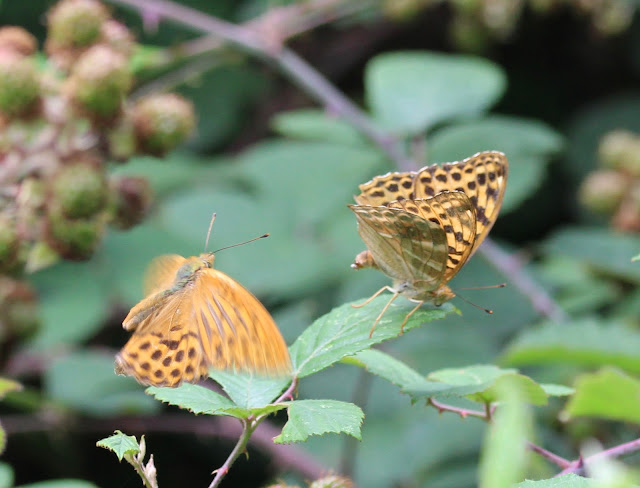
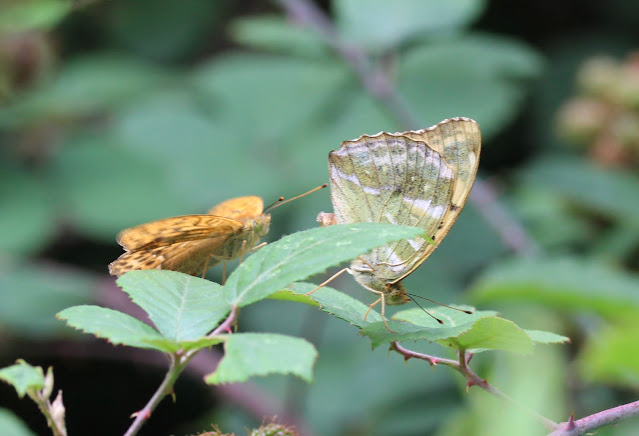
A trip, with camera, round our local forest. We came across a couple of Silver-Washed Fritillaries doing their bit to ensure there's some fritillaries around next year.

Here's the happy couple, with the female on the right indicating a certain willingness to proceed.


The whole process was quite elaborate with lots of fluttering of wings. Good to have these butterflies in number in the forest.

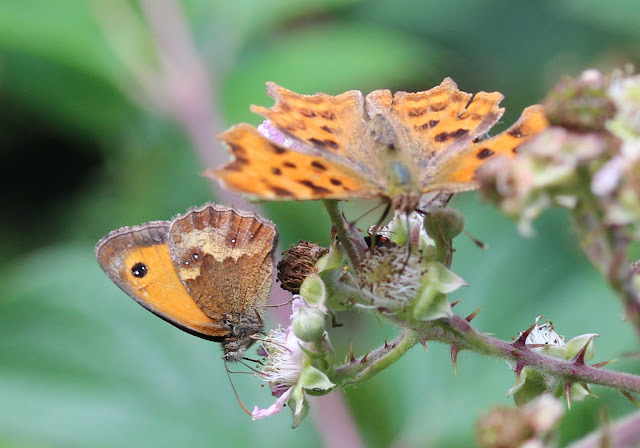
Elsewhere there were more butterflies. There are three species in the photo below.


You can really only see two, but the Comma moved off allowing a decent view of the third.


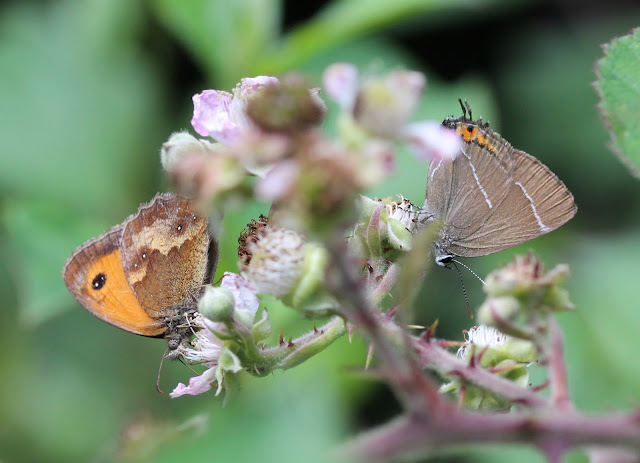
Always amazed at the style and neatness of the Purple Hairstreak's face!

UPDATE: ** Thanks to Mike for pointing out that this is not a Purple Hairstreak but is a White-Letter Hairstreak. On checking the books it matches quite clearly. That's not just a first for me for Hatfield Forest but a Lifer - thanks Mike! **

It wasn't just butterflies. The Orchid bible Harrop states HF has Violet Helleborines. After asking some of the local Naturalists and doing a bit of hunting around I found some gone-over spikes last Autumn. This time they were in full bloom. We are indeed fortunate to have these so close to us.


Kent part 2

Bonsai Bank had a lot more than just masses of Lady Orchids and Fly orchids. We had single Greater Butterfly Orchid, several White Helleborines, and there were still some Early Purple Orchids.


The weather wasn't ideal for Butterflies, but we did get a few Duke of Burgundies.


We went on to Yocklett's Bank and then Parkgate Down. The issue at both was parking, but we managed to find places both times.

Yocklett's Bank had similar to Bonsai Bank but more. The Greater Butterfly Orchid was in flower. Also a Turtle Dove purring loudly. 

Greater Butterfly Orchid

Parkgate had magnificent Monkey Orchids in decent numbers. Just mad exploding golf-balls of vivid purple colour. Our appreciation was only slightly diminished by learning these had all been relocated from another site a while ago.


For an exploratory trip this was excellent and I think I will be back for more next year.


Monday, August 14, 2023

Going Nuclear.

I know, I know, its very bad form to observe a couple of months of silence and then return for a rant. But here we are.

I'm getting increasingly fed up with the 'green' lobby and their sheer logic-defying brainlessness. But lets not spend half a day going over that. Instead let's just consider the available options on 'green energy' and look for the best solution.

I worked on computer systems in banks for many years, and my experience is that lots of people are keen to sell you there latest wacky idea as though its the future, but if you want actual results on a realistic timescale, you go with something that is proven to work.

And what is proven to work, if you are shopping for an energy form that doesn't emit Carbon Dioxode, is available whenever you need it, doesn't need non-existent storage solutions, is Nuclear. It is proven in many places over many years. We start from a point of known technology, known results. 

If you want to invest in new 'green' energy generation methods that would be Nuclear Fusion. Lawrence Livermore Labs in the US have repeated the process of generating energy over a short period, which gives real hope that developments can extend the performance. It's in as good a position for an experimental technology as one can reasonably ask for. 

This is just obvious isn't it?

Thursday, June 01, 2023

In Kent with the Ladies (part 1)

To Kent to see orchids. If you have an interest in wildlife beyond just birds, then Orchids appear on your horizon, and then the reserves in Kent near Canterbury and their fantastic flora get mentioned, so it was very much an ambition to visit at the right time. 

We got excellent directions from Peter Alfrey's blog here and also consulted Orchid Hunter's video. These made all the difference and meant the day went smoothly. Thanks to both of those.

And what a day. First up Bonsai Bank in Denge Wood.

There were Lady Orchids well scattered in excellent condition throughout the bank. It is frankly weird and wonderfully bizarre to go into an English woodland and see flowers like this in this number. As if a stately home over the fence had accidentally seeded some exotic flowers. And in close-up the ladies in their bonnets are a real picture.


We had been hoping to see Fly Orchids and we were told of a couple of spikes just round to the left after entering. We saw those and more. Orchid Hunter (see above) says when you see a Fly Orchid get down and look carefully, and by following that advice we ended up with twenty spikes in clusters throughout the area. A cracking flower.


There was more to see, which I will reveal in a second post


Sunday, May 28, 2023

Year list. Bird 172. A lump of flint.

First trip this year to the Norfolk Coast, and with both Mike and David. Would we get a special bird for a special day?

First stop was North Point Pools to get our bearing and check Birdguides. Twenty Blackwits, Avocets, Redshank, Shelduck, a couple of Little Ringed Plovers and a Common Sandpiper. A wing-tagged Marsh Harrier and distantly a Cuckoo calling. A decent first stop. 

Titchwell seemed to be our best bet so we headed west. But first we stopped at Choseley Barns for the remaining Dotterel that had been reported that morning. We scanned with no luck but were saved when a birder found it sat down. We could just see a very peachy breast and a darker head but the heat haze made getting more detail difficult, but even in the heat haze I could see it turn its head.

With year tick 172 in the bag we went on to Titchwell. The three 1st year Little Gulls put on a decent display both on the ground and in flight. Our search for more birds was rudely interrupted by Mike who had found a Grey-Headed Wagtail on the bank. This bird had been seen yesterday but not so far today. We managed to get terrific views, even down to the gorget of dark feathers indicating its first year plumage. We managed to get a few others on to telescope views of this before it flew off over the reserve centre.

We got a few more birds - Mediterranean Gulls, Spoonbills, a couple of Little Terns on the tidal lagoon, Sanderlings on the beach, and then sat down on a bench by the reed bed; three old men on a day out, talking nonsense and pulling each others legs, and inbetween whiles we got first class views of Bearded Tit and Reed Warbler. So often birds ticked on sound not sight.

Just time to go back and check on the Dotterel. We decided that if it was still sat in the same place I would have to admit defeat. And there it was. Number 172. A lump of flint.


Phone scope pic of Grey Headed Wagtail

Thursday, May 04, 2023

Stellar Day at Frampton

We chose RSPB Frampton as our venue on the basis of a stellar list from the previous day. We arrived at a packed car park and saw the fantastic wader habitat that now stretches from the car park to the back of the reserve. We had two Wood Sandpipers on a small near-by pool before we'd even got out of the car, and went on to add a Spotted Redshank in dusky summer plumage, many Ruff, a pair of mating Little-Ringed Plovers (the first of five pairs on the reserve) and as we moved towards the centre added two Black-Winged Stilt in the corner. Frankly we could have gone home then more than happy. 

Down the path on the NW side we added Lesser Whitethroat singing, Cetti's and Sedge Warbler, then on the walk along the western edge we added Whimbrel, Common Sandpiper, a few Yellow Wagtails, many Whitethroats, along the sea-wall a few Mediterranean Gulls flying around, a line up of birders fruitlessly searching for the Blue-Winged Teal (see previous post), a few Pale-Bellied Brents amongst the thousand plus Dark-Bellied out on the marsh then along the road back to the centre we had about fifty Dunlin and a cracking Spoonbill feeding in a channel. 

Lunch then back for another go at the Teal which proved successful, and that was more or less our list for the day, but we had two further sightings of the kind that make birding a challenge not just wildlife tourism. The Temminck's Stint had been seen the previous day rom the road, and as we went through the Dunlin I picked up a likely candidate; nice pectoral band, spangly back, all white belly, and called a few people over as a likely. But on comparison with a Dunlin thats arrived it was the same size and had a longer curved bill than the Stint, so we had to write that one off as a Dunlin. 

Almost back at the centre and a large bumble bee appeared, a real whopper and all black. On checking this later it matches the black form of Bombus Ruderatus, the Large Garden or Ruderal Bee. I'm not going to claim it as I know from experience bees are tricky creatures and you have to get very good photos to be sure, but exciting to see this beast nevertheless. 

The lasting impression was not the list but the quantities. I haven't even mentioned the Shelduck, Shovelers, a few Wigeon, flocks of Black-Tailed Godwits, the many Avocets, the vast gull colony; the feeding Brents across the fields, and the 60+ Ruff, many males in splendid black and orange. One was so near even I could get some photos. Just imagine if these were taken by a decent photographer, or even someone with a basic knowledge of the settings


Goodbye ... and Hello

It's been a while. It's tested the patience of the most dedicated reader. As he told me on a number of occasions. So I've decide...